27 March 2011

LIFE: Is it Easter Yet?

SARONNO, Italy -  A couple of weeks ago, after I had written about the grand finale of the pre-Lent celebrations at the Carnival in Venice, I took a walk around Saronno. Much to my surprise the streets were full of kids dressed like little royal princesses and Johnny Depp pirates with eye patches and gray plastic swords, giggling and laughing and throwing confetti and silly string at each other. And it wasn’t just the kids. In Saronno’s main piazza, right in front of the Cathedral, kiddie rides and stands selling colorful candies and other goodies had been set up and everyone was acting like Carnival was still in full swing. What’s going on here, I asked myself. Don’t these people know Carnival is over?

 These two Italian kids are not from Saronno but I couldn resist.
So I went home and started re-checking my Carnival facts thinking I would have to re-write the blog and apologize to everyone for getting my facts wrong. But the truth is Carnival really did end on Fat Tuesday, and there really was a grand finale along Venice’s Grand Canal with candles and costumes and a gondola parade, and Lent really has started. 

I decided to call my Saronno maven, Andrea, and ask him if he knew what was going on.

“Oh sure,” he said, “it's simple. In Saronno we don’t follow the calendar of the Roman Catholic Church, we follow the Ambrosian calendar, and for us Lent doesn’t start on Ash Wednesday but the following Sunday.”

 An Carnival Announcement from a few years back
Oh, well that explains it. Are you kidding me? For all of my life the church was the church, the rules were the rules, and now I find out that isn’t the case? There are two calendars and what else? Are there two Christmas’, two Easters? Can I make up my own calendar?

So back I go to the internet, Google in Ambrosian calendar and oh my God! up pops a whole load of stuff starting with Saint Ambrose.

If you have ever visited the Duomo in Milan, you already know that Saint Ambrose (Aurelius Ambrosius) is the patron saint of Milan. He was Bishop of Milan in the 4th century, a time when various religious factions, including the Church in Rome and the church here in Lombardia, were struggling to become the prevailing religion in Europe. And while the Roman rite eventually became the dominant Catholic rite, the Ambrosian rite, or Milanese rite, has managed to maintain its position. At least here in Lombardia  - until you get to Como that is. In Como they follow the Roman calendar, or maybe their own, I’m not quite sure of anything any more.

While the Roman calendar and the Ambrosian religious calendar are similar, there are basic differences. In the Ambrosian calendar Advent has six weeks and not four; Lent starts four days later so there is no Ash Wednesday, and Carnival isn’t over until Sabato Grasso (Fat Saturday) instead of Martedi Grasso (Fat Tuesday aka Shrove Tuesday).

Another difference is that Mass is not celebrated on Fridays during Lent and communion is not offered.

But reading on, I discover that the Ambrosian rite, or Milanese rite, is only one of several variations on this theme. 
 Milan's Duomo 

There are others. The ancient Mozarabic rite was first practiced in Spain. They have their own calendar and even their own feast days like December 18th, which is the Mozarabic Feast of the Incarnation, and January 23, the feast day of Saint Ildephonsus. both of which are still celebrated.

In the area in and around Venice they used the patriarchal rite of Aquileia. It was similar to the Milanese rite and practiced until the ended in the sixteenth century when the calendar of the Roman church was adopted. In France the traditions of the Gallican liturgy were popular and are still followed in the city of Lyon. While in Braga, the oldest city in Portugal and one of the oldest Christian cities in the world, the Archdiocese of Braga practices still another rite, the rite of Braga, just as they still do occasionally in the city of Providence, Rhode Island.

This is all so confusing. I was never all that great at keeping up with  all the rules and regs anyway so I think the best thing for me to do is to get my oh-so-blonde Paris Hilton wig, the old faux fur boa and my red high heel shoes off the top shelf of the closet, call up some friends and have my own private Carnival. And for Lent I can give up trying to figure all this stuff out. 

20 March 2011

LIFE: Blog Number 100!


SARONNO, Italy - I realized yesterday afternoon that this was the 100th blog posted on This Italian Life. It’s a milestone, one I never dreamed I would reach when I first started thinking about writing a blog back in the summer of 2009. I knew I had a lot of stories to tell, twenty years of living in Italy worth, but was anyone really interested?


Genova -Nervi  
What I didn’t want to do was write articles glorifying the joys or living of Italy, there are enough of those out there without me adding to the pile. I felt my purpose was threefold, if there is such a word: the first was that I wanted This Italian Life to reflect life in Italy today lived by an ex-pat, which is different than life in Italy lived by an Italian.  

The main difference is the Italians understand what’s going on, while I still don’t, even after all these years. Right this minute another one of those things I don’t understand is happening. Under a pouring rain, with lots of loud thunder and lightning streaking down from the sky, there is a parade passing under my balcony. It’s not a big parade, just a base drum and about 150 young guys who are all wearing some kind of uniform. They are chanting something I don’t understand, but whatever it is they are very enthusiastic about it.

Genova Nervi
Secondly I wanted to write about Italian food. While pasta really is my all time favorite thing to eat, Italian cuisine is so much more.  And the beauty of it is that every once in a while I discover a dish or a fruit or vegetable that I’ve never seen before. Barba di Frate, (Auntie Pasta: Color Me Green, May 13, 2010) that strange dark green vegetable that looks like grass and tastes like heaven, was one of them.

And since I’m not a professional cook, although I did cook professionally in my day, I wrote not just about the successes, like Barba di Frate, but of the failures too, like the not-so-great Zuccotto (Auntie Pasta: Zuccotto, May 6, 2010). What I wanted to do was show how food, culture and daily life are all intertwined – for Italian food is life and a reflection of Italy. What I didn’t want to do was just publish recipes, those you can get from a cook book or the internet.

Thirdly, most of the places I have visited in Italy have been pretty spectacular. From my first days in Italy, when I lived on the Italian Riviera, I was out exploring the towns up and down the coast. I fell in love with the lushness of the greenery, the vibrant, red bougainvillea, the swaying   palm trees, orange trees so full of fruit the branches would almost touch the ground, and the honeysuckle and jasmine that perfumed the air, and the sea. It was the most delicious place in the world, and it still is.

 Camogli
I remember walking past a bookstore with a friend of mine, just months before I moved to Italy. In the bookstore window there was a big, coffetable size travel book about Italy and it had a photograph of Camogli, a small town on the Riviera, on the cover. I stopped in my tracks – “that’s where I’m going,” I said to her. I don’t think she believed me, it was too beautiful to be real. But it is real, and I did go.

My hope was that the travel pieces would encourage you to visit not just the travel trinity of Rome, Florence and Venice, but entice you to venture out and explore some of the other magnificent towns that don’t get as much press as the big three. And to do it with a sense of adventure, not with a shopping list of “must sees”. Did I succeed? Like so many other things in this life, I guess I’ll never know.

For me it is nothing short of a small miracle that this is the 100th blog of This Italian Life. There’s so much more to tell about the Cleans and the Means, and all the comings and goings here in Saronno and elsewhere. in Italy  I would like to do more fashion blogs, after all, this is Milan, and more reflective pieces.  In spite of the difficulties my love affair with Italy continues, and grows stronger each day. I know how fortunate I am to be here - and that’s a celebration in itself.

13 March 2011

LIFE: Carnival in Venice


Oh tears, the party is over! Last Tuesday was Martedi Grasso, aka Mardi Gras in the United States, the end of Carnival in Italy. But it sure was fun while it lasted.

In Venice, the last hurrah started at midnight with a flotilla of gondolas and boats along the Grand Canal.Hundreds of people holding flickering candles lined the banks of the Canal. It was a magical moment.


Venice is not the only city with a strong Carnival tradition in Italy, but it continues to be the most popular. In the northern Italian city of Ivera they throw oranges at each other. during Carnival. There must be a reason why they do that, but I can't imagine what it is.


Carnival as we know it today started out as a Pagan Roman festival called the Saturnalia. It was a time when slaves and masters hid their faces behind mask and ate, drank and danced (and maybe other things too) as equals with no fear of reprisals.

Celebrating carnival in Italy first shows up in the history books in 1092 AD. Wearing masks goes back to the 13th century. In 1268 the Council of Venice outlawed men throwing scented eggs at ladies. Can't imagine why they threw them in the first place. You mean guys were weird even back then? 

Because of all the hanky-panky that went on during Carnival, and still does, the Italian government has tried for centuries to restrict celebrations and ban the wearing of masks. But after all this time I think they’ve just about given up. After all, look at the Prime Minister we have and the fine example he sets.

Unlike Carnival in Brazil which is celebrated with a huge parade with floats and dancing girls, in Venice the people are the show, men and women parade up and down and all around Piazza San Marco, and pose for photos on Venice’s famous bridges. All in costume and masks of course, although this guy looks like he puts this outfit on every day of the week.


I think that's her hair sticking out of the top of her hat, but I can't be sure. All I know is that after the gondola and boat parades along the Grand Canal, after the confetti and multi-colored streamers that fly through the air,Carnival in Venice ends with a great fireworks show,and grand parties in elegant Venetian palazzo.Those Venetians, they really know how to throw a party.

06 March 2011

LIFE: Milan’s Fashion Week


SARONNO, Italy - Last week was Fall Fashion Week in Milan. Tina Turner got a front row seat at Giorgio Armani’s  show and I got poked in the back at least a hundred times by the bony elbows of the paper thin models that invade the subway every time Milan sponsors a fashion event. Doesn't seem fair somehow.

Giorgio Armani's new longer look
A few years ago the Italian fashion industry, along with the French and Americans, made a big fuss about hiring more normal looking models instead of the anorexic models they usually hire. It was a semi-fake attempt to fool the public into thinking they were concerned about the image the anorexic models were presenting to impressionable young girls. If you ask me, the real reason was there were too many girls passing out before the runway shows– and yes, even dying – because they had starved themselves to sticks.

It is a little better now, but not by much.  At any rate there is no use focusing on the dark side of the fashion industry when there are so many bright sides to talk about. To begin with there is no denying that Giorgio Armani is still the king of Fashion. He shows it time and time again and this season was no different. His clothes were gorgeous, with lots of swing and sway. We saw it in his longer winter coats and also in the new cut of his trousers, slightly flared and ending just above the ankle. All the better to show off the embroidered booties and soft suede sandals he featured. His evening wear was a dream of silks and satins that melted into the skin, with velvet gowns that shimmed like jewels and chiffons that floated down the runway like clouds. 

One designer who has been around for a while but isn’t exactly a household name yet is Francesco Scognamiglio. He’s the go-to guy for Lady Gaga, Madonna and Rihanna when they want something special for a red carpet appearance or a video. He’s dressed Lady Gaga almost a dozen times and Madonna just called him for something special to wear to an event she’s been invited to in the spring.

 The dark side of Francesco Scognamiglio (photo: Telegraph UK)
While he does do a lot of ‘stand-out’ clothes, Scognamilglio's regular clothes are pretty normal and very good looking. For Fall/Winter 2011/2012 he showed pale beige sculpted pantsuits with moto-cross or bomber-jackets edged with fox collars and rippled, pleat details at the back. His shift dresses were low cut showing a lot of skin, and some of his mini-dresses were trimmed with fox hems – how extravagant!  How chic!

Many of the designers, like Prada, are still playing with fabric and texture mixing python-skins, sequins and fur, fake and real. It doesn’t always work but Prada fans are Prada fans and it doesn’t seem to matter what off-the-wall look Minuccia Prada comes up with, they will buy it.

Jil Sander went in the other direction and used elements of ski-wear mixed with vintage silk prints for a sporty couture look. Her hip belts, sashes and low slung pockets all draw your eye to the hip, which is fine if you don’t have any.

 One of Prada's signature looks
So from what we saw here in Milan it looks like the hot ticket colors for next fall and winter are going to be teal, jade, terracotta, mustard, amber and bronze. Tweeds are bigger than ever, over-the-knee boots will still be with us, handbags, instead of looking like travel cases, will shrink to a more normal size and if you have to carry a lot of stuff you can do it in a colorful tote that doesn’t pass itself off as a handbag. 

It will be interesting to see what looks and colors actually make it to the stores. They are already showing a lot of teal for spring here ,but for the rest of it, it all depends on what the advance sales look like. I'm sure I'll recover from my last pass through Milan long before fall comes around, and when I do I’ll gather my courage, get back on the train and head for the shops to see what's what. You will be the first to know.

23 February 2011

Life: This Italian Life Plus One

  SARONNO, Italy - It seems like a lifetime ago that I posted that last article. So much has happened, not only to my eyes but to my life. Obviously my eyesight is better, not 100 percent, but certainly good enough to start writing again and that makes me very happy. I miss my little blog and I’m delighted to be back, even if I have to limit my posts to once a week.

 My Darling Daughter

But there have been other changes as well. My all-grown-up daughter is living with me now. We had been talking about it for well over a year, skyping almost every night, her from New York and me here in Saronno,  making plans and planning trips as I tried to make Italy sound like Paradise on Earth. Even with my super selling skills there were times, many times, when I thought it would never happen. 

While it wasn’t exactly a “hold your nose”and jump" moment for her, after all she was coming to her mother and her mother’s protective embrace, I understand how difficult a  decision it was for her to make. Life is different here. Milan is not New York, and Saronno, well Saronno isn’t even a borough. Not to mention the problem of her not speaking Italian. 

“Not to worry,” I said.

But there was plenty to worry about. In the beginning I hovered over her like a helicopter.  Certainly she thought I was just being an over-protective parent, but the truth is after waiting half my lifetime for this very moment, I was terrified to let her out of my sight. How could I let her go to Milan alone? What if she didn’t come back? She doesn’t speak Italian and she wanted to go – by herself – into a city of 1.5 million people, none of whom speak one word of English (only a slight exaggeration). What if she gets lost, gets hurt, gets scared, who will help her? My rational self knew it was a ridiculous fear but that didn’t stop my heart from pounding every second she was gone and no matter what I did it wouldn’t stop until she walked back in through the door. 

It was actually worse than that. I didn’t even want her wandering the streets of bucolic Saronno. How could I put into words the years of heartbreak and worry that I suffered so deeply when we were separated? How could I explain the overwhelming love and emotion I felt at actually having her near me again, of the joy of being able to go into the next room and hug her whenever I wanted to, and I wanted to a thousand times a day. How could I risk losing that? I couldn’t. This is my baby girl we are talking about.

But that phase has passed. I’m sure she’s more than delighted that I’m not calling her every five minutes just to see how she is. What she doesn’t  know is what torture it is not to call her. All I want is to hear her voice and be reassured that she is still alive. And I swear it’s only when I think I’m going to explode with worry that I pick up the phone and dial her number now.  

In the meantime things in Italy are changing faster than the speed of light and there is much to be said about that, but it will have to wait.  Here in Saronno I am taking each day as it comes, grateful for each and every one.  And that’s as it should be. See you next Sunday. And yes, Zaronno still rulez.

17 October 2010

LIFE: NOT GOODBYE, JUST ARRIVERDERCI

SARONNO, Italy - Because of continuing health problems this blog, which I love writing, has to be temporarily suspended. With a little bit of luck I’ll be back in December with more tales of Mrs. Clean and Mrs. Mean and an update on how Aldo and Carla are doing as well as adventures and travels through Italy. My alter ego, Auntie Pasta, will also be back with her views and news on Italian food.

The problem is that the rheumatoid arthritis, that has plagued every bone in my body for the past few years, has found a new playground – my eyes. Is that not bizarre? My eyes, however, are not as cooperative as my bones and they did not responding to conventional treatment. What that means is that I now have to be subjected to further tortures, and there is no guarantee the further tortures are going to solve the problem either. But, either way, I have to drastically reduce the amount of time I spend on the computer, at least for the time being.

Thanks so much for your support, it is much appreciated and I look forward to “seeing” you all again in a few weeks.

Phyllis Macchioni


11 October 2010

AUNTI PASTA: Shhh, It’s Ossobuco Time

Ossobucco alla Milanese
SARONNO, Italy - You should never say the word ossobuco, or l’ òs büüs in Milanese dialect, out loud in Milan. Just the name of this slow braised veal shank is enough to bring the strongest of the strong Milanese to tears. Mention that you paired it with risotto Milanese, that is risotto with saffron and parmigiano cheese, and you’ll have them on their knees.

The Makings of a Good Soffrito

Few dishes affect the ever-so-busy, ever-so-chic Milanese like this one does. And yet it is a simple dish to make. The traditional recipe calls for veal shanks, patiently braised in white wine and broth, with the addition of a battuta of celery, carrots, onion and parsley and served with Risotto alla Milanese. It is one of the few “piatti unici”, or one dish meals in Italian cooking.

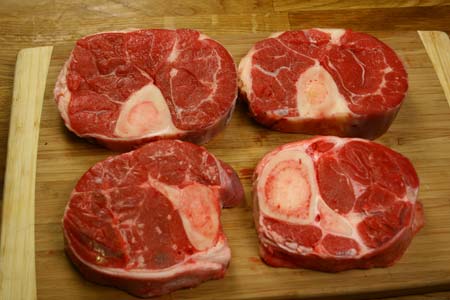
Veal Shanks

It takes a couple of hours to prepare ossobuco but the results are worth it. The veal shanks, which should be at least two inches thick, are first dipped in flour, and then browned in a rather heavy pot or deep frying pan. If the shanks are very large, one per person should be enough, otherwise two, or even three will do if they are very small.

You can find dozens of recipes for ossobuco on the internet so I won’t publish one here, but I will tell you that the wine, a couple of fresh tomatoes or a small can of peeled tomatoes, a cup or two of beef broth, a soffritto of onions, celery and carrots paired with the veal shanks creates the most delicious sauce. It even goes well even with mashed potatoes, but don’t tell anybody I said that. If you decide to take the traditional route and make risotto as a side dish, you might want to reduce the amount of parmigiano cheese you normally would use in the risotto.

Makings of Gremolada

For many Milanese the best part of the dish is the marrow. There is a special long-handled spoon called an esattore that they use to dig it out of the bone. But don’t despair if you are a marrow fan but don’t happen to have an esattore on hand. A demitasse or baby spoon works just as well. In Milan the act of scooping the marrow out of the bone is called riscuotere le tasse or tax collecting, maybe because of the determined way marrow eaters try to get every little bit of marrow out of the bone. Actually one of the secrets of making a really good risotto is to mix in a spoonful of bone marrow in with the rice before you start adding broth.

The Winning Combination: Ossobuco with Risotto Milanese

The most traditional way to serve ossobuco is with a simple condiment called gremolada. It is made with parsley, garlic, a little lemon zest and half a canned anchovy all finely chopped together. If you intend to eat the bone marrow add the gremolada to the center of the shank bones just before serving the dish. Otherwise you can add a little to the sauce. Either way it adds a certain zing to the dish, or as the Italians would say, si sposa bene con ossobuco.