17 July 2011

LIFE: Italia Nostra


SARONNO, Italy - Italia Nostra  is a non-profit  organization based in Rome. It was founded in 1955 with the specific purpose of protesting the projected demolition of part of the city’s historic center.
Rome's Colosium
From the beginning, the organization focused on promoting a more sensitive approach to urban planning, which included the preservation of historic architecture. Today there are more than 200 Italia Nostra affiliates across Italy dedicated to the protection and promotion of the country’s historical, artistic and environmental patrimony.
 
As the government systematically cuts away at the already tiny budget set aside for conservation, Italy’s cultural patrimony is in danger of crumbling, and Italia Nostra is waving the red flag.
 Roman Aqueducts - Engineering Marvel
In this country, sprinkled with Roman aqueducts and amphitheatres, medieval piazzas and renaissance palazzos, only a tiny portion of the national budget is allotted to conservation, far less than other countries with a fraction of the patrimony.  
 
According to the latest figures available from the Organization for Economic Cooperation and Development (OECD), Italy earmarked only 0.8% of its public spending to culture and leisure in 2006. This put it at number 22 on a list of 27 countries for which heritage conservation statistics were available. 

  Patheon, Temple of the Gods, Built in 27 BC
All you have to do is look across the border to France to see the difference. France,  has 20 national museums, while in Italy there are 400. There are 25,000 protected buildings in France, while in Italy there are between 350,000 and 400,000, and yet France spends twice as much to protect its heritage. 

To make matters worse, in Italy the bulk of the tiny budget is generally allotted for restoration and conservation of the most popular sites, like the Coliseum in Rome and Pompeii. The rest are all at risk.  
 Monument dedicated to King Vittorio Emanuale II
Few  tourists who come into Rome by taxi realize as they speed through the Porta San Giovanni that the walls on both sides of the Porta were built in the 3rd century. The so-called Aurelian walls, of which some 8 miles remain, are among the glories of the Eternal City. They were built between 270 and 273 BC by the Roman Emperor Aurelian. Yet the Romans, as well as tourists, take them for granted, and the result is that they are gradually crumbling. A 15-metre stretch collapsed in 2007.
 Section of Aurelian Wall
The Aurelian walls are perhaps the biggest structure on Italia Nostra's "red list". So far, it takes in only seven of Italy's 20 regions, but it already comprises the names of 60 severely endangered buildings and sites.
 
They include barely known castles, far off the beaten tourist track, such as the one at Olcenengo in Piedmont, and archaeological sites of acknowledged importance such as the 7th century Greek settlement at Selinunte in the valley of the Temples in Agrigento, Sicily.

7th Century  Greek Ruins in Sicily
No one can visit Italy without looking at the crumbling buildings and monuments that you find everywhere and wonder why the government doesn’t do more to conserve them. The fact that there are so many is precisely the problem.   

There are entire nations whose total cultural heritage isn’t a fraction of what you will find just in the city of Rome or in Florence, or many other Italian cities, particularly in southern Italy. This is not a new phenomenon. The Italian government has traditionally been indifferent to conservation. The feeling seems to be that it will all be there forever.  


To find out more about Italia Nostra, visit their web site (in Italian) at www.italianostra.org, or contact them at:  Viale Liegi, 33, 00198 Rome Italy, Tel. 068537271/Fax. 0685350596.

For the latest in fashion news, views and now photos from the fashion capital of the world - follow me on twitpic.com/Italianlife
 

14 July 2011

AUNTIE PASTA: Tasty Fakes

SARONNO, Italy – When wedges of Parmesansan cheese, made in Lithuania, Parmazano Fiorentino, made in Britain, and Parmeano made in Germany were discovered recently, the Italian food police (NAS) went into action. It was like waving a red flag in front of a bull. At stake is Italy’s reputation for high quality, great tasting food products, and unless  you want to start World War III, it’s probably not a good idea to mess with Italian mothers or Italian food.

The Real Deal
To make matters worse, ham, olive oil and even basil carrying false credentials saying they are genuine Italian products have been found in supermarkets and deli counters in Italy and abroad. We can only imagine how many hams, disguised as Parma or San Daniele, or bowls of pasta dressed with pesto made from basil from who knows where have already disappeared into the stomachs of unsuspecting consumers. It’s a jungle of gastronomical rip-offs out there. 

At the Proscuitto Fair
Last year the NAS food piracy unit seized some 1,000 hams that had been falsely labeled DOP by unscrupulous ham fakers.  The Food Police suspect that some of the hams were sent to deboning plants outside of Italy where they were branded with the coveted DOP prosciutto trademark, the five-point crown, and then shipped back to be sold to unsuspecting consumers.

For most of us prosciutto is prosciutto, they all look the same, but not for the Food Police. How can they  tell if the five-point crown branded on the side of the ham is the real deal or not? The same way the American government can tell if a $20 bill is real or counterfeit: by periodically inserting the tiniest, almost imperceptible flaw into the design of the trademark and then distributing the updated branding machine to prosciutto makers. It’s those pre-established flaws the Food Police look for as they go about their daily inspections. 

To verify falsified olive oil a different, and very old technique is used. A technique that has been used by olive oil producers for hundreds of years to determine the quality of their freshly pressed oil -  they smell it and they taste it.  Much like wine tasters, who have been trained to identify the individual notes within a wine, members of the NAS food piracy unit are now being trained as olive oil tasters. 
Olive Oil Tasters at Work
By the flavors they smell and taste, they can tell if an oil is 100% pure olive oil or not, and which region in Italy it came from. If sunflower oil or soybean oil has been added to an oil which is then bottled and labeled as extra-virgin Italain olive oil, they know it.  Recently 25,000 liters of suspect oil were recently seized, most of it on its way to the United States and Germany. 

That sting operation pointed up the importance of labeling olive oil to show its source. Where olive oil comes from is important, not only for the oil producers but for consumers as well, and members of the national farm association Coldiretti were very happy when Italy finally won the long battle with the European Union to make sourcing labels obligatory on bottles of olive oil. 
Liquid Gold
Sourcing labels are important. Consumers are not trained olive oil tasters so they have to put their faith in the information they find on labels, and that information has to be correct. Otherwise they end up paying top dollar for olive oil labeled as Italian but actually pressed from olives grown in Spain, Greece and Tunisa.   And yes Dorothy, there is a difference.  

Italy is Europe’s second largest producer of olive oil behind Spain, but unlike other Spain, Italian olive oil has won 38 certificates of quality, the highest number in the European Union. Now that’s something to brag about. Granted the labels can also be a bit confusing, but you can uncover the DOP, DOC, IGP etc. mysteries in Auntie Pasta PDO, DOP, et al posted 04 February 2010, and for more info on Italian olive oil see Auntie Pasta: Oil Change, 30 September, 2010. 

For the latest in fashion news, views and now photos from the fashion capital of the world - follow me on twitpic.com/Italianlife

10 July 2011

LIFE: Lake Como

SARONNO, Italy - On these hot summer days I can't think of a better place to be than Lake Como. With the temperatures heading toward the 90's, a friend of mine, from my Conde' Nast days and I decided to take the ferry to Cernobbio and have lunch at the opulent Grand Hotel Villa d'Este.
 Small Corner of Lake Como
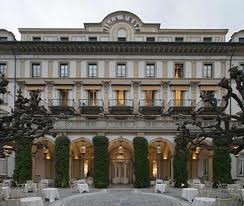
The restored villa is set in a large Italian Renaissance garden, complete with a rippling waterfall that starts at the fountain of Hercules and ripples down a stone staircase. Inside, the villa is furnished with exquisite museum quality antiques and crystal chandeliers. 

With the sun high in the sky, we decided to have lunch under the tall chestnut trees on the Villa’s lake front terrace. We picked a lakeside table with a view of the sapphire blue water, and with the sound of the lake softly lapping against the shore, how could we not get caught up in the magic of this sweet dolce vita. 
 Villa d'Este, Lake Como
In the mid-afternoon we took the ferry north, along the west side of the lake to visit the Villa Carlotta. In the spring, large buses filled with tourists from Europe and beyond line the narrow road in front of the villa. It’s not just the lure of the pink and white villa that brings them here, but the gardens, that are spectacular in their spring finery of camellias, rhododendrons and azaleas. 
Villa Carlotta, Lake Como
The Villa was a wedding gift from the Prussian princess, Princess Marianna to her daughter Carlotta. The Villa Carlotta is just about mid-way around the lake, at the Tremezzo/Cadenabbia ferry stop, where the lake is at its widest and most beautiful. Here the sparkling water is framed by the mountains that hug the border between Italy and Switzerland, opening up from the spur that makes up the inverted Y shape of the lake.

In the days before World War II, Cadenabbia was one of the favorite watering holes for sun-starved northern Europeans. At the historic Hotel Rodrigo, the guest list read like a who's who in Italian and European nobility. With pure silk sheets on the beds, and the reputation for having the best dining room in the area, it was a favorite of Britain’s Edward VIII, who would bring Wallis Simpson here for lunch and romantic afternoon trysts. While the hotel has been closed for several years, the   building has been declared a national treasure. 
Approaching Cadenabbia, Lake Como
The beauty and languorous melancholy of Lake Como continues to attract lovers from all around the world. It was rumored that Prince Charles secretly rendezvoused with Camilla at Castello Maresi in nearby Griante when he was still married to Diana. The rumor was hotly denied by castle employees. 

The pink fairy-tale Castello Maresi sits behind heavy wrought iron gates in a lush, flower filled park-like estate facing Lake Como and the promontory of Bellagio. The tall towers, turrets and a high stone wall add to the castle's secluded romantic atmosphere. 
 The Lucia, traditional boat of Lake Como
From the ferry dock in Tremezzo it is only a short ride across the lake to Bellagio. The town is anchored at one end by the white neoclassic Villa Melzi known for its exquisite gardens and at the other end by the Grand Hotel Villa Serbelloni, playground of the rich and famous. 

Small boutiques and art galleries line the winding cobblestone streets and the old arcades, cafes and ferry jetties give the waterfront a fin de siècle air. Stendhal, who considered Bellagio the most beautiful place in the world, spent his happiest summers here enjoying opera, fighting duels and falling in love. 

During the 18th century the Russian upper classes, the charming and sentimental figures familiar from the pages of Chekhov and Tolstoy, made the hotel their own. Guests coming down to breakfast would often see the Empress of Russia, Prince Metternich or Queen Victoria buttering their toast in the hotel dining room. The Hotel Serbelloni still has an aristocratic air about it. 

Sunset, Lake Como
With the sun starting to set behind the mountains, it was time to board the ferry boat and return to Como. Standing at the rail, watching as the lake unfolded before us, the light soft and sheer, it was easy to see why, since the days of the Romans, all who pass fall this way fall in love with Lake Como. 

For the latest in fashion news, views and now photos from the fashion capital of the world - follow me on twitpic.com/Italianlife
What's Auntie Pasta up to now? Tune in on Thursday and find out.

08 July 2011

AUNTIE PASTA: Stuff It

SARONNO, Italy – Yesterday was market day in Saronno, and you didn’t need to check a calendar to know that summer is in full bloom. The Saronno mamas were buying plump peppers, eggplants, zucchini and tomatoes, and I have a sneaky suspicion they were planning to stuff them. 
Picture Perfect Peppers
Stuffed vegetables are very popular in Italy and have been throughout the Mediterranean for centuries. It’s a tasty way to use up the bits and bobs of meat that are left over by combing them with rice or tiny pasta or even cous cous. 

In some regions of Italy you might see pine nuts added to rice and ground beef, or raisins added to a cous cous and lamb stuffing, or neither of them. That is  the beauty of stuffed vegetables, you can fill them with almost anything, bake them in the oven, and they won’t disappoint you. 
 
My love of stuffed vegetables expanded beyond my mother’s delicious recipe for stuffed peppers with rice and ground beef when I lived in Genova. In the city’s historic center, and in the area behind the Oriental Market, there are take-out shops, no bigger than a closet, that sell stuffed zucchini and stuffed onions alongside trays of farinata and foccacia.  (see Auntie Pasta post of August 13, 2010, http://thisitalianlife.blogspot.com/2010/08/on-road-savory-savona.html  

The most common Genovese filling is made up of bread (the soft white center) soaked in milk, bread crumbs, parmigiano cheese, a variety of herbs and eggs to bind the mixture. 

The flavoring agents depend on what vegetable is being stuffed. For eggplant, they add chopped porcini mushrooms plus a little garlic and oregano; for zucchini and onions, the mushrooms are omitted and they throw in a pinch of nutmeg. Chopped parsley is added to stuffed tomatoes and the mushrooms are back for stuffed artichokes. The artichokes recipe also calls for the chopped stalks of the artichokes, chopped leeks, oregano and nutmeg. 
Yummy Stuffed Mushrooms
My grandmother would come back to haunt me if I ever put oregano on artichokes – no matter how I cooked them. The Romans have a special herb called mintuccia that they use exclusively for artichokes, a type of mint that grows wild on the hillsides around Rome. I have mintuccia growing in a container on my kitchen balcony and just the smell of it brings back wonderful memories of my grandmother’s kitchen.

You can stuff almost any vegetable, even escarole and lettuce, but that seems to me to be a lot of work because you have to tie the whole thing together with string to keep the filling from falling out when you cook it. No doubt it is delicious but there are so many other vegetables that are just begging to be filled, like tomatoes for example, why bother.
Refreshing Stuffed Tomato
Here’s an easy recipe from the Corriere della Sera, Milan’s daily newspaper. 

Baked Stuffed Tomatoes
Serves 4
Ingredients

4 large tomatoes
80 grams of ground beef (more or less 3 ounces)
60 grams of long grain rice
60 grams of fresh (or frozen) peas
2 small zucchini
1 carrot
1 white onion
1 tablespoon of chopped parsley
Extra virgin olive oil
Salt and freshly ground pepper

Wash the tomatoes and cut off the tops (see photo). You can also cut a very little bit off the bottom so they stand up better. Scoop out the inside of the tomatoes, chop it into pieces no larger than the peas, and set it aside.  Chop the onion, the carrot and the zucchini also into pieces no larger than the peas. 

Put a small amount of extra virgin olive oil in a frying pan and add the chopped onion, carrot and zucchini, the ground beef, the rice, a cup of water and let it cook together for about 10 minutes, or until the water is absorbed. 

Fill the scooped out tomatoes with the rice and ground beef filling, and cover them with the tomato tops.  Drizzle a little olive oil over the top of them and then place a small amount of extra virgin olive oil in a casserole pan and bake in a preheated oven (160ᴼ C/325ᴼF) for 40 minutes. 

The recipes calls for making a sauce out of the chopped tomatoes and serving the stuffed tomato on top of it, just as you see in the photo, but to tell you the truth you could just as easily add the chopped tomatoes to the rice and meat mix and reduce the amount of water, or leave it out altogether. 

You can use this filling for any vegetable you want to stuff. You can substitute the rice with couscous or the soft center of Italian bread, or tiny pasta, or leave them out as well and just chop the vegetable centers   you’ve scooped out, either with ground beef, lamb or pork, or no meat at all. You don’t need peas, or carrots but you do need onions.

Thinking about these delicious combinations is making me hungry, so I think I'll      turn the computer off and head for the kitchen and rustle me up some grub. Buon Apettito.
 
For the latest in fashion news, views and now photos from the fashion capital of the world - follow me on twitpic.com/Italianlife

03 July 2011

LIFE: Easy Money

SARONNO, Italy - A little more than a year ago, when my best friend was planning her first trip to Italy, her advisor at the local Triple A office tried to sell her travelers checks. “Not a good idea,” I said. “Nobody uses traveler’s checks any more, I don’t even think the banks know what they are.”
 Euros come in all colors and sizes
So she went back to Triple A and told her trip advisor what I had said. The trip advisor then tried to sell her a “euro” pack. A fixed amount of euros, I don’t remember the exact value, at a truly terrible exchange rate with an added Triple A service charge.  When I told her not to buy it, my friend started to suspect my advice.  
 Unicredit is one of Italy's largest banks

I find it hard to believe that U.S. travel agents, Triple A included, don’t know that you can use ATM cards, or a debit or credit cards in Italy to get cash as easily as you can in your own neighborhood, but maybe they don’t.  In my opinion, they are in the business of making money, selling travelers checks and euro packs earns them a nice profit. There isn’t even a language barrier as the international ATM machines have the capability to provide instructions in English. 

It’s easy. You simply put in your American bank card, punch in your password, choose how many euros you want,  and out they come. The only charge, and this is true for Italian banks, is the fee charged by the American bank you are accessing. There is no charge for the service on the Italian side.  It’s that easy, or as my friend Gary says, it’s too easy. Just don’t ask for an ATM machine, especially in Milan where ATM is the public transportation system. You get money from the Bancomat.   
Bancomat at Intesa/San Paolo Bank
Apparently Triple A isn’t the only one who doesn’t know this. A recent article in the NY Times on using American credit cards in Europe prompted a bevy of responses from readers recounting their bad experiences. http://travel.nytimes.com/2011/07/03/travel/credit-card-problems-abroad-readers-respond.html?hpw Some complained about their cards not working at toll booths and ticket machines in the train stations, while others encountered “technological glitches” outside of the major metropolitan areas. 

There were as many suggested solutions as there were problems, including one man who went through the trouble of opening a bank account in Italy so he would have cash on hand when he traveled here. The truth is, there is no need to go through all that trouble for there is a very, and I mean very, simple solution.
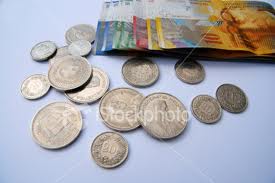
 Swiss franc
I don’t use my American card to pay for purchases very often so my experience in that area is somewhat limited, but earlier this year when I was buying my daughter a new winter coat the clerk asked me if I wanted the transaction in dollars or euros. It might have been because we were in Milan and the store was Max Mara, but that was the first time I had that experience in Italy. When she gave me the receipt it showed the total amount spent in dollars and euros. There was a time when I only saw double currency receipts like that in Switzerland.   
Switzerland’s currency is the Swiss franc and they, like England where they still use pounds and pence, never switched to euros. Most of the time the exchange rate between Swiss francs and euros is favorable and with the retail exchange rates competitive with currency exchange facilities, I don’t bother changing money at the train station any more. It’s easier to just pay for my purchases in euros. The only drawback is that your change is in Swiss francs. To avoid coming home with a pocket full of heavy Swiss coins, I carry low denomination euros, nothing over 50 euro bills.  
Shopping in nearby Lugano
You have to give it to the Swiss, they are so accommodating they will even let you use both euros and Swiss francs for the same transaction if you want. It makes no difference to them and all the cash registers show the amount of purchase in both currencies. It’s one of the reasons why I love them. They understand money is money, no matter what color it is. Unfortunately it makes spending it a whole lot easier.

For the latest in fashion news, views and now photos from the fashion capital of the world - follow me on twitpic.com/Italianlife