19 March 2015

AUNTIE PASTA: A Few of My Favorite Things


CHIAVARI, Italy – There are many cookies and pastries connected to Lent and St. Joseph’s Day, the Festa of San Guiseppe, and every town and region in Italy seems to have its own specialty. You probably know the first pastry as they are popular all over the world, but the others might be a bit of a surprise.
 Pasticceria Giolitti, Rome, Italy
It’s not always easy to follow the threads from probable origins to the tables of today. But even though stories may jump centuries, they seem to turn up again and again and pick up not always where they left off, but where they are at that particular moment, and then go on to continue the story from there.  If nothing else, the tales show a respect for tradition and the foods – in this case sweets - that have come down to us through the centuries to find their place in the story of Italian food today.

 Zeppole
NAPLES’ ZEPPOLE

Zeppole, or zeppele, are a good place to start. The origin of the zeppole dates back to the ancient celebration of the Roman festival Liberalia. This pagan feast, which was held on March 17th, celebrated the transition of 14 year old boys to manhood.  For the Romans it was an important festa complete with sacrifices, processions, rowdy songs and of course eating, drinking and carousing.   

Then, somewhere between the Romans carrying on as Romans liked to do, and the onset of Christianity, the buckwheat pancakes hung-over Romans used to fry up for breakfast after being out half the night, morphed and re-morphed into what we now know as zeppole.

The zeppole went on to become one of Naple’s favorite pastries, and in the early 1900’s, when millions of Italians migrated to the Americas, they brought with them the joy of the delicious cream filled zeppole we all enjoy today.
 
 Frittelle
TUSCANY’S FRITTELLE OF SAN GUISEPPE

In the month of March, you will find these sweet little rice frittelle for sale throughout Tuscany. In Siena they are called frittelai, and in the past those who made them did their best to keep the recipe a secret. They wouldn’t tell anyone if they used rice, and if they did use rice, what kind of rice they used, or what kind of flour they used, if they flour.  Everything was done behind closed doors and as far away from prying eyes as they could get.

But then Maestro Martino de 'Rossi  wrote his famous cookbook "Libro de Arte Coquinaria" and right there, in Chapter 5, under “Frictella”, was the long held secret of the Siennese frittelle. No one knows how Maestro Martino got the recipe, but since it was the second half of the 1400’s, and he cooked for Ludovico Sforza, Duke of Milan and also for Pope Martin V, you can believe he had some powerful friends who helped him out.   

What I find interesting is that at the time, rice was a mysterious thing to Italians, and they really didn’t know what to do with it. They certainly did not eat it. Instead, cooks in the medieval kitchens ground the grains into a powder and used it as a spice or to thicken soups and sauces.

Now that their secret cookie recipe is no longer a secret, on or around March 23rd, the women of Lupicciano-Pistoia throw a big party in the town’s piazza with music and games for the kids and lots of Frittelle di San Guiseppe to eat.  So do the ladies of Corsalone-Chiusi della Verna (Arezzo), but their party day is March 30th.  Even after all these centuries, the tradition of frittelle di San Guiseppe lives on in the heart of Italy, and in the hearts of the Tuscans.

 Maritozzo
ROME’S MARITOZZO 


Maritozzi are small sweet breads, about the size of a croissant. In the days of the Roman Empire they were sweetened with honey and raisins and called pagnottelle – or possibly pagnottelius. Either way they were a favorite snack with the locals, especially after a night out on the town.   

On the first Friday of March couples who were engaged would exchange maritozzi decorated with entwined hearts or hearts pierced with an arrow, often hiding rings or small gold trinkets in the sugary decorations. It was Valentine’s Day Italian style before there was a Valentine’s Day.

The name maritozzi was most likely extracted from the Italian word for husband, “marito”, as knowing how to make a good maritozzi was one of the criteria a guy used when he was looking for a bride. The girls who made the best maritozzi always got the most attention from the boys – and with a little luck, a marriage proposal. That must be where that old saying, “the way to a man’s heart is through his stomach” came from. 

Sweet as they are, maritozzi are one of the few pastries allowed during Lent. The only reason why that is true, at least the only reason I can think of is either one of the Popes had a brother, or another relative, who was a baker, or he himself had a real weakness for maritozzi, so he gave them a thumbs up during Lent. I guess we will never know. Have a Happy St. Joseph’s Day.


15 March 2015

LIFE: Easter at the Vatican Redux


CHIAVARI, Italy - As we get closer to Easter, the Italian television airwaves will be taken over by the religious Easter festivities in Rome.  The celebrations officially start on Holy Thursday with the Mass of Chrism, (holy anointing oil).  This mass includes the reading of the Passion, which chronicles Jesus’ capture, suffering and death.
The Vatican, Rome
Later in the day, at the Mass of the Lord’s Supper, Pope Francis will wash the feet of 12 men, following the tradition of Jesus and his Apostles. Both masses mark Christ's founding of the priesthood at the Last Supper on the night before he died.

On Good Friday, the day of Christ’s crucifixion in 33AD, the Pope says mass in the Basilica of St. John Lateran (Basilica di San Giovanni in Laterano). St. John’s was built by the Roman Emperor Constantine in the 4th century. Constantine was the first Roman Emperor to convert to Christianity and St. John’s is the cathedral of the Bishop of Rome. It is known as Omnium urbis et orbis Ecclessarium Mater et Caput – the Cathedral of Rome and of the World.   

 Via Crusis, Rome
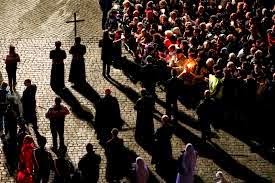
On Friday evening the Pope leads a torch-lit procession from the Colosseum to Palatine Hill (Via Crucis Procession), and at predesignated stops, they recite the prayers appropriate for each of the Stations of the Cross.

The Easter Vigil mass at the Vatican’s St. Peter’s Basilica will start at 9PM on Saturday night. No lights will be lit. The Basilica will be shrouded in darkness until Pope Francis enters. He will be carrying a long, white Paschal, a special Easter candle decorated with gold leaf. 

 Pope Francis, Holy Friday Mass
From the single flame of the Paschal, twelve candles are lit and from those twelve, hundreds of other smaller candles will be lit, one by one, until the entire church is bathe in candlelight. As the candles are being lit, the Pope will proceed to the altar and begin Mass by saying: 

 “Brothers, on this most holy of nights, in which Jesus Christ our Lord passed from the depths of death to life, the Church, in every part of the world, calls on its children to keep watch and pray.” 

Pope Francis
He will be dressed in a gold robe, called a chasuble, with a white and gold stole around his neck. On his head will be a precious gold and white mitre encrusted with jewels. The style was adopted by the clerics from the Romans who wore hats that were very similar in style to the mitre, and the chasuble is a variation of the robes worn throughout the Roman Empire.

The colors of the Pope’s chasuble and mitre are important as colors represent qualities such as virtue and holiness.  The gold color of the Pope’s chasuble symbolizes what is precious and valuable. It also symbolizes majesty, joy and celebration, and because of its brightness, metallic gold, like that found on the Pope’s miter, symbolizes the presence of God. 

Under the chasuble he is wearing a white robe.  Visible is a part of the collar around his neck and the edges of the cuffs under his sleeves. The color white has long symbolized purity, holiness and virtue, as well as respect and reverence. It is used for all high Holy Days and festivals.

 Easter Mass at the Vatican
Easter Sunday is joyful. The Vatican altar is filled with flowers in anticipation of the mass that will be said there to celebrate the Resurrection of Jesus and his Ascension into Heaven. The Pope shares this special day with the thousands of faithful followers who gather in St. Peter’s Square to see him. He stands before the crowd and delivers his message of peace for the Urbi et Orbi (the city and the world).  After the Urbi et Orbi message, which is broadcast throughout the world, the Pope blesses the crowd.  

You can participate in all of the Easter events  and information on how to do that is available on the Vatican web site (www.vatican.va). And it is all free. You do need to make reservations for everything however, including the Sabato Santo (Holy Saturday) mass at the Vatican. 

You can also make a reservation for a Papal audience on the same web site. Some tour operators have been known to charge large amounts of money for a Papal audience, but the truth is the Vatican does not charge for the Papal audiences. They are free. Actually you are better off if you organize your own visit.  You just have to do it well in advance as tickets are limited. 

 Invitation to a Papal Audience at the Vatican
To reserve a place at a Papal audience go to this page of the Vatican website: http://www.vatican.va/various/prefettura/index en.html and click the “continue” button at the bottom of the page. It will take you to an application form that you can download, fill out and return to the Vatican office. The form must be sent by fax or mail (no email) - the instructions are on the site - and when your application has been processed you will receive instructions regarding your audience and where to pick up your tickets. 

It's a good idea to stay until the end of the audience as that is when the Pope will bless everyone in the audience and those who can’t be there. And if you take your medals and rosary beads and other items to the audience, you can then give them as gifts knowing that they have received the Pope’s personal blessing.

12 March 2015

AUNTIE PASTA: Easter in Italy


CHIAVARI, Italy –  In Italy, torta Pasqualina is to Easter what turkey stuffing is to Thanksgiving in the U.S.A. It just wouldn’t be the same without it. This savory torta, which is similar to the better known French dish – quiche, originated in Genoa during the 1600’s.
 Torta Pasqualina Genovese
In the past this dish was only served in the spring – at Easter to be more precise - which is how it got its name – Pasqualina, pasqua meaning  Easter in Italian. And it is also why the traditional Pasqualina recipe called for 33 layers of puff pastry, one for each year of Christ’s life.

One of the differences between quiche and torta Pasqualina is that the ingredients of our torta are not mixed together and cooked in an egg and milk custard as they are in a quiche, but layered. The first layer is Swiss chard.  Next comes a layer of prescineua, a fresh, light cheese that is similar to cream cheese. Prescineau, which I’m still trying to figure out how to pronounce, is a Ligurian specialty cheese and not found outside of the region so ricotta is often used as a substitute.

As for the 33 layers of pastry, no one really does that any more. One of the more modern recipes I found  called for 10 layers of pastry, five on the bottom and five on the top, but most recipes seemed to make do with four, even when using frozen grocery store puff pastry. The recipe below calls for two layers of puff pastry, one for the bottom and one for the top, but if you choose to go the traditional route and use more than one, be sure to brush a little olive oil between each layer so they stay flakey and don’t stick together.

But the most distinctive difference between torta Pasqualina and quiche is the addition of whole raw egg yolks to top the final layer. In the traditional torta recipe, the one with 33 layers of pastry, it calls for 13 yolks to be placed on the top of the torta, twelve yolks around the edges and one yolk in the center, representing Christ and His 12 apostles.

 A Slice of Culinary Heaven
But whether you use 13 or 4 as called for in the recipe below, the raw yolks are placed in a hollow made in the cheese layer with the back of a tablespoon. The whites are then lightly beaten and a few spoonfuls of the frothy whites are spooned over the top before adding the final layer of pastry.


TORTA PASQUALINA

Serves 6-8 (as an appetizer)

500 grams of frozen puff pastry
1 kg of Swiss chard
½ medium onion finely chopped
500 gr. of whole milk ricotta
250 gr. light cream
8 eggs
50 gr. butter
125 gr. grated Parmesan cheese
1 tablespoon of chopped, fresh marjoram
Salt and pepper

Thaw the frozen puff pastry at room temperature (about 2 hours).

Sauté the chopped onion in a little butter and olive oil until it is translucent. Blanche the Swiss chard in boiling water for 3 or 4 minutes, drain, squeeze dry, rough chop and add to the sautéed onions and cook together to blend the flavors. Then add a pinch of salt, pepper and the marjoram to the Swiss chard and onions, mix and set aside to cool.

In the meantime, as the Swiss chard is cooling, combine the ricotta with the Parmesan cheese, light cream and 2 lightly beaten eggs. Set aside.

Roll out one portion of puff pastry and place it in the lightly greased baking pan, with a couple of inches of overlap, which will be used to seal the top.  When the Swiss chard is room temperature, mix in 2 lightly beaten whole eggs and sprinkle with a few spoons of grated parmesan cheese and spread the mixture on the bottom of the baking pan.

Layer after Layer of Deliciousness
Top the Swiss chard with an even layer of ricotta. With the back of a tablespoon, make 4 evenly spaced indentation on the top of the cheese layer. Separate the first raw egg and place the yolk in the indentation. Fill the remaining indentations the same way, using the last 3 eggs.

Lightly beat the egg whites and carefully spoon some of the frothy egg white mixture over the cheese and egg yolk layer.  Cover with the remaining sheet (or sheets) of puff pastry and carefully seal the edges. Brush the top with a bit of milk, and prick with a fork or a small sharp knife, to allow the steam to escape.

 The Final Touch
Bake in a pre-heated oven – 186 degrees C (360 degrees F) for 40 minutes, or until golden brown. If the instructions on the package of frozen puff pastry call for a higher temperature, I would suggest following those directions, just check the torta often to make sure it cooking and browning and not burning.

Serve warm or room temperature.

Afterthoughts:

If you are not familiar with Swiss chard, it’s a dark green leafy vegetable that looks a lot like spinach, but tastes a little sweeter. In other parts of the world Swiss chard stems come in different colors, but here in Italy they are usually white. Like spinach, Swiss chard needs to be carefully washed and the stems trimmed.   If it is not available in your area, fresh spinach can be substituted. It’s not the same, but it’s close enough.

Also, there is nothing that says you can’t mix the Swiss chard and ricotta together and eliminate the layers, and in fact many recipes call for you to do just that. You might be tempted to eliminate the egg yolks on the top layer as well, but I wouldn’t recommend it. They really do add an extra dimension to the dish.

Torta Pasqualina can be served warm or cold and it’s a ‘must’ for Easter as it is perfect to take along for the traditional Pasquetta  ‘picnic fuori casa’,  picnic in the country – or at least out in the open - on Easter Monday, which is also a national holiday here in Italy.