Showing posts with label Easter at the Vatican. Show all posts

20 March 2016

LIFE: EASTER AT THE VATICAN

CHIAVARI, Italy – In this week before Easter, religious festivities in Rome will be front and center on Italian television. The celebration officially start on Holy Thursday with the Mass of Chrism, (holy anointing oil).  This mass includes the reading of the Passion, which chronicles Jesus’ capture, suffering and death.
St. Peter's Basilica, at the Vatican
Later in the day, at the Mass of the Lord’s Supper, Pope Francis will wash the feet of 12 men, following the tradition of Jesus and his Apostles. Both masses mark Christ's founding of the priesthood at the Last Supper on the night before he died.

On Good Friday, the day of Christ’s crucifixion in 33AD, the Pope says mass in the Basilica of St. John Lateran (Basilica di San Giovanni in Laterano). St. John’s was built by the Roman Emperor Constantine in the 4th century. Constantine was the first Roman Emperor to convert to Christianity, and St. John’s is the cathedral of the Bishop of Rome. It is known as Omnium urbis et orbis Ecclessarium Mater et Caput – the Cathedral of Rome and of the World.   
 
Via Crucis Procession, Rome
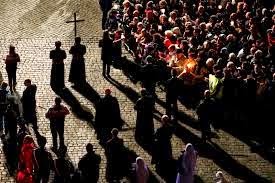
Friday evening the Pope leads a torch-lit procession from the Coliseum to Palatine Hill (Via Crucis Procession), and at pre-designated stops, the faithful recite the prayers for each of the Stations of the Cross.

The Easter Vigil mass at the Vatican’s St. Peter’s Basilica will start at 9PM on Saturday night. No lights will be lit. The Basilica will be shrouded in darkness until Pope Francis enters. He will be carrying a long, white Paschal, a special Easter candle decorated with gold leaf. 

From the single flame of the Paschal, twelve candles are lit and from those twelve, hundreds of other smaller candles will be lit, one by one, until the entire church is bathe in candlelight. As the candles are being lit, the Pope will proceed to the altar and begin Mass with:  “Brothers, on this most holy of nights, in which Jesus Christ our Lord passed from the depths of death to life, the Church, in every part of the world, calls on its children to keep watch and pray.” 
Pope Frances
He will be dressed in a gold robe, called a chasuble, with a white and gold stole around his neck. On his head will be a precious gold and white mitre encrusted with jewels. The mitre style was adopted from the Romans who wore hats that were very similar, and the chasuble is a variation of the robes worn throughout the Roman Empire.

The colors of the Pope’s chasuble and mitre are important as colors represent qualities such as virtue and holiness.  The gold color of the Pope’s chasuble symbolizes what is precious and valuable. It also symbolizes majesty, joy and celebration, and because of its brightness, metallic gold, like that found on the Pope’s miter, symbolizes the presence of God. 

Under the chasuble Pope Frances will wear a white robe, but all you will see of it V is a part of the collar around his neck and the edges of the cuffs under his sleeves. The color white has long symbolized purity, holiness and virtue, as well as respect and reverence. It is a color used by the Church for all high Holy Days and festivals.
Celebrating Easter at the Vatican 
Easter Sunday is joyful. The Vatican altar is filled with flowers in to celebrate the Resurrection of Jesus and his Ascension into Heaven. The Pope shares this special day with the thousands of faithful who gather in St. Peter’s Square to see him. He stands before the crowd and delivers his message of peace for the Urbi et Orbi (the city and the world).  After the Urbi et Orbi message, which is broadcast throughout the world, the Pope blesses the crowd.  

You can take part in all of the Easter events, and it is all free. You do need to make reservations however, including the Sabato Santo (Holy Saturday) mass at the Vatican. You’ll find information for all events, including Papal audiences at this web site: to http://www.papalaudience.org/papal-mass
A Keepsake from a Glorious Easter in Rome
Some tour operators have been known to charge large amounts of money for a Papal audience, but the truth is the Vatican does not charge for the Papal audiences. They are free. It’s easy to organize your own visit, you just have to do it well in advance, as tickets are limited. 

It's a good idea to stay until the end as that is when the Pope blesses everyone in the audience and those who can’t be there. And if you take medals and rosary beads and other religious items with you to the audience, you can give them as gifts knowing that they have received the Pope’s personal blessing.  Happy Easter

Copyright © 2016 Phyllis Macchioni


15 March 2015

LIFE: Easter at the Vatican Redux


CHIAVARI, Italy - As we get closer to Easter, the Italian television airwaves will be taken over by the religious Easter festivities in Rome.  The celebrations officially start on Holy Thursday with the Mass of Chrism, (holy anointing oil).  This mass includes the reading of the Passion, which chronicles Jesus’ capture, suffering and death.
The Vatican, Rome
Later in the day, at the Mass of the Lord’s Supper, Pope Francis will wash the feet of 12 men, following the tradition of Jesus and his Apostles. Both masses mark Christ's founding of the priesthood at the Last Supper on the night before he died.

On Good Friday, the day of Christ’s crucifixion in 33AD, the Pope says mass in the Basilica of St. John Lateran (Basilica di San Giovanni in Laterano). St. John’s was built by the Roman Emperor Constantine in the 4th century. Constantine was the first Roman Emperor to convert to Christianity and St. John’s is the cathedral of the Bishop of Rome. It is known as Omnium urbis et orbis Ecclessarium Mater et Caput – the Cathedral of Rome and of the World.   

 Via Crusis, Rome
On Friday evening the Pope leads a torch-lit procession from the Colosseum to Palatine Hill (Via Crucis Procession), and at predesignated stops, they recite the prayers appropriate for each of the Stations of the Cross.

The Easter Vigil mass at the Vatican’s St. Peter’s Basilica will start at 9PM on Saturday night. No lights will be lit. The Basilica will be shrouded in darkness until Pope Francis enters. He will be carrying a long, white Paschal, a special Easter candle decorated with gold leaf. 

 Pope Francis, Holy Friday Mass
From the single flame of the Paschal, twelve candles are lit and from those twelve, hundreds of other smaller candles will be lit, one by one, until the entire church is bathe in candlelight. As the candles are being lit, the Pope will proceed to the altar and begin Mass by saying: 

 “Brothers, on this most holy of nights, in which Jesus Christ our Lord passed from the depths of death to life, the Church, in every part of the world, calls on its children to keep watch and pray.” 

Pope Francis
He will be dressed in a gold robe, called a chasuble, with a white and gold stole around his neck. On his head will be a precious gold and white mitre encrusted with jewels. The style was adopted by the clerics from the Romans who wore hats that were very similar in style to the mitre, and the chasuble is a variation of the robes worn throughout the Roman Empire.

The colors of the Pope’s chasuble and mitre are important as colors represent qualities such as virtue and holiness.  The gold color of the Pope’s chasuble symbolizes what is precious and valuable. It also symbolizes majesty, joy and celebration, and because of its brightness, metallic gold, like that found on the Pope’s miter, symbolizes the presence of God. 

Under the chasuble he is wearing a white robe.  Visible is a part of the collar around his neck and the edges of the cuffs under his sleeves. The color white has long symbolized purity, holiness and virtue, as well as respect and reverence. It is used for all high Holy Days and festivals.

 Easter Mass at the Vatican
Easter Sunday is joyful. The Vatican altar is filled with flowers in anticipation of the mass that will be said there to celebrate the Resurrection of Jesus and his Ascension into Heaven. The Pope shares this special day with the thousands of faithful followers who gather in St. Peter’s Square to see him. He stands before the crowd and delivers his message of peace for the Urbi et Orbi (the city and the world).  After the Urbi et Orbi message, which is broadcast throughout the world, the Pope blesses the crowd.  

You can participate in all of the Easter events  and information on how to do that is available on the Vatican web site (www.vatican.va). And it is all free. You do need to make reservations for everything however, including the Sabato Santo (Holy Saturday) mass at the Vatican. 

You can also make a reservation for a Papal audience on the same web site. Some tour operators have been known to charge large amounts of money for a Papal audience, but the truth is the Vatican does not charge for the Papal audiences. They are free. Actually you are better off if you organize your own visit.  You just have to do it well in advance as tickets are limited. 

 Invitation to a Papal Audience at the Vatican
To reserve a place at a Papal audience go to this page of the Vatican website: http://www.vatican.va/various/prefettura/index en.html and click the “continue” button at the bottom of the page. It will take you to an application form that you can download, fill out and return to the Vatican office. The form must be sent by fax or mail (no email) - the instructions are on the site - and when your application has been processed you will receive instructions regarding your audience and where to pick up your tickets. 

It's a good idea to stay until the end of the audience as that is when the Pope will bless everyone in the audience and those who can’t be there. And if you take your medals and rosary beads and other items to the audience, you can then give them as gifts knowing that they have received the Pope’s personal blessing.

20 May 2012

LIFE: Underground

SARONNO, Italy –  Last January, when they were working on the restoration of the large  bronze statue of King Vittorio Emanuele in Milan’s Piazza Duomo, they found a tunnel under the statue. Now they’ve found seven rooms. The rooms are all interconnected to the central vertical shaft, which was used to lower workers inside the statue. They also found the point where, in all probability, the last worker left after completing the work. Why they are there is a mystery. No one knew about them, not even the City of Milan.  
Piaza Duomo, Milan - Statue of Vittorio Emanuele on the right
 Secret tunnels are nothing new in Milan. There are secret tunnels in other parts of the city as well. Under the Sforza Castle, for example, there’s a tunnel which Leonardo da Vinci called the ‘strada secreto dentro’, the secret street below’. No doubt it was the ace up Duke Ludovico Sforza’s velvet sleeve as the Duchy of Milan was not only a hotbed of local uprisings but a prime target for outsiders, ready to attack at the first sign of weakness. No doubt the secret road was his plan B,  for in those wild and wooly days, you just never knew when it would be prudent to slip out the back door and take the secret road out of town.
 Sforza Castle in Vigevano
Ludovico applied the same strategy in Vigevano. At that castle, his favorite, there are underground tunnels that lead to a wide, covered road that run from the center of the castle to the outer edges of the town. Leonardo da Vinci was working for the Duke when he remodeled the castle in Vigevano, and designed the royal stable. (See http://thisitalianlife.blogspot.it/2010/01/on-road-vigevano.html

There are also tunnels under Duomo of Milan. Most of the tunnels were built in secrecy so it’s difficult to know if they were built when they were building the Duomo, during the time of Duke Ludovico, or later. Were they built to save the treasures of the Duomo in case of an all-out attack, which in actually did happen in 1499, when the French King Charles VIII invaded Milan, or later, and used when Napoleon Bonaparte invaded the city in 1796? 

But it doesn’t end there. There are also secret tunnels under Milan’s Chamber of Commerce. As much as I would like to think that they were built in an attempt to save the Chamber member’s skin from hostile crowds, the tunnels were, in fact, built a long time before the Chamber moved to that location. So, whoever was there first, felt the need to have a secret get-a-way just in case they got caught doing what they shouldn’t have been doing, or maybe not. Maybe that’s just my imagination at work.
The Pope's Fortress - Castel Sant'Angelo
Truth is, there are secret tunnels and getaways under most Italian cities. In Rome, there is a secret passage  from the Vatican to Castel Sant’Angelo. Some records claim it was built by Nicholas III in 1277,  but others say it was built by the anti-pope John XXIII (1410-15). What is certain is it was repaired by the Borgia Pope, Alexander VI, later in the fifteenth century. The narrow corridor was built within the thickness of the wall and during the sack of Rome in 1527, it enabled Pope Clement VII to escape the Vatican and take refuge in Castel S. Angelo.  
  
The tunnels were often used as secret escape routes, but in Turin, the King used his tunnels as storerooms for wine and cheese and other foods. He also put his alchemists down there, under the city, to mix and stir and brew potions, with the ultimate goal of discovering the secret of how to turn base metals into gold. They never did, of course, but it couldn’t have been easy climbing out from the dank and dark tunnels every day with the King waiting at the other end.

Gold Plaques on Royal Palace Gate in Turin
You can tour the tunnels under Turin, it’s a fascinating world. You can also tour the tunnels under Naples, but those were built for still another reason. The Naples tunnels were built by the Romans to carry water to houses throughout the city.  
  
These stories fascinate me, all of the stories fascinate me, they are part of the joy of this Italian life.

24 April 2011

LIFE: Celebrating Easter at the Vatican


SARONNO, Italy - For the past few days  the Italian television airwaves have been taken over by the religious Easter festivities in Rome. Here in Italy the celebrations  officially start on Holy Thursday with the Mass of Chrism, (holy anointing oil).  This mass includes the reading of the Passion, which  chronicles Jesus’ capture, suffering and death. 

Later in the day, at the Mass of the Lord’s Supper, Pope Benedict XVI will wash the feet of 12 men, following the tradition of Jesus and his Apostles. Both masses mark Christ's founding of the priesthood at the Last Supper on the night before he died.

 The Vatican, Rome
  On Good Friday, the day of Christ’s crucifixion in 33AD, the Pope says mass in the Basilica of St. John Lateran (Basilica di San Giovanni in Laterano). St. John’s was built by the Roman Emperor Constantine in the 4th century. Constantine was the first Roman Emperor to convert to Christianity and St. John’s is the cathedral of the Bishop of Rome. It is known as Omnium urbis et orbis Ecclessarium Mater et Caput – the Cathedral of Rome and of the World.   

On Friday evening the Pope leads a torch-lit procession from the Colosseum to Palatine Hill (Via Crucis Procession), and at predesignated stops, they recite the prayers appropriate for each of the Stations of the Cross.

The Easter Vigil mass at the Vatican’s St. Peter’s Basilica will start at 9PM on Saturday night. No lights will be lit. The Basilica will be shrouded in darkness until Pope Benedict XVI enters. He will be carrying a long, white Paschal, a special Easter candle decorated with gold leaf. 

Pope Benedict XVI carrying the Paschal candle
From the single flame of the Paschal, twelve candles are lit and from those twelve, hundreds of other smaller candles will be lit, one by one,  until the entire church is bathe in candlelight. As the candles are being lit, the Pope will proceed to the altar and begin Mass by saying: 
Brothers, on this most holy of nights, in which Jesus Christ our Lord passed from the depths of death to life, the Church, in every part of the world, calls on its children to keep watch and pray.” 

He will be dressed in a gold robe, called a chasuble, with a white and gold stole around his neck. On his head will be a precious gold and white mitre encrusted with jewels. Versions of the chasuble and the mitre were part of the normal clothing worn by the Romans in the early days of Christianity, and were adopted by Christian clerics.  The Romans wore hats that were very similar in style to the mitre, and the chasuble is simply a variation of the robes worn throughout the Roman Empire. 

The colors of the Pope’s chasuble and mitre are important as colors represent qualities such as virtue and holiness.  The gold color of the Pope’s chasuble symbolizes what is precious and valuable. It also symbolizes majesty, joy and celebration, and because of its brightness, metallic gold, like that found on the Pope’s mitre, symbolizes the presence of God. 

Under the chasuble he is wearing a white robe. You can see part of the collar around his neck and the edges of the cuffs under his sleeves. The color white has long symbolized purity, holiness and virtue, as well as respect and reverence. It is used for all high Holy Days and festivals.

  St. Peter's Basilica at the Vatican
Easter Sunday is joyful. The Vatican altar is filled with flowers in anticipation of the mass that will be said there to celebrate the Resurrection of Jesus and his Ascension into Heaven. The Pope shares this special day with the thousands of faithful followers who gather in St. Peter’s Square to see him. He stands before the crowd and delivers his message of peace for the Urbi et Orbi (the city and the world).  After the Urbi et Orbi message, which is broadcast throughout the world, the Pope blesses the crowd.  
 Invitation for Holy Saturday Mass
You can participate in all of the Easter events  and and information on how to do that is available on the Vatican web site (www.vatican.va). And it is all free. You do need to make reservations for everything however, including the Sabato Santo (Holy Saturday) mass at the Vatican. 
As you can see, it's free
You can also make a reservation for a Papal audience on the same web site. Some tour operators have been known to charge large amounts of money for a Papal audience, but there is absolutely no charge . Actually you are better off if you organize your own visit.  You just have to do it well in advance as tickets are limited. 

To reserve a place at a Papal audience go to this page of the Vatican website http://www.vatican.va/various/prefettura/index en.html and click on the “continue” button at the bottom of the page. It will take you to an application form that you can download, fill out and return to the Vatican office. The form must be sent by fax or mail (no email) - the instructions are on the site - and when your application has been processed you will receive instructions regarding your audience and where to pick up your tickets. 

It's a good idea to stay until the end of the audience as that is when the Pope will bless everyone in the audience and those who can’t be there. And if you take your medals and rosary beads and other items to the audience, you can then give them as gifts knowing that they have received the Pope’s personal blessing.
Happy Easter.


For the latest in fashion news, views and now photos from the fashion capital of the world - follow me on twitter.com/Italianlife