Showing posts with label Easter dinner. Show all posts

28 March 2013

AUNTIE PASTA: Torta Pasqualina

CHIAVARI, Italy –  In Italy, torta Pasqualina is to Easter what turkey stuffing is to Thanksgiving in the U.S.A. It just wouldn’t be the same without it.  This savory torta, which is very similar to the far more popular French dish – quiche, originated in Genova during the 1400’s
  1. 
     Torta Pasqualina
It is a dish that in the past was served exclusively in the spring – at Easter to be more precise - which is how it got it’s name – Pasqua, which means Easter in Italian. And it is also why the traditional Pasqualina recipe called for 33 layers of puff pastry, one for each year of Christ’s life.
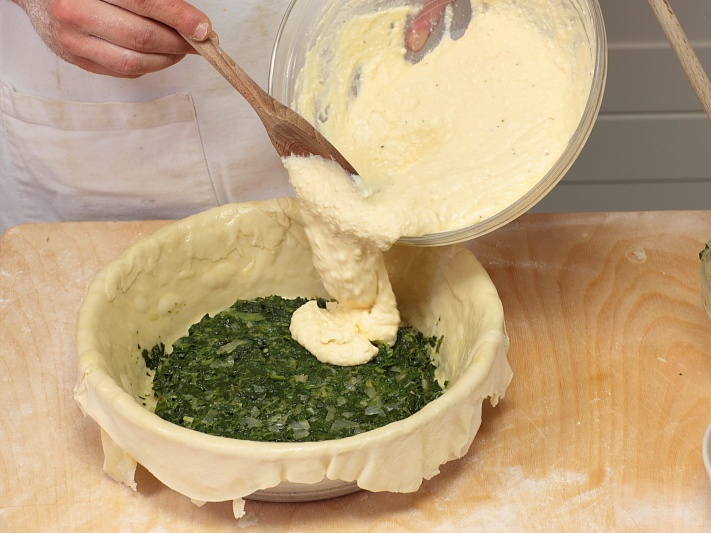
One of the differences between quiche and torta Pasqualina is that the ingredients of our torta are not mixed together and cooked in an egg and milk custard as they are in a quiche, but layered, starting with Swiss chard. Next is a layer of prescineua, a fresh, light cheese that is similar to cream cheese. It is a Ligurian specialty and not found outside of the region, so ricotta is often used as a substitute.
  1. Layers of Deliciousness
  2. As for the 33 layers of pastry, no one really does that any more. One more modern recipes I found  called for 10 layers of pastry, five on the bottom and five on the top, but most of the recipes seemed to make do with four, even when using frozen grocery store puff pastry. The recipe below calls for two layers of puff pastry, one for the bottom and one for the top, but if you choose to go the traditional route and use more than one, be sure to brush a little olive oil between each layer so they stay flakey and don’t stick together.

  3. But the most distinctive difference between torta pasqualina and quiche is the addition of whole raw egg yolks to top the final layer. In the traditional torta recipe, the one with 33 layers of pastry, it calls for 13 yolks to be placed on the top of the torta, twelve yolks around the edges and one yolk in the center, representing Christ and His 12 apostles.

  1. The Final Touch
  2. But whether you use 13 or 4 as called for in the recipe below, the raw yolks are placed in a hollow made in the cheese layer with the back of a tablespoon. The whites are then lightly beaten and a few spoonfuls of the frothy whites are spooned over the top before adding the final layer of pastry.

  3. Torta Pasqualina
  4. Serves 6-8 (as an appetizer)

  5. 500 grams of frozen puff pastry
  6. 1 kg of Swiss chard
  7. ½ medium onion finely chopped
    500 gr. of whole milk ricotta 
    250 gr. light cream
  8. 8 eggs
  9. 50 gr. butter
    125 gr. grated Parmesan cheese   
  10. 1 tablespoon of chopped, fresh marjoram
  11. Salt and pepper


  12. Thaw the puff pastry at room temperature (about 2 hours)

  13. Sauté the chopped onion in a little butter and olive oil until it is translucent. Blanche the Swiss chard in boiling water for 3 or 4 minutes, drain, squeeze dry, rough chop and add to the sautéed onions and cook together to blend the flavors. Then add a pinch of salt, pepper and the marjoram to the Swiss chard and onions, mix and set aside to cool.

  14. In the meantime, as the Swiss chard is cooling, combine the ricotta with the Parmesan cheese, light cream and 2 lightly beaten eggs. Set aside.

  15. Roll out one portion of puff pastry and place it in the lightly greased baking pan, with a couple of inches of overlap, which will be used to seal the top.  When the Swiss chard is room temperature, mix in 2 lightly beaten whole eggs and sprinkle with a few spoons of grated parmesan cheese and spread the mixture on the bottom of the baking pan.

  16. Top the Swiss chard with an even layer of ricotta. With the back of a tablespoon, make 4 evenly spaced indentation on the top of the cheese layer. Separate the first raw egg and place the yolk in the indentation. Fill the remaining indentations the same way, using the last 3 eggs.

  17. Lightly beat the egg whites and carefully spoon some of the frothy egg white mixture over the cheese and egg yolk layer.  Cover with the remaining sheet (or sheets) of puff pastry and carefully seal the edges. Brush the top with a bit of milk, and prick with a fork or a small sharp knife, to allow the steam to escape.

  18. Bake in a pre-heated oven – 186 degrees C (360 degrees F) for 40 minutes, or until golden brown. If the instructions on the package of frozen puff pastry call for a higher temperature, I would suggest following those directions, just check the torta often to make sure it cooking and browning and not burning.

  19. Serve warm or room temperature.

  1. 
    Perfect for a Picnic
  2. Afterthoughts.

  3. If you are not familiar with Swiss chard, it’s a dark green leafy vegetable that looks a lot like spinach, but tastes a little sweeter. In other parts of the world Swiss chard stems come in different colors, but here in Italy they are always white. Like spinach, Swiss chard needs to be carefully washed and the stems trimmed.   

  4. There is nothing that says you can’t mix the Swiss chard and ricotta together and eliminate the layers, and in fact many recipes call for you to do just that. You might be tempted to eliminate the egg yolks on the top layer as well, but I wouldn’t recommend it. They really do add an extra dimension to the dish.

  5. About puff pastry. Here in Italy puff pastry is sold two to a package, so I usually buy two packages for this recipe because I prefer four thin layers of dough.  It’s not a bad idea to lightly grease your baking pan with olive oil, or line it with parchment paper, and if you use a spring form baking pan it will be easier to remove the torta for serving.

  6. Torta pasqualina can be served warm or cold and it’s a ‘must’ for the Easter table as it is perfect to take along for the traditional Pasquetta  ‘picnic fuori casa’,  picnic in the country – or at least out in the open - on Easter Monday, which is also a national holiday here in Italy. Happy Easter.

05 April 2012

AUNTIE PASTA: Hello My Little Lamb (Chop)

SARONNO, Italy- This Italian life that I live started long before I moved to Italy, it started back in upstate New York when I was really young. We lived in an apartment next to my Italian grandparents, in a big house that had a large basement. My grandfather used to make wine in one section of that basement and I remember going down there with him as he checked on the barrels of fermenting grape juice, to make sure they were doing what they were supposed to be doing, becoming wine. 
 Sheep grazing in a field outside of Rome
Every now and again there would be something else in the basement, a baby lamb. It would be tied up in the same area as the wine barrels, and when I would go down to check on the wine with my grandfather, I would play with the lamb while my grandfather did whatever he had to do. 

And then the lamb would be gone. I didn’t think too much of it, in fact it never occurred to me that the only thing that had happened between the last time I played with the lamb, to the next time when the lamb was gone, was Easter.  
Roast lamb with potatoes
So ever since I’ve been in Italy, I’ve been looking for a leg of lamb that looks and tastes like the one my grandmother used to put on the table on Easter Sundays, brown and juicy, studded with slivers of garlic and rosemary, but I’ve never found it. The lamb they sell in Italy is baby lamb, but so baby that there isn’t any meat on it. To me, the lamb they sell here looks like a pile of bones. It is a pile of bones.

Once, about six months ago, I saw what looked like a real leg of lamb (my idea of a real leg of lamb). It was at Carrefour, a French grocery chain that is very popular here in Italy. I bought the lamb immediately and cooked it, but it had a different taste than the one I expected. The store offered the larger legs of lamb only that once, I’ve never seen them since. So at this point I’ve about given up. On the outside chance that you can find some meaty lamb where you live, here's an Italian recipe from the Corriere della Sera, Italy's leading newspaper, for lamb alla Romana.  
Macellaio (Butcher) @ Eataly, Torino, Italia
After the recipe was published one viewer wrote in saying: "i filetti di acciuga nell'abbacchio alla romana? ma chi inventa queste ricette? Translation: Anchovy filets in abbacchio alla romana? Who invents these recipe?" Which leads me to doubt the authenticity of the recipe, but maybe it’s like everything else here, everyone thinks their version of things is the one and only true version. As for me, I just hope my grandmother isn’t reading this.

Abbacchio alla Romana
Ingredients for 4 People

2 lbs of leg and shoulder of lamb – cut into pieces
3 cloves of garlic
3 filets of anchovy (preserved under salt)
1 spring of rosemary
3 tablespoons of extra virgin olive oil
½ cup of vinegar
Flour
Salt and pepper

Crush the peeled garlic along with the anchovy filets (that have been well rinsed). When the garlic and anchovy become a smooth paste, dilute it with the vinegar.

On the stove, add the oil to a large frying pan and add the sprig of rosemary. When the oil begins to smoke, remove the rosemary and add the pieces of lamb that have been lightly floured.

Brown the meat well on both sides, then remove it from the frying pan and set aside. Season with salt and pepper.

Reduce the cooking juices by two thirds. Put the lamb back into the frying pan with the cooking juices and cook for another 10 minutes. Remove from heat and serve immediately.

Preparation time: 25 minutes.
Cooking time: 30 minutes