CHIAVERI, Italy – Every once in a while I come across things at
the fruit and vegetable market that I have never seen before. Some are easy to
identify, like the onions from Zerli, Zerli being a town high in the hills
behind Chiavari where the onions are grown. Even though they are pink, they are still onions. Other things are not so easy.
 |
| Chiavari's Daily Fruit and Vegetable Market |
A couple of springs ago, when I was still living in Saronno, I
came across a strange looking vegetable called agretti. They look like green sea grass with pink roots. I didn’t
buy them because I didn’t know what to do with them, but then one day my
curiosity got the best of me and I decided to give them a try. After all they
were green, I’m in Italy, and if there is one thing Italians know about, it’s
green things.
My first idea was to just put them in a frying pan and sauté them with a little olive oil and garlic, the classic Italian treatment. But then I remembered a dreadful experience I had with artichokes that never cooked, and decided it might be a good idea to boil them first. I cut off the roots, cleaned them and put them in a pot with a little water and brought them to a boil. I wasn’t sure how long they should cook so I just kept testing them until they felt “tender”.
My first idea was to just put them in a frying pan and sauté them with a little olive oil and garlic, the classic Italian treatment. But then I remembered a dreadful experience I had with artichokes that never cooked, and decided it might be a good idea to boil them first. I cut off the roots, cleaned them and put them in a pot with a little water and brought them to a boil. I wasn’t sure how long they should cook so I just kept testing them until they felt “tender”.
 |
| Sure Sign of Spring in Italy - Agretti, Fave Beans, Asparagus, and Fresh Peas |
Then
I drained them and put them in a sauté pan with a little rosemary oil, a couple
of medium size cloves of garlic, and for good measure I threw in a small chili
pepper. My father always said, when in doubt, put an egg on it. So I did. A
little salt, a grind or two of pepper and then - the moment of truth.
I don't know what I expected but much to my surprise, my agretti frittata was really delicious, sweet, tender and flavorful. Like a lot of Italian foods agretti are called different names in different parts of Italy. Even in Saronno they were sold as barba di frate, barba di cappuccino and agretti, depending on who was selling them. In other parts of the country you’ll find them called everything from barba del negus to bacicci, soda, ruscano, riscolo, lischi and finocchi di mare.
I don't know what I expected but much to my surprise, my agretti frittata was really delicious, sweet, tender and flavorful. Like a lot of Italian foods agretti are called different names in different parts of Italy. Even in Saronno they were sold as barba di frate, barba di cappuccino and agretti, depending on who was selling them. In other parts of the country you’ll find them called everything from barba del negus to bacicci, soda, ruscano, riscolo, lischi and finocchi di mare.
 |
| Pink Onions |
So
now I’ve come across more green things, this time in Chiavari, but this time I have
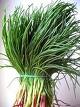
no idea what they are called. The Chiavari green things are kind of like agretti but longer, and skinnier and the
roots are not a pretty pink.
I found them sitting next to a mound of green beans at one of the vegetable stands at the morning market so I figured they must be some kind of mutant green bean. I bought them anyway.
“Do I cook these like green beans?” I asked the woman at the vegetable stand, handing her the bundle of green things.
“They are better if you cook them with some tomato,” she said.
I found them sitting next to a mound of green beans at one of the vegetable stands at the morning market so I figured they must be some kind of mutant green bean. I bought them anyway.
“Do I cook these like green beans?” I asked the woman at the vegetable stand, handing her the bundle of green things.
“They are better if you cook them with some tomato,” she said.
 |
| Agretti |
Later that day I sautéed a finely chopped onion in some olive oil and threw in a crushed clove of garlic. So far I know I’m OK. After I washed the green things very carefully, I cut off the root end and cut them into three parts. I put them into a pot of boiling water and cooked them using the same method I used for the agretti – tasting them every couple of minutes. They had a strange feel, kind of rough, not smooth like a green bean.
 |
| The Chiavari Green Things |
While
they were cooking, I finely chopped a couple of tomatoes and added them to the
onions and garlic and let them cook down. If I were a really good cook, I would
have peeled the tomatoes first, but I’m not, so I didn’t. When the green things were tender I drained
them and when the tomatoes, onion and garlic were perfectly cooked, I added the
green things to the pan. I cooked everything together for a couple of minutes
and then turned off the heat.
That’s when I got the bright idea to make some rice to go along with my tomato and green thing dish. My mother-in-law used to make green beans in tomato sauce and she always served rice with it. My tomatoes were not exactly saucy, but they would do. In the end, the green things were really tasty. The fruttivendolo was right, the tomatoes did add to the dish, and if I ever see them in the market again, I would cook them the same way. I just wish I knew what they are called.
That’s when I got the bright idea to make some rice to go along with my tomato and green thing dish. My mother-in-law used to make green beans in tomato sauce and she always served rice with it. My tomatoes were not exactly saucy, but they would do. In the end, the green things were really tasty. The fruttivendolo was right, the tomatoes did add to the dish, and if I ever see them in the market again, I would cook them the same way. I just wish I knew what they are called.
 |
| They'll Never Make the Cover of Bon Appetit |
What
I’m hoping is that someone will recognize them and post a comment or send me an
email and tell me what they are. Am I too hopeful?


+quiche.jpg)

