CHIAVARI,
Italy - As we get closer to Easter, the Italian television airwaves will be taken
over by the religious Easter festivities in Rome. The
celebrations officially start on Holy Thursday
with the Mass of Chrism, (holy anointing oil). This mass includes the
reading of the Passion, which chronicles Jesus’ capture, suffering and
death.
%2Bvatican%2BBIGGER.jpg) |
| The Vatican, Rome |
Later in the
day, at the Mass of the Lord’s Supper, Pope Francis will wash the feet of 12
men, following the tradition of Jesus and his Apostles. Both
masses mark Christ's founding of the priesthood at the Last Supper on the night
before he died.
On Good
Friday, the day of Christ’s crucifixion in 33AD, the Pope says mass in the
Basilica of St. John Lateran (Basilica di San Giovanni in Laterano). St. John’s
was built by the Roman Emperor Constantine in the 4th century. Constantine
was the first Roman Emperor to convert to Christianity and St. John’s is the
cathedral of the Bishop of Rome. It is known as Omnium urbis et orbis
Ecclessarium Mater et Caput – the Cathedral of Rome and of the
World.
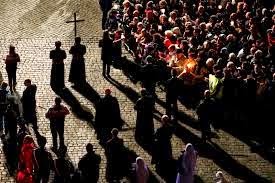 |
| Via Crusis, Rome |
On Friday
evening the Pope leads a torch-lit procession from the Colosseum to Palatine
Hill (Via Crucis Procession), and at predesignated stops, they recite the
prayers appropriate for each of the Stations of the Cross.
The Easter
Vigil mass at the Vatican’s St. Peter’s Basilica will start at 9PM on Saturday
night. No lights will be lit. The Basilica will be shrouded in darkness until
Pope Francis enters. He will be carrying a long, white Paschal, a special
Easter candle decorated with gold leaf.
 |
| Pope Francis, Holy Friday Mass |
From the
single flame of the Paschal, twelve candles are lit and from those twelve,
hundreds of other smaller candles will be lit, one by one, until the entire
church is bathe in candlelight. As the candles are being lit, the Pope will
proceed to the altar and begin Mass by saying:
“Brothers, on this most holy of nights, in
which Jesus Christ our Lord passed from the depths of death to life, the
Church, in every part of the world, calls on its children to keep watch and
pray.”
 |
| Pope Francis |
He will be
dressed in a gold robe, called a chasuble, with a white and gold stole around
his neck. On his head will be a precious gold and white mitre encrusted with
jewels. The style was adopted by the clerics from the Romans who wore hats that were very similar in style
to the mitre, and the chasuble is a variation of the robes worn
throughout the Roman Empire.
The colors of the Pope’s chasuble and mitre are important as colors represent qualities such as virtue and holiness. The gold color of the Pope’s chasuble symbolizes what is precious and valuable. It also symbolizes majesty, joy and celebration, and because of its brightness, metallic gold, like that found on the Pope’s miter, symbolizes the presence of God.
The colors of the Pope’s chasuble and mitre are important as colors represent qualities such as virtue and holiness. The gold color of the Pope’s chasuble symbolizes what is precious and valuable. It also symbolizes majesty, joy and celebration, and because of its brightness, metallic gold, like that found on the Pope’s miter, symbolizes the presence of God.
Under the
chasuble he is wearing a white robe.
Visible is a part of the collar around his neck and the edges of the
cuffs under his sleeves. The color white has long symbolized purity, holiness
and virtue, as well as respect and reverence. It is used for all high Holy Days
and festivals.
 |
| Easter Mass at the Vatican |
Easter Sunday
is joyful. The Vatican altar is filled with flowers in anticipation of the mass
that will be said there to celebrate the Resurrection of Jesus and his
Ascension into Heaven. The Pope shares this special day with the thousands of
faithful followers who gather in St. Peter’s Square to see him. He stands
before the crowd and delivers his message of peace for the Urbi et Orbi (the
city and the world). After the Urbi et Orbi message, which is broadcast
throughout the world, the Pope blesses the crowd.
You can
participate in all of the Easter events and information on how to do that
is available on the Vatican web site (www.vatican.va).
And it is all free. You do need to make reservations for everything however,
including the Sabato Santo (Holy Saturday) mass at the Vatican.
You can also
make a reservation for a Papal audience on the same web site. Some tour
operators have been known to charge large amounts of money for a Papal
audience, but the truth is the Vatican does not charge for the Papal audiences.
They are free. Actually you are better off if you organize your own
visit. You just have to do it well in advance as tickets are
limited.
 |
| Invitation to a Papal Audience at the Vatican |
To reserve a
place at a Papal audience go to this page of the Vatican website: http://www.vatican.va/various/prefettura/index
en.html and click the “continue” button at the bottom of the page. It
will take you to an application form that you can download, fill out and return
to the Vatican office. The form must be sent by fax or mail (no email) - the
instructions are on the site - and when your application has been processed you
will receive instructions regarding your audience and where to pick up your
tickets.
It's a good
idea to stay until the end of the audience as that is when the Pope will bless
everyone in the audience and those who can’t be there. And if you take your
medals and rosary beads and other items to the audience, you can then give them
as gifts knowing that they have received the Pope’s personal blessing.


