Showing posts with label Florence. Show all posts

04 October 2015

LIFE: Bits and Bobs About Florence

CHIAVARI, Italy – One of these days, in the not so distant future, I’m going to be one of the 10 million who visits Florence, Italy this year. (See Statistical Fact No. 23).  Working as a fashion journalist in Milan, I used to be in Florence two or three times a year covering fashion event. It was nice work, and they paid me!
 Florence, Italy
But I haven’t been there in a few years, not since I changed my life and moved back to the Riviera, so it’s time. If there is a trip to Florence in your future too, here are some tidbits about the city that I plucked from the Internet that you might find interesting.

1. Amazing Fact: According to UNESCO, almost a third of the world’s art treasures are in Florence, not bad for a small city. The main viewing galleries include the Uffizi, the Bargello and the Academy. The main viewing attractions include the cute Italian guys.
   
2. Food Fact: Florence’s Mercato Centrale is one of Europe’s largest covered markets, where the food and the noise compete for attention. By the way, the market stall with the picture of the cute little horse on it, sells horsemeat. Just so you know.
Mercato Centrale, Florence, Italy 
3. Disaster Fact: After torrential rainfall in November 1966, the River Arno rose more than 5.2 meters (almost 18 feet). In two days 35 people were killed and hundreds left homeless as the city, and many of its treasures, was engulfed by silt, sewerage and water. ‘Mud Angels’ as they came to be known, flew in from around the world to help with the massive cleanup and restoration process.

4. Secret Fact: To provide a private passage between the Palazzo Pitti and Palazzo Vecchio, a raised passageway was built in 1565 that runs through the Uffizi gallery and across the Ponte Vecchio. The Prince’s Passage, known as the Vasari Corridor, is one kilometer long, (a little more than half a mile) and contains a vast collection of artwork. You can go there, but tours need to be booked well in advance. For info try the APT, Azienda di Promozione Turistica Firenze, in Via Manzoni, 16.
The "Gallo Nero" 
5. Red Fact: Florence borders the vineyards of Tuscan Chianti country. It’s where the grapes for some of the softest reds in the world grow. A bottle with the Gallo Nero (black rooster) classification is a Chianti Classico, and guaranteed to be heaven in a bottle

6. Tourist Fact: The Galleria degli Uffizi is the single most visited building in Italy with some one and a half million people passing through each year. It’s housed in what used to be the administrative offices of the city’s most famous family, the Medicis.
  
7. Film Fact: Florence has been the star in many a film, capturing the heart of big screen audiences in films such as Tea with Mussolini, A Room with a View, The Stendhal Syndrome and Hannibal.
Galleria degli Uffizi
8. Odd Fact: One of the oddest museums to be found anywhere has to be the Salvatore Ferragamo Shoe Museum, where footwear made from dyed fish skins are among the 10,000 exhibits of privately commissioned shoes. Who ordered the fish skin shoes? Yuck!

9. Street Fact: In 1339 Florence became the first city in Europe with paved streets instead of wood or cobblestones.

10. Woodenhead Fact: Pinocchio, the wooden boy whose nose grows when he tells a lie, was published in Florence between 1881 and 1883 by the Florentine Carlo Lorenzini, who wrote under the pen name Carlo Collodi.

11. Wonderful Fact: On November 30th, 1786, under the reign of the Grand Duke of Tuscany, Pietro Leopoldo, Tuscany was the first modern European state in the world to do away with torture and capital punishment.

12. Building Fact: The Duomo of Florence took approximately 140 years to build. Construction of the Cathedral started on September 8th, 1296, and was completed on March 25th 1436. Worth the wait though, don’t you think?
 Duomo of Florence
13. Take the Elevator Fact: The Duomo of Florence has 463 stone steps which, if you climb to the top you can reach the cupola for a close-up of The Last Judgment and a sweeping view of the city.

14.Medical Fact: Florence Nightingale, the famous nurse, was born in Florence on May 12th, 1820. She was named for the city of her birth.

15. Roman Fact: Tradition states that the history of Florence began in 59 BC when the legions of Giulio Ceasar founded a village and called it   Florentia. After they finished with the village, they played a little calcio Fiorentino and knocked each other around a bit, errrr, a lot.

16.Doesn’t Make Any Sense Fact: The symbol of Florence is a red lily, which is based on the Florentine iris, a white flower that was very common in the local area. What?

 The Florentine Lily
17. World War II Fact: Florence was severely damaged during World War II by the Germans, who blew up all its bridges except the Ponte Vecchio. It seems Hitler thought it was too beautiful to destroy. Or so they say.

18.Explorer Fact: Amerigo Vespucci, the famous explorer and navigator, was born in Florence on March 9th, 1454. He’s also the guy America was name after.

19.Language Fact: Dante, Petrarch and Boccaccio were the first to use a language other than Latin, namely Tuscan, which went on to become the recognized language of Italy and called Italian. This was the beginning of the end of Latin being used as the common language throughout Europe. Such is life, or as they say in Latin: Pro Bozo Publico – Support your local clown (or language).

20. Musical Fact: The piano was invented in Florence around 1720 by Bartolomeo Cristofor. It was based on the harpsichord and was originally called a pianoforte.

 Michelangelo's David
21. Artistic Fact: The right hand of the statue of David is disproportionately large compared to the body because in the Middle Ages David was commonly said to be of “manu fortis” – strong of hand.

22. Food Fact: Tuscan bread is usually made without salt, and has been   since the 12th century. It seems that people of Pisa thought blocking shipments of salt to Florence would force the Florentines to surrender in whatever battle they were involved with at the time, and there were many. Instead, the people of Florence just made their bread without salt and for some weird reason they still do.

23. Statistical Fact: The City of Florence attracts over 10 million visitors per year.

24. You’re Making Me Hungry Fact: A famous Florentine specialty is the bistecca alla Fiorentina, a mammoth chargrilled t-bone steak.

25. Artistic Fact: The Galleria degli Uffizi (Uffizi Gallery) has the world's largest collection of Renaissance art, most of which was collected by members of the Medici family during the 16th and 17th centuries. The Medici’s were very rich.

26. Sad Fact: Florence has had two floods both on November 4th, the first in 1333 and then November 4th, 1966.
 Marzocco and the Florentine Lily
27.Weird Fact 1: One of the symbols of Florence is the Marzocco, a seated lion with the emblem of Florence resting on its paw. The name comes from the Roman God Mars, which was the very first symbol of Roman Florentia. They eventually replaced the Marzocco with the lily, which was a good idea as lily is a lot easier to say than Marzocco. That doesn’t change the fact, however, that during the Middle Ages live lions were kept behind the Palazzo Comunale, and watched very closely during times of crisis because it was believed their behavior foretold the fortune of the State. This must be a true story because you can see the lion symbol engraved on every cornerstone and doorstep of the Ponte Vecchio. I think there is more to this story, I’m going to have to do some digging.

28.Weird Fact 2: Florence streets can be one name at one end of the street and another name at the other end.  For example, Via Martelli is the street leading away from Piazza del Duomo then at the first intersection it turns into Via Cavour. Actually, this is not unique to Florence, you see the same pattern in many Italian cities. There must be a reason for it, I just don’t know what it is. Also, Italians don’t count blocks, they count intersections. So when you ask for directions they  tell you, “go down three intersections, and then turn left.”

 Via Chiantigiana
29. Interesting Fact: Via Chiantigiana is one of the most beautiful roads in all of Italy.  It winds through the vineyards and woodlands that connect Florence to Siena. 

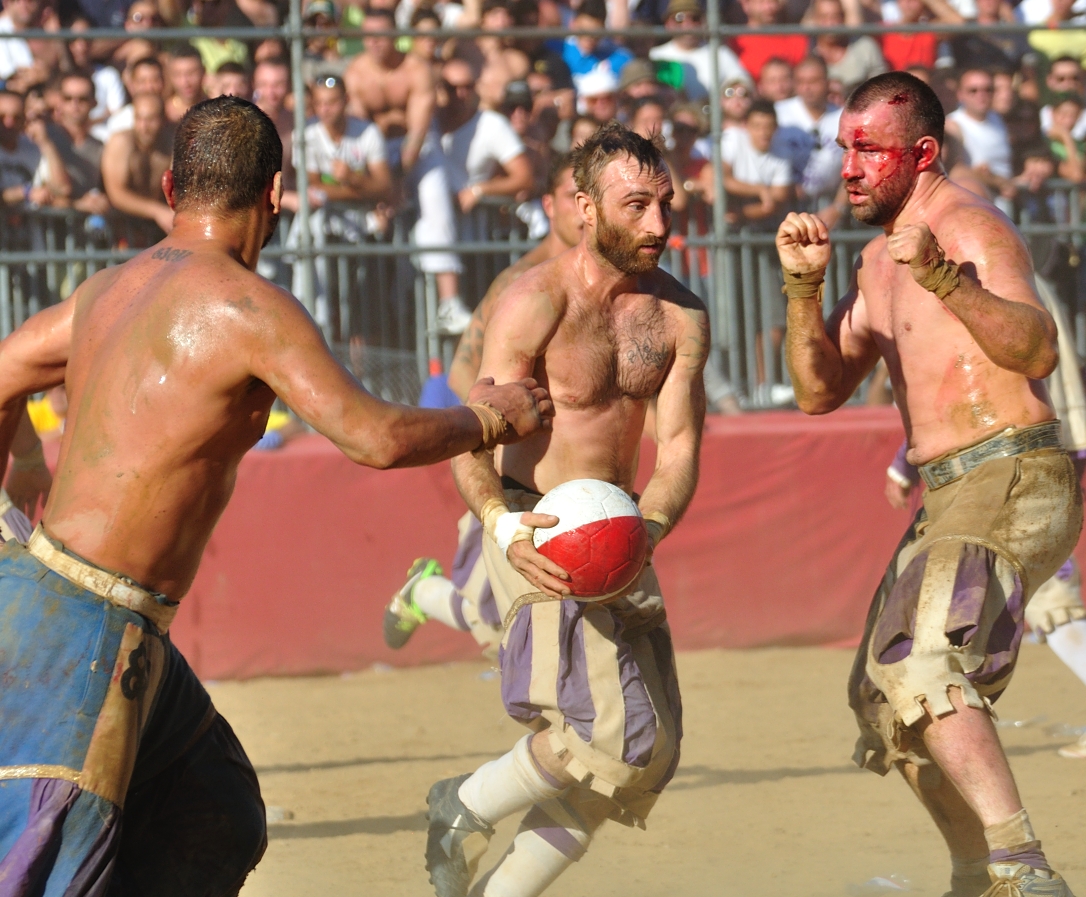
30. Game Fact: Calcio Fiorentino (also known as calcio storico or historic football) is an early form of football that originated in 16th century. It’s a combination of rugby, football, bare knuckle fighting and hair pulling. In other words, knocking the beejeebers out of each other. What fun!


27 September 2015

LIFE: Calcio Fiorentino

CHIAVARI, Italy - In 16th century Italy, Italians played a sport called Calcio Fiorentino. It is an extremely violent game, and combines elements of soccer, rugby and bare-knuckle fighting into one brutal and bloody event. Some history books say it was played by rich aristocrats, and sometimes even Popes, Clement VII, Leo XI and Urban VIII were said to be particularly fond of the game and often joined in. But I find that hard to believe
A Little Calcio Fiorentino Action 
The reason I find it hard to believe is that rich aristocrats and Popes didn’t even dress themselves in those days, so it’s hard to imagine them jumping into the middle of such a bloody and brutal sport. And by the time the Popes were elected Pope, they were old and kind of on the chubby side and well, you look at the photos and tell me if you think this is a sport for chubby, old men.

The truth is Calcio Fiorentino is a blood sport and because it is such a brutal game, the Italians stopped playing it sometime around the 17th century. But then, in 1930, a group of Florentines decided to revive it. 
 
Now, Now Boys, Let's Play Nice 
Traditionally Calcio Fiorentino, or calcio storico (historic football), is played on a sand field that is twice as long as it is wide. At each end, there is a net goal that stretches the width of the field.

There are 27 men from each team, and they are all on the field at the same time. That means there are 54 men knocking the snot out of each other for 50 full minutes straight, which is how long the game is. When the 50 minutes of insane brutality are over, whoever scored the most points wins.
 
A New Defense Tactic 
To score a goal, which is called a caccia, players have to put the ball into the opponents’ net. Easier said than done as all the while you are trying to put the ball in the other teams net, they are hard at work beating the crap out of you. And don’t take a shot for the goal unless you know you are going to make it because if you miss, the other team gets half a caccia.

There are rule, of course. Kicking, punching, head-butting and choking are all allowed, but you’ll get booted out of the game if you are caught throwing a sucker punch or kicking an opponent in the head. Biting opponent’s ears off is not encouraged either, nor is ganging up on one player.
 
The Kick in the Shin Maneuver
While there are referees on the field, the guys in the spiffy red and white pantaloons, but they only get involved if a fight or brawl breaks out. While you can smash the bejeebers out of your opponent when you are trying to score a caccia, you can’t just beat them into the ground and continue to do so without a referee coming over and chastising you. After all, the object of the game is to put the ball in the net, not kill the people you’re playing against.

There’s no way of telling if those rules always applied, especially back in the day when the Greeks ran things. They played a version of this game that they called Sfermomachia. The game was later adopted by the Roman army and transformed into a type of warrior training. The Romans called it Harpastum, which in Latin literally means to rip off – like rip off your head.  

This Might Work   
The Romans loved the continuous body-to-body, head to head combat for possession of the ball, it brought out their inner gladiator and it was through their love of the game that it spread throughout the Roman Empire.  

For all we know the Romans could have been playing calcio Fiorentino back in 59 A.D. when they founded the city of Fiorenza, now known as Florence.  Anything is possible. One thing we do know is that by the second half of the 5th century, calcio was so popular among young Florentines that they often played it in the streets and squares of the city. And one winter, back in 1490 when the Arno River was completely frozen over, they marked off a field and played a few games on the ice.

 Now, Now Boys, Choking is Against the Rules
The game is now played in Florence as a tournament during the 3rd week of June. Florence is divided into quadrants and each quadrant provides one team to play. After two opening games, the two remaining teams play in the final. The championship game is played on June 24th, which is San Giovanni (St. John)’s Day, who happens to be the Patron Saint of Florence.

Each team fights its hardest to win the grand prize, a cow! Not just any cow, but a Chianina cow which is the largest cattle breed in the world, and also one of the oldest in existence. Their meat is delicious and the best cut is used for bistecca alla Fiorentina, a massive T-bone steak. 
 
Where Do You Think You're Going? 
What better way to celebrate a win than to fire up the grill and share a steak dinner with your teammates and their families.  Laugh if you want, but the Italians know this: you can’t eat a shiny Winner’s Cup.


By the way, if you are interested, you can watch full Calcio Fiorentino matches on YouTube. Check it out.

26 March 2015

AUNTIE PASTA: Favorite Things Part II


CHIAVARI, Italy – It seems to me there are an awful lot of cookies and pastries connected to Lent, which is supposed to be a period of fasting, moderation, and self-denial. Almost every town and region in Italy seems to have its own Quaresimali (Lenten) cookie or pastry, and often more than one.
 Convent of Sant'Antimo, Toscana
Lent begins with Ash Wednesday and ends with Easter Sunday, and those six weeks are often compared to the way people in the Old Testament fasted and repented in sackcloth and ashes. In keeping with that old tradition, only sweets and treats made with the most basic of ingredients were allowed.

The rules were simple: no meat and no animal fats. But leave it to the clever Italians to figure out how to create treats that followed the rules of the Church, but at the same time were delicious. Here are two cookies and a surprising snack that get the Quaresimali seal of approval.  
 Genova's Biscotti Quaresimali

GENOVA’S  BISCOTTI QUARESIMALI

It’s impossible to know how long it took the Augustinian nuns of the church of San Tommaso in Genova to figure out how to make a cookie without butter or eggs, but they did. The answer was not easy to find, in fact it was hundreds of miles away in Sicily. In Sicily the nuns were making a sweet called marzipan out of ground almonds and orange flower water. It was one of many Arab-Persian recipes that had been handed down from generation to generation starting back in the 800’s when Sicily was the Emirate of Sicily, an Islamic state whose capital was Palermo.

The Genovese nuns tried the ground almond and orange flower water recipe and it was fine as long as they didn’t bake it, but they wanted cookies, not candy. They knew the problem was the no eggs rule. They needed eggs to hold the mixture together, there was no way around it. But just maybe, if they only used the white of the eggs the cookies would hold together and it would only be a partial infraction of the rules. So they did. And it worked.

During the three hundred years that followed, the Convent of San Tommaso closed and no one was making the Quaresimali cookies any longer. In the 1800’s the Genovese confectioner’s shop Romanengo decided to start making their version of the cookies, and they have been making them every Lenten period ever since.

Romanengo’s Confectioner’s shop is still around and still selling Quaresimali cookies and they are just as delicious as they were in the 1500’s when the clever Augustinian nuns first created them.
 Florence's Biscotti Quaresimali

TOSCANA’S BISCOTTI QUARESIMALI FIORENTINI

The only “luxury” allowed on these special cookies from Florence was a sprinkle of cocoa, which when these cookies were first made, was truly a luxury. It was the nuns in a convent between the Tuscan cities of Florence and Prato who first came up with a recipe that didn’t use butter or egg yolks. They made the dough and shaped it into the letters of the alphabet to remind them of the words of the Gospel.

The nuns made the cookies for the priests and other men of the church, and for the rich, aristocratic families of Florence who supported their convent. However, it wasn’t long before a famous Florentine cookie factory started producing and promoting the cookies   as a Lenten treat. Needless to say they were a big hit in a time when fasting and self-denial was taken very seriously. Today you will find alphabet cookies in pastry shops in Florence and Prato and many other Tuscan towns during Lent. 
 South Tyrol's Fastenbrezel

SOUTH TYROL’S FASTENBREZEL

In the mountains of South Tyrol, the favorite snack during Lent is a pretzel called a Fastenbrezel  -  and it’s thought to be the oldest snack in the world. It certainly is the most popular snack in the German speaking parts of Italy – South Tyrol - as well as in Germany and Switzerland.

In the late 18th century, Southern German and Swiss German immigrants introduced pretzels to North America.  Many of them settled in Pennsylvania and were known as Pennsylvania Dutch. They started selling pretzels and the idea took off from there. I never realized how popular pretzels were until I moved to Philadelphia in the 1980’s  and saw street vendors selling big soft pretzels – with mustard or without – on almost every corner in Center City. 
I thought it was a new twist on the hot dog carts that you find on many a corner in New York. Little did I know that the average Philadelphian eats twelve times as many pretzels as the national average, and that the Philly vendors were actually carrying on an old European tradition.  

There are a few versions of how the pretzel came to be but my favorite is that they were created in 610  AD by a Benedictine monk in northern Italy. He made them as a prize for his students who had managed to memorize verses from the Bible.  The form represented two hands clasped in prayer while the three holes symbolized the Holy Trinity.  And as the word “pretzel” is derived from the Latin word “pretiola”, which means reward, this may very well be its true origin.

Because pretzels are made from simple ingredients, it wasn’t long before people realized they were perfect as a Lenten snack. They still are, but their popularity has gone well beyond Lent as a stop at any bar in Philadelphia at Happy Hour will prove.