Showing posts with label Italian summer food. Show all posts

06 May 2015

AUNTIE PASTA: The Three P's - Patate, Pomodori e Pepperoni

CHIAVARI, Italy – The shiny red peppers and plump tomatoes in the market Saturday were irresistible, so I scooped them up, brought them home and made one of my favorite dishes; potatoes with peppers and tomatoes. With a grilled chicken breast, some crusty fresh baked bread and a glass of full-bodied Barbera wine, lunch was a spectacular feast.
 Too Beautiful to Resist
This dish, called the Three P’s in Italian, patate, pomodori e pepperoni, pepperoni being the Italian word for peppers, is more of a marriage of ingredients than a recipe. The flavors blend beautifully together but if you are thinking that a marriage of three is not possible, think ménage à trois, which is not a marriage, but close enough. But regardless of what you call it, do give this dish a try.

You can use almost any type of potato and peppers of any color - red, yellow, orange, chocolate brown, ivory, deep purple or green, but the tomatoes have to be blood red, super ripe and juicy. You need the juice from really juicy tomatoes to cook the potatoes and peppers, and firm, green tinged tomatoes just don’t cut it.
A Tisket a Tasket, Potatoes in my Basket  
The success or failure of this dish relies entirely on the quality of the ingredients you use. If your Three P’s are ripe and full of flavor, if your olive oil is sweet and your onion isn’t so old it’s sprouting green shoots, your dish will be full of flavor.  


There isn’t a region in Italy that doesn’t claim the Three P’s as their own, but the second recipe I’ve included is more of a southern dish. I don’t know if it even has a name, we always called it baked tomatoes because that’s what it is. The recipe is my mother’s, who got it from my grandmother, who got it from her mother when they all still lived in Italy. And once again it is such a simple dish to make I hesitate to even say it’s a recipe, but it’s so good how could I not include it?
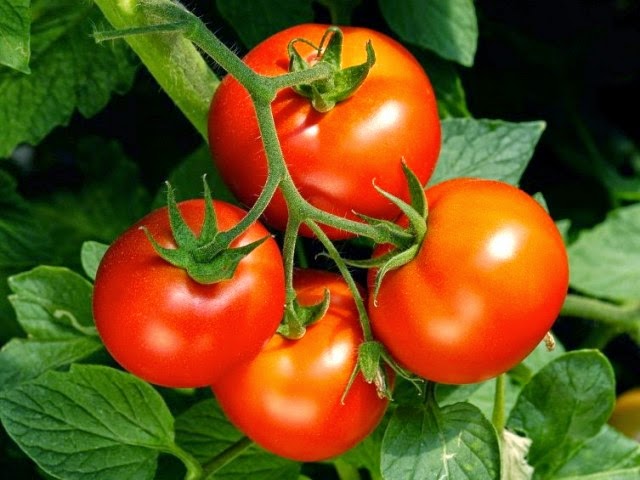
Ripe, Juicy Tomatoes  
But let’s start with the Three P’s.

Peperoni, Patate e Pomodori
Ingredients

1 pound potatoes, peeled and cut into 1 inch cubes
1 pound sweet bell peppers, seeds removed and cut into ½ inch strips
½ pound mature tomatoes, peeled and roughly chopped
1 medium red onion, sliced
extravirgin olive oil
salt

1. Remove seeds from the pepper, peel and cut lengthwise into 1/2 inch wide strips.

2. In a heavy sauté pan that can hold all the ingredients, put in the thinly sliced onions and olive oil, and turn to heat to medium. Cook, stirring until the onions wilt and become light gold in color, then add the sliced peppers. Cook for 3-4 min, stirring occasionally, then add the tomatoes with their juice, adjusting the heat to cook at a slow, but steady simmer.

3. While tomatoes are cooking, peel the potatoes, wash them in cold water, and cut into 1-inch cubes.

4. When the oil floats free of the tomatoes, and the peppers are just starting soften, add the potatoes.  Turn the heat down to very low, and cover the pan. Cook until the potatoes and peppers feel tender when prodded with a fork. While cooking, stir well from time to time bringing the vegetables on the bottom of the pan up to the top.  Add salt and pepper to taste.

I have also made this dish with a can of whole tomatoes and had very good results.  

Now for the baked tomatoes. This recipe does not have set amounts, you can make as many or as few as you want.  My mother and grandmother would make this dish whenever there was a bumper crop of tomatoes in the garden, and they both used good size cookie trays to bake them on. Keep in mind the tomatoes will shrink as they bake, and you can't just eat one. You just can't. They are too good.
 
Brutti but Buoni - They May Not Look Pretty, But oh, What Flavor
Lip Smacking Good Baked Tomatoes
Ingredients

Ripe tomatoes
Dried oregano
Garlic cloves, peeled and sliced lengthwise into thin strips
Salt and pepper
Extra virgin olive oil
Sprinkle of sugar (optional)

Wash the tomatoes and cut them in half. Place them cut side up on a greased baking pan (like a cookie sheet), or you can cover the bottom of the baking pan with oven paper if you like.

Insert several slivers of garlic in each tomato half. Sprinkle with dried oregano, salt and pepper and a drizzle of extravirgin olive oil. If you want you can also give your tomatoes a very light sprinkle of sugar.

Bake in a pre-heated oven 150° C / 300° F for about one hour. The tomatoes will shrivel up, and taste the best when they are a little blacked around the edges. Let them cool and serve them at room temperature.


11 July 2013

AUNTIE PASTA: The Cook and the Pea Redux


CHIAVARI, Italy - Long before I decided to move to Italy I worked as a cook at the Syracuse Hotel, in Syracuse, New York. The Chef, who was from Switzerland, had been trained in Europe and had worked in some pretty impressive restaurants. He was delighted to have me in the kitchen for unlike the rest of the staff, almost all ex-military cooks whose culinary training consisted of a Mess sergeant telling them to cook whatever they were cooking until it was dead, real dead, I actually knew a little bit about food. And I was interested in learning more.  
 
 It's All About the Peas
Unfortunately the Chef and I didn’t work together very often. He did volume cooking for banquets and weddings which required massive amounts of food cooked in pots that were bigger than my bathtub and I was assigned lunch duty at one of the hotel restaurants, and chief food organizer for the hotel’s Sunday brunch. 

Lunch was a lot of work but preparing brunch was fun. On Sunday mornings I would go into the giant walk in coolers and see what was left over from the banquets and events that had been held during the week to see the leftovers looked like. Whatever was in there was what I had to use for the brunch table, but first it needed to be transformed into “new” food. It was a fascinating journey because there were always new and interesting foods, things I had never seen before, like hearts of palm, to experiment with.
 
 Just Defrost, Don't Cook
What I found on one auspicious day was a tray of hollowed out fresh tomatoes that had been filled with something smooth and green. I tasted it. Puree of peas most certainly, but there was also something else, something I couldn’t identify but made it very, but very delicious. I couldn’t wait to see the Chef and ask him what the other ingredient or ingredients were.

“Calves brains,” he said when I finally caught up with him. “It’s a puree of peas with calves brains.” 

Oh yuck!
 It's All About the Peas

That kind of put a damper on my love affair with pea puree that is until last summer when I decided it was time to try it again. After a bit of thinking I came up with a simple version that is actually quite delicious. Not as delicious as the puree in the Chef’s stuffed tomatoes, but delicious enough that my friend Gary took the recipe home and made it for Chris, his significant other. It got a thumbs up.

As with many of my recipes there are no exact measurements, so you'll have to use your own best judgement.
Pea Puree Soup

Bag of tiny frozen peas (not defrosted)
1 bouillon cube (vegetable or regular)
1/8th  teaspoon fresh lemon or lime juice
Boiling water

Dissolve the bouillon cube in the boiling water. When dissolved, turn off the heat and add the bag of frozen peas. There should be enough water to cover the frozen peas. Let them sit for a minute or two, stir and taste a pea to make sure they are defrosted but not cooked.

When the peas are defrosted put them, along with a small amount of broth into a blender and puree on medium speed until perfectly smooth. The soup should be thick, but pourable. Add the fresh lemon juice and stir. Transfer to a glass pitcher and cover. Let cool. This soup is best served cold. 
 
 Lif is Just a Bowl of Peas
In Chef Thomas Keller’s best selling cookbook “The French Laundry” there is a pea puree soup similar to mine except I don’t think he adds lemon or lime juice but what he does add is a few drops of white truffle oil just before serving. He also serves the soup with cheese crisps, aka fricos (see June 9 blog http://thisitalianlife.blogspot.com/2011/06/auntie-pasta-northern-fried-chicken.html 

This puree would also be good under a piece of salmon or, if you are feeling adventuresome, carefully clean poach and puree a small amount of calves brains, combine them with the peas and pipe the mix into hollowed out tomatoes. Chill and serve.

This article was first published on this blog on 25 August 2011

16 May 2013

AUNTIE PASTA: Erbe della Riviera Ligure


CHIAVARI, Italy – Walked into my favorite greengrocer the other day just in time to see the owner coming in with an armful of fresh marjoram. I had never seen such large stalks of marjoram in my life, they were at least two feet long, but then again my experience with growing marjoram is limited to the 7 or 8 inch stems of my herbs in a pot windowsill garden.
 
 Marjoram
Then I noticed he had also brought in a fresh supply of bay leaf branches and piled them up over in a corner. I have some of their bay leaves in my kitchen that I bought a few weeks ago. They are tied together with some kitchen string and hanging up to dry. Now I have to find a container that is large enough to hold them and still fit in my limited kitchen space. I would have bought some of their marjoram as well if my own little plant wasn’t growing like the weed that it is and producing more marjoram than I can possibly use in a year.

I also bought oregano yesterday, a bouquet of dried Sicilian oregano sealed in a plastic bag. When I got home I beat the (sealed) bag of oregano against the table for about 15 minutes until all the leaves came off leaving behind the dried oregano buds clinging to the top of the now bare stalks. Then I cut the bag open and put the leaves in a container. It didn’t seem to be such a large bouquet when I bought it, but I sure got a good supply of oregano from my small investment.

 Herbes de Provence
There was a time, in my early years in Italy, when I spent many a weekend in the south of France. I always envied the French for being so clever at maximizing whatever they have, and the merchants in Nice for being especially clever. I would look at the bright lemon shaped soaps and the ribbon tied bags of ‘herbes de Provence’, and wonder why the Ligurians didn’t do something similar. Maybe not soap, but how about ‘herbs of the Italian Riviera,’ or something more exotic like ‘erbe della Riviera Ligure.’ That would work.  

I was very sad when I learned that the ‘herbes de Provence’ is just a generic term for herbs found in Provence, typically savory, fennel, basil, thyme and lavender leaves, and   the herbs in the cute little bags don’t actually come from Provence, or even from France.  Most of them come from central and Eastern Europe, North Africa and China. And no one could explain the presense of lavender leaves as the French, especially those from Provence, don’t use lavender leaves in their cuisine.

But that’s not the point. The point is I thought the Ligurians could easily create a thriving cottage industry producing equally adorable ribbon tied sackettes of herbs that are grown in Liguria and could have the DOP designations to prove it. (See: Auntie Pasta PDO, DOP, et all http://thisitalianlife.blogspot.it/2010/02/auntie-pasta-pdo-dop-et-al.html for a PDO, DOP primer). Why they, the Ligurians, didn’t take advantage of their natural bounty was a mystery that puzzled me for quite a while.
Parsley, Basil, Marjoram and Thyme
Then I figured it out. The reason they never did it, nor will they ever do it, is because they use more fresh herbs than dried herbs. Oregano may be exception to the rule, but even the Ligurians bow to the Sicilians when it comes to growing flavorful oregano. Oregano is one of the few herbs that actually tastes better dried so that would work as an herb product, but like I said, the Sicilians have the corner on that market. The herb most associated with Liguria is basil, but dried basil tastes like sawdust and dried parsely isn’t much better. Actually most herbs taste better fresh.

The story still goes round expat circles of the American who used to drive to Nice, some 96 kilometers (120 miles) from Genova, to buy dried parsely from the grocery department of Galleries Layfatte. When asked why, she explained that she had asked every greengrocer in town for dried parsely but there was none to be had. They only had fresh parsely.

But fresh or dried, Italians generally don’t use a lot of herbs in their cooking. And they rarely mix and match. They may use garlic and rosemary for a roast, or oregano, garlic and red pepper for a spaghetti sauce, but they don’t have a large jar of ‘Italian’ herb mix sitting by the stove. They try to bring out the flavor of whatever they are cooking and create a balance between their ingredients and the herbs and spices.
 
 Canata

Today’s recipe is called Canata, it’s a typical recipe from Lazio and it is another example of the simple deliciousness of Italian cuisine. It is very similar to Tuscany’s panzanella and like most authentic Italian recipes it’s a little short on details, but you are all used to that by now, right? There is also a Ligurian version of this summer favorite and probably a version for every other Italian province as well. On the plus side, the ingredients are few, the taste is big, and it’s super easy to make.
Canata
Serves 4
4 tomatoes
4 tablespoons of extra virgin olive oil
Rustic bread, at least three days old, cut in slices (cibatta is ok*)
6-8 fresh basil leaves
Vinegar (red wine or balsamic)
Salt and pepper
Wash the tomatoes in cold water, cut them in half and rub them on the bread slices. Then cut the tomatoes into smaller pieces, put them in a large salad bowl, drizzle them with olive oil, a little vinegar, salt and pepper. Tear the bread (by hand) into bite size pieces and add them to the tomatoes. Tear the basil (by hand) into smaller pieces and add it to the salad. Mix all the ingredients together making sure the bread is well coated with the juices. You can do this with a large spoon but it’s better if you use your hands.

Suggestions: If your bread is really stale, but really really stale, you might want to dampen the pieces with a little water to soften them before adding them to the other ingredients. However if the bread isn’t stale enough, it will turn to mush if you dampen it with water. You can also add other vegetables to this salad, such as celery or sliced artichoke hearts, the ones that have been preserved in oil.