Showing posts with label Milan Fashion Week. Show all posts

31 January 2016

LIFE: Celebrating Fashion


CHIAVARI, Italy - Men’s Fashion Week in Milan ended last week, but its not over yet. The city is still trying to catch its breath from the onslaught of fashion buyers, models, seamstresses, hairdressers, make-up artists, carpenters, set and stage designers, photographers and of course all those journalists who fly in to bear witness to one of the greatest shows on earth – Italian fashion.
 
Moschino Spring/Summer 2016
Fashion is a huge business here. Traders on the Milan stock market closely follow the fashion shows and the design trade shows. Milan’s financial newspapers run special fashion sections each week, and Milan is home to an international news service dedicated solely to the fashion industry. Who’s lunching with Krizia and who’s having dinner with Donatella are not just items for the gossip mill, but serious industry indicators.

Like other rites of passage, the rites of fashion celebrate change, and every three months, designers must create a new miracle. Each season has to have a new set of commandments on color, length, cut, fit and fabric. Nothing can be the same. A new a blouse, a skirt, a dress, a coat and don’t forget the accessories, need to be new, never seen before, and then artfully presented, for the presentation is part of the show as well.
Dolce and Gabbna, Fall/Winter 2015/2016
Some fashions are meant to shock, others are designed to fill you with waves of nostalgia, but mostly it is scramble to catch headlines, to be the most outrageous or the most beautiful – the most talked about. Fashion is fluid, it moves, sometime slow and sometimes at breakneck speed, and while we may feel a little sea sick along the way, we do eventually catch up with the ideas designers present. But that doesn’t mean no one complains.

You can’t imagine the public outcry when in 1917 Coco Chanel grabbed up bolts of jersey and turned them into dresses. There was a war on, all the fabric mills were busy turning out materials for military uniforms, the only fabric left was jersey, and at the time, jersey was used exclusively for men’s underwear. It was a shocking idea, but not for long.
 
 Dolce and Gabbana Spring/Summer 2016

A few years later, when Chanel put on a pair of trousers and went to a posh garden party, the guests were once again scandalized. They had never seen a woman wearing trousers before, at least not in public. Shocking ideas come and go and then somehow work their way into normality. And even though we know that every fashion show has the potential to make us gasp, somehow we are always caught off guard when that moment comes.

So as the men paraded down the runway wearing sequined sweaters and colorful little flowers embroidered on overcoat sleeves, the audience tightened their seat belts and hung on.
 
 Prada Menswear Fall/Winter 2016

The way fashion news is presented depends on who the readers are. Working for the Milan bureau of Women’s Wear Daily (WWD), a New York based publication for the fashion industry. It is considered the bible of the fashion industry and my job was to tell our readers what was hot and what was not in the world of Italian fashion and design.

WWD is not a slick magazine like Vogue, it’s a newspaper, a workhorse, a deliverer of industry news and trends. Vogue, on the other hand, is a magic carpet. As we turn the pages of that slick magazine we are taken into a dream world, a fanciful myth, a fantasy dressed in aspirational clothes.
 
Dolce and Gabbana Spring/Summer 2016
We all know we will never look like the super models on their pages, but who cares. A little daydreaming never hurt anyone. Besides, it fattens the bottom line of the designer’s financial statements, although not necessarily in the way you might think.

Picture the fashion industry as a pyramid, a fashion pyramid divided into three parts. The very top of the pyramid is reserved for the super expensive haute couture lines, the clothes you see on the runways. Those clothes are rarely sold and primarily serve as publicity generators. It’s that need for publicity that is behind the elaborate fashion shows staged during Fashion Week in Paris, New York or Milan, and Red Carpet events at the Oscars and other award shows.
 
 Moschino, Spring/Summer 2016

You already know the first question celebs are asked as they approach the interviewer, “who are you wearing.” That’s when the big names start rolling off their lips like dew off a grape: Armani, Versace, Prada, the list goes on and on.

And if you think those celebs have reached into their own pockets for those gowns or tuxedos, think again. Most of the clothes are “on loan” which often translates as possession is nine-tenths of the law. I’ve got it – I keep it. So the top one third of the fashion pyramid on its own doesn’t actually translate to big sales, in fact it hardly translates into any sales at all.
 
Cavalli, Menswear Fall/Winter 2016
In the middle section of the pyramid you’ll find expensive clothes, but not as expensive as haute couture. The price tags don’t seem to faze the top earners in London, Tokyo, New York and Beijing, who are not shy about spending big bucks for clothes in general, and especially for special events. But while the middle of the fashion pyramid does generates its share of profit for designers, it falls far short of the real moneymaker - the bottom third of the pyramid.

The bottom third of the fashion pyramid is where you’ll find $250 Gucci belts, $300 Prada scarves, key chains, wallets, small accessories, bed linens, sunglasses, cosmetics and perfume. Flashing the much sought after designer label, this is where the designers make the money to buy villas in France and penthouse apartments in New York.
 
 Moschino, Spring/Summer 2016
Those who are not able to afford the higher-ticket items will buy a little something from his/her favorite designer that makes them feel part of the bigger, more glamorous, picture. And the products are good. I’m not a designer junkie, but I confess, I love Chanel 5 parfum and I don’t feel at all guilty about spending money on it.

While most fashion journalists try to maintain a neutral position regarding the designers and their creations, they rarely succeed. We are all dazzled, bewitched and bewildered by the magic fashion creates, and even if a journalist struggles to find something positive to say about a particular line, most hope that they have been able to convey a little of the magic.   

Copyright © Phyllis Macchioni 2016

06 March 2011

LIFE: Milan’s Fashion Week


SARONNO, Italy - Last week was Fall Fashion Week in Milan. Tina Turner got a front row seat at Giorgio Armani’s  show and I got poked in the back at least a hundred times by the bony elbows of the paper thin models that invade the subway every time Milan sponsors a fashion event. Doesn't seem fair somehow.

Giorgio Armani's new longer look
A few years ago the Italian fashion industry, along with the French and Americans, made a big fuss about hiring more normal looking models instead of the anorexic models they usually hire. It was a semi-fake attempt to fool the public into thinking they were concerned about the image the anorexic models were presenting to impressionable young girls. If you ask me, the real reason was there were too many girls passing out before the runway shows– and yes, even dying – because they had starved themselves to sticks.

It is a little better now, but not by much.  At any rate there is no use focusing on the dark side of the fashion industry when there are so many bright sides to talk about. To begin with there is no denying that Giorgio Armani is still the king of Fashion. He shows it time and time again and this season was no different. His clothes were gorgeous, with lots of swing and sway. We saw it in his longer winter coats and also in the new cut of his trousers, slightly flared and ending just above the ankle. All the better to show off the embroidered booties and soft suede sandals he featured. His evening wear was a dream of silks and satins that melted into the skin, with velvet gowns that shimmed like jewels and chiffons that floated down the runway like clouds. 

One designer who has been around for a while but isn’t exactly a household name yet is Francesco Scognamiglio. He’s the go-to guy for Lady Gaga, Madonna and Rihanna when they want something special for a red carpet appearance or a video. He’s dressed Lady Gaga almost a dozen times and Madonna just called him for something special to wear to an event she’s been invited to in the spring.

 The dark side of Francesco Scognamiglio (photo: Telegraph UK)
While he does do a lot of ‘stand-out’ clothes, Scognamilglio's regular clothes are pretty normal and very good looking. For Fall/Winter 2011/2012 he showed pale beige sculpted pantsuits with moto-cross or bomber-jackets edged with fox collars and rippled, pleat details at the back. His shift dresses were low cut showing a lot of skin, and some of his mini-dresses were trimmed with fox hems – how extravagant!  How chic!

Many of the designers, like Prada, are still playing with fabric and texture mixing python-skins, sequins and fur, fake and real. It doesn’t always work but Prada fans are Prada fans and it doesn’t seem to matter what off-the-wall look Minuccia Prada comes up with, they will buy it.

Jil Sander went in the other direction and used elements of ski-wear mixed with vintage silk prints for a sporty couture look. Her hip belts, sashes and low slung pockets all draw your eye to the hip, which is fine if you don’t have any.

 One of Prada's signature looks
So from what we saw here in Milan it looks like the hot ticket colors for next fall and winter are going to be teal, jade, terracotta, mustard, amber and bronze. Tweeds are bigger than ever, over-the-knee boots will still be with us, handbags, instead of looking like travel cases, will shrink to a more normal size and if you have to carry a lot of stuff you can do it in a colorful tote that doesn’t pass itself off as a handbag. 

It will be interesting to see what looks and colors actually make it to the stores. They are already showing a lot of teal for spring here ,but for the rest of it, it all depends on what the advance sales look like. I'm sure I'll recover from my last pass through Milan long before fall comes around, and when I do I’ll gather my courage, get back on the train and head for the shops to see what's what. You will be the first to know.

26 September 2010

LIFE: Passion for Fashion

SARONNO, Italy - You would think that after working for Women’s Wear Daily and all the other Conde’ Nast fashion publications for years and years, I would post more fashion oriented articles on this blog. There’s no real reason why I’ve stayed away from writing about it, especially since my tweets are  fashion oriented, it just happened.


Corso Vittorio Emmanuele, Milan
But September is fashion month in Milan, and like the elephant in the room – it is impossible to ignore. On Sept. 9th Vogue Magazine sponsored Milan’s Fashion Night Out, which simply means an evening of fashion extravaganza when the designer shops of Milan’s Fashion Quad stay open until the wee hours of the morning, bands play, people dance in the streets, it's a festa. 

The Quad, which is sometimes called the golden Quad, is the area between Via della Spiga, Via Sant'Andrea, Via Montenapoleone and Via Manzoni in downtown Milan. It  is where you will find glitzy boutiques like Giorgio Armani, Dolce & Gabbana, Gucci, Versace, Prada, Krizia, Fendi, Louis Vuitton, La Perla, Bruno Magli and all the others.

From Sept. 21 to Sept. 26 Milan will be gasping in the grip of Moda Donna Spring/Summer 2011. It is one the biggest fashion events of the season and all the major fashion houses will be strutting their stuff on the runways. Milan is buzzing with fashion editors, buyers, photographers and gorgeous, long legged models, both male and female, crowding and pushing their way into the subways and onto the trolley cars.

Tickets to the private parties and backstage events sponsored by fashion houses are in great demand as everyone wants to feel they are part of the “in” crowd, the insiders who dictate what the rest of us will be just dying to wear come spring.

Daily Flower Delivery on Via Montenapoleone

Even before the madness started the Italian fashion magazines could talk of nothing else. One article I found interesting (more commercial than fashion oriented however) was in the weekly woman's magazine Corriere della Sera publishes.   

I thought you might find it interesting what Italian women are wearing this fall, and  the prices. I checked the internet (http://www.x-rates.com/calculator.html) for the most current euro to dollar exchange rate.

Here’s what I found:


1. Sunglasses by Borsalino: $295
2. Zip-up leather jacket by Caractere: $697
3. Silk blouse by Conbipel: $67
4. Leather gloves by Emporio Armani: $241
5. Stretch tube skirt by Max Mara: $226
6. Platform shoes in black and red by Love Moschino:$315
7. Leather handbag by Serapian: $603

The clothes in Io Donna are pretty much a cross section of what is in the shops now  here in Milan and Saronno, except for the Max Mara store. Every outfit, including coats, boots and gloves in their Milan store windows was black. That’s absolutely fine with me but sometimes even I like to get a little wild and step out in something bright and colorful, like beige. 

Here are a few of the other outfits featured in Io Donna.


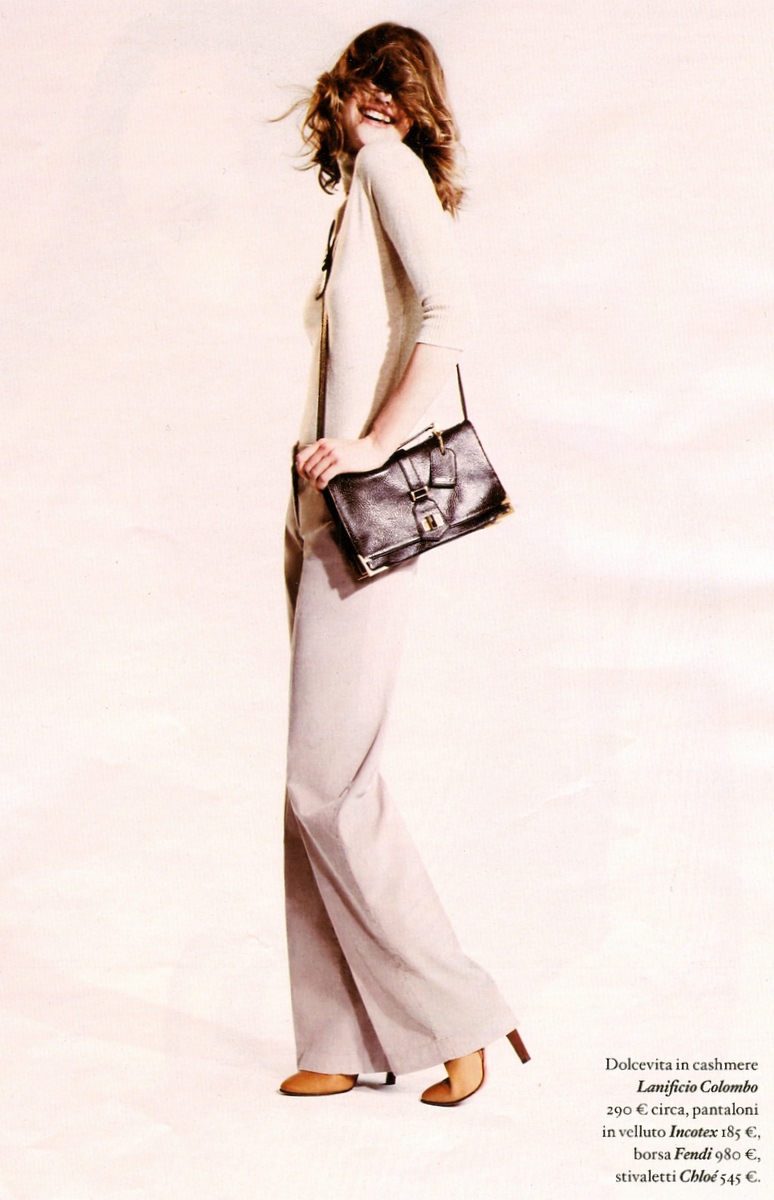
Cashmere turtleneck, Lanificio Colombo, €290$369; corduroy pants, Incotex, €185/$235; handbag, Fendi, €908/$1,248, boots, Chloe’ €545/$694.

Denim shirt, MCS Marlboro Classics, €115/$146; jeans, Chloe’, €390/$497; leather moccasin Tods, €280/$356.

Alpaca and wool cardigan, Daniela Drei, €790/1,006; corduroy pants MCS €115/$146; snakeskin moccasins, Armani, €311/$396
Wool and tricot cardigan, Midali Toujours, €198/$252; silk plisse’ blouse, Sportmax, €249/$317, wool flannel wide leg pants, Stephan Janson, €500/$637.

You have to admit the clothes are beautiful, albeit expensive. I could do with a few new outfits myself this fall and if I could only find that sack of gold I hid somewhere in this apartment, I would go shopping. 

For the latest in fashion news and views from the fashion capital of the world follow me on twitter.com/Italianlife

12 September 2010

ON THE ROAD: Milan

This is another in a series of monthly travel articles inspired by a New York Times article on 31 places to see in 2010. All of the towns are in Italy, and while most are small, rich in history and art and for the most part off the beaten track, this month’s article is on Milan, not small and definitely on track.

MILAN, Italy - The very fabric of Milan is Valentino red, Armani black and Versace gold. And as the glam models strut their stuff down the Milan fashion runways during Fashion Week, they keep the Made in Italy label on the front cover of every fashion magazine in the world. And even after Fashion Week is over and the designers have packed their collections away, the city rocks.

La Scala Opera House 

Milan is slick and snazzy and marches to the beat of a different drummer. It’s not like any other city in Italy, especially not the ones that are so absorbed with their past. No no, it’s nothing like them at all. This northern metropolis lives with one foot in the here and now, and the other foot in the future. It’s about art, it’s about design, it’s about fashion. Oh yes, above all it is about fashion.

Apart from a taxi, the best way to get around is on one of the orange trams that criss-cross the city. Board one going up Via Manzoni heading for super chic Via Montenapoleone, and chances are you’ll find yourself sitting next to the editor of an international fashion magazine or the marketing director for Prada or Dolce and Gabbana. Morning traffic is intense. Vespas zoom in and out, taxis honk and drivers stick their heads out car windows and mutter to themselves. What’s the hold up? . Everyone is in a hurry. No strolling allowed.

Milan is not an easy city to visit and it’s no wonder many first time visitors are disappointed. It is big, confusing and difficult to find your way around. Plus the city has a strange look about it. Yes, the massive Duomo is breathtaking. Topped with a crown of two thousand and two marble statues and a brilliant gilded statue of the Madonna, few visitors realize it is Italy’s second largest cathedral. Only the Vatican is bigger.

Milan's Cathedral

Yes, the Sforza castle is amazing. A thousand years of history right in the center of town, surrounded by a moat complete with drawbridges - but no water of course.

Sforza Castle

Yes, the Galleria’s soaring iron and glass arches were soaring years before Mr. Eiffel built his tower in Paris, imagine that! And every great Italian composer since the 18th century has composed for La Scala opera house. But alas the overall impression is of a city of drab, gray buildings, and not much more. For me, understanding the reason why, seems to make it less so.

The Galleria

If you turn the clock back to the years right after World War II, you find a Milan in shambles. The city suffered heavy bombing, and entire neighborhoods were reduced to rubble. When the dust finally settled, the massive job of reconstruction began. It was the intense need to rebuild in a hurry and get the city working again that gives Milan its strange look. Ultra modern, sleek angular buildings that were simple to design and quick to construct, sit next to ornate 17th and 18th century beauties disturbing the visual continuity.

“Is the city old or new,” visitors ask. Is it in the past, or in the here and now?
The answer is both, at least architecturally speaking. But for the rest, Milan has always been in the here and now. As soon as the war ended and the textile mills that dominated the small towns around Milan were up and running again, textile salesmen were off for New York. They soon realized that in addition to the American appetite for Italian fabrics, there was also a budding interest in Italian clothes.

Within a relatively short period of time Gucci, Pucci and Valentino became household names. Gone were the days when Italian women cut photos out of French fashion magazines and took them to their seamstresses to duplicate. Italian fashion had arrived. The Made in Italy label was successfully launched and on its way to the moon.


Click for a tourists view of Milan
Traders on the Milan stock market follow the fashion shows and the design trade shows. Milan’s financial newspapers run special fashion sections each week, and Milan is home to an international news service dedicated solely to the fashion industry. Who’s lunching with Krizia and who’s having dinner with Donatella are not just items for the gossip mill, but serious industry indicators.

In the spring and fall, when the city gears up for the all-important twice-a-year fashion shows, the trams and subways are crowded with tall, leggy models, male and female, carrying large black portfolios. They make the rounds of the booking offices, anxious to see if they are good enough to walk down Armani’s runway, or if they’re to be relegated to working the show rooms.

When they have an half an hour free, you will find them standing in awe in front of Leonardo da Vinci’s Last Supper, which is in the Refectory of the church of Santa Maria della Grazie. There is more da Vinci at the Biblioteca Ambrosiana, the world’s first public library, and still more at the Pinacoteca di Brera, a world class museum in a 16th century palazzo. And oh yes, there’s also the Museo della Scienze e della Tecnica, where you’ll find models based on Leonardo’s original sketches. When they are not on the da Vinci trail, they haunt the shops for gifts to bring to the folks back home.

“Who pays these prices,” an American on his first visit to Milan once asked me, “I can get the same things cheaper back home”. And he is right. There are no shopping bargains here and he is not the first to be taken aback at just how expensive a plain navy blue sweater can be. Too bad he wasn’t going to be in town long enough to see the long lines that form in front of Prada, or Ferragamo when the sales are on. He would have been amazed the way the big designer names draw shoppers from around the world. So many in fact that many designer boutiques have started following Gucci’s policy of limiting the number of items an individual shopper can buy.

Shopping in Milan

Soon after I moved to Milan I discovered that while the tourists head for the Armani store on Via Manzoni, or the chic shops on Via Montenapoleone, Via della Spiga, and the other the streets of Milan’s famous Golden Shopping Quad, locals head for Brera, a small neighborhood behind the La Scala opera house.

Some of the narrow cobblestone streets in Brera, like Via Fiori Chiara, are pedestrian only and on weekends, fortunetellers set up their tables in the middle of street ready to gaze into their crystal balls, or let the Tarot cards tell your fortune. Not in the winter, of course.

Brera has always been a commercial area, harkening back to the days when the ladies of the night sat bare breasted in the windows of the houses plying the oldest trade in the world. Milan’s antique row is here, as are art and photo galleries, trendy boutiques, bars, restaurants, all very in and very arty, and very Milan. The prices may not be any better than those on Via Montenapoleone, but the goods are offbeat and one of a kind, just like Milan.

For the latest in fashion news and views from the fashion capital of the world follow me on twitter.com/Italianlife

28 February 2010

LIFE: Passion for Fashion

SARONNO, Italy - The Mayor of Milan, Letizia Moratti, is mad. Furious, actually.

“Nobody, not even Anna Wintour, has the power to change our fashion calendar,” she snapped to reporters a few days ago.


It’s Fashion Week in Milan, five days of non-stop fashion shows, fashion parties, fashion dinners, and now fashion controversy. The problem is that Anna Wintour shortened her trip to Milan by two days, throwing the Italian fashion industry into a tizzie. If you don’t recognize the name, Wintour is Editor in Chief of Vogue Magazine and the “devil” who inspired the book “The Devil Wears Prada”.

With Vogue the most important fashion magazine out there these days many Made in Italy designers were scrambling to re-scheduled their runway shows for the last two days of the week. But every even remotely acceptable venue was already overbooked, not to mention the models, hairdressers, make-up artists and stylists. And so another layer of stress was added to the milieu.

So was la Wintour satisfied? Apparently not.

"This is absolutely crazy,” said Mario Boselli, the president of the National Chamber of Italian Fashion. “She wants designers to schedule their shows during the three days she will be in town."

“We should just say no. Italian fashion rules the world and no one can take that away from us," added Saverio Moschillo, the deputy chairman of the Italian Fashion Association after la Wintour failed to show up for his Haute collection.

To make matters worse, Mayor Moratti decided to ban all auto traffic in Milan on Sunday, a solution Italian cities often use to reduce air pollution. 


When Fashion Week organizers heard that bit of news they began bouncing off the walls. In a desperate, last minute plea they finally convinced the Milan town council to grant journalists, buyers, florists and others attending Sunday’s shows, special permission to drive into the city.

It’s hard to fathom just how big an industry fashion is here in Italy. In Milan it is super important and super intense. The country’s economy revolves around the Made in Italy label and Milan is at the epicenter of this world. What happens on these streets determines the failure or success of a large number of industries up and down the Italian peninsula, and in these days of global business, also around the world.

Traders on the Milan stock market scrupulously follow the fashion shows and design trade shows. Il Sole 24 Ore, Italy’s number one financial newspaper, runs a special fashion section each week, and Milan is home to an international news service dedicated solely to the fashion industry. Who’s lunching with Krizia and who’s having dinner with Giorgio are not just items for the gossip mill, but serious industry indicators.

The end-of-the-year figures are staggering. Design houses report income in the billions of dollars and fashion brands earning mere millions are a dime a dozen. It’s a town of handshakes and back slapping that goes on behind mountains of fluffy tulle and soft silk organza. It’s a multi-billion dollar a year kissy-kissy business conducted with kid gloves, in the latest fashion color of course.

Milan’s Fashion Week runs from February 24 to March 2. Be glad you are not here
.


Photos: (1) Donatella and Santo Versace, Feruccio and Massimo Ferragamo with Emaunuel Ungaro, Missoni family, Miuccia Prada with husband and sons, Diego delle Valle and his family. (2) Massimo and Alberta Ferretti