Showing posts with label New York. Show all posts

13 October 2013

LIFE: This Country Called America


CHIAVARI, Italy - "God Bless America", my grandmother used to say. My grandfather used to say something else about America. She was thrilled to be there, and he, well that's another story. My grandparents were just two of the two million Italians who immigrated to the United States at the beginning of the 1900’s. 
 Taken when America was still a dream
My grandmother was fiercely proud of her heritage. She loved Italy; she loved everything about it, the food, the traditions, the closeness of her family. She just didn't want to live there, and mostly she did not want to raise her children there. She was not alone.

Between 1870 and 1920, close to 5 million Italians boarded steamships for America. Only Germany matched that exodus - one of the largest immigrations in modern history. Whole towns in Southern Italy, and some of the poorest areas of the Veneto and Tuscany, were emptied as people jumped at the opportunity for a better life. And yes, maybe even riches. In all fairness my Grandmother and her family were not starving, it was just that she saw America's open immigration policy as a once in a lifetime opportunity not only for her children, but for herself and my Grandfather as well.

The town they left behind, Piansano (VT)
My Grandfather was a furniture maker, but in the impoverished province of Lazio, there was little money for furniture. To supplement the family income he had turned to making wine barrels and was managing to make ends meet, but barely.

And then one day a stranger came to town with an offer my Grandmother couldn’t refuse. The stranger was an agent. His job was to travel throughout Italy spreading the golden image of America, rich and generous, democratic and open, a country with endless possibilities for success. And best of all the company the agent worked for would take care of the paperwork. It was an irresistible combination: yes, the agents were salesmen for the steam ship companies but the product they were selling was good. 
The cars may be newer, but little else has changed
So my Grandmother made a plan. My Grandfather, and her brother, Joe Bronzetti, would go to America first. They would get jobs – which according to the agent there were plenty of -  earn money, buy a house and then send second class steamer tickets for her, my father and my Aunt Louise, who was just a baby. My Grandmother really wanted to go to America but not in steerage. I don’t know how much resistance there was to her idea, all I know is that on Feb 18. 1913 my Grandfather, and his brother-in-law Joe   were walking around in that land called America.  

As soon as they stepped off the boat in New York the two men were offered work. The Pennsylvania Railroad was being built and the railroad company needed men to lay railroad tracks. So my Grandfather and Uncle Joe signed on. The company offered to provide food and inexpensive shelter along the way, the cost of which would be deducted from their pay. When the project was completed they would get the money they had earned, less their expenses.  

 So near and yet so far
You probably already know the end of the story. When the project was completed, there was no money. The paymaster had skipped town and taken the payroll with him. They were destitute. My Grandfather and Uncle Joe had heard from other Italians they had met while working on the railroad that some families from the province of Lazio had settled in upstate New York, in a town called Siracusa. Their only hope was to try to get to Syracuse and meet up with their piasani.

Stranded in a foreign country, and unable to speak English, the two men left Reading, Pennsylvania and began walking north. To survive the 233 mile journey they were forced to beg for food and shelter along the way. Anti-Italian newspaper articles published at the time claimed that Italian immigrants, especially those from Southern Italy, seemed to beg for the pure pleasure of begging. Obviously they never met my Grandfather and Joe.

Finally, free to go
When the two men got to Syracuse they found work, got settled and bought a house. A year later, on April 14, 1915, my Grandmother, my father and my Aunt Louise boarded a ship bound for America. Uncle Joe went on to own a string of bars, and I doubt there is an old timer in Syracuse who doesn’t recall with nostalgia hanging out in Joe’s Bar and Grill on Lodi Street, including yours truly.  

In few other countries in the world have the Italians had as much success as those who went to America. The children, grandchildren and great grandchildren  of the factory workers, masons, laborers, and waiters who landed on Ellis Island in the early 1900’s have gone on to become senators and governors, lawyers, doctors, engineers and managers, and yes even journalists. With their sweat and tears they built America. They are the embodiment of the American dream. 

 Many Italians settled in New York's Lower East side
It was not easy being Italian in those days and our forefathers had to jump through a lot of hoops in order to survive. Many changed their name to make their lives easier. When I was growing up we lived next to the Bond family. Their name wasn't really Bond, it was Bonacci. And I always loved my cousin Jimmy’s favorite story about his friend Mario who changed the name of his auto mechanic shop to sound more American. Instead of  Mario Bianco's, he renamed it Mario White's. 

What brought on this wave of nostalgia is the Columbus Day celebrations that will take place across America tomorrow. On October 14 thousands of us, the descendants of those who sacrificed and suffered to get to America, will celebrate Columbus' discovery. It's an important day for Italian-American because with this celebration, we can show our pride in being Italian, and we have a lot to be proud of.
As I remember them
There are now between 25-50 million Italians in America. Three million just in the metropolitan New York area, 5 million in the Tri-State area of New York, New Jersey and Connecticut. According to a study by the Angelli Foundation, the average income of Italians in America is now 25% higher than that of the average American. Imagine that. The population that was once looked down on, laughed at and called gangsters and beggars has become 25% richer than the average American. Who’s laughing now? 

On a trip back to the United States a few years ago, I spoke with a number of Italian-Americans. Many of them had never visited Italy and they were interested in hearing about life in Italy today. In talking to them I heard a curiosity about the land their families left more than a hundred years ago. It was nice. It was also a major factor in my decision to start this blog. What’s also nice are all the Italian-American Facebook pages where people just like me can celebrate their Italianness every day, and keep alive the customs and traditions their grandparents and parents brought with them in their search for a better life in this country called America. Happy Columbus Day.

 photos: Ellis Island web site.

14 October 2012

LIFE: America, Caput Mundi

SARONNO, Italy –There is a new exhibit in Rome this month, Roma Caput Mundi – a City between Domination and Integration. This celebration of the power and the glory of the Roman Empire is being held at the Coliseum and runs from 10 October 2012 to 10 March 2013. It has generated interest in comparing the current situation in the United States with the situation the Roman Empire faced thousands of years ago.
 Mitra Tauroctono, the Deity was the Guarantor of the Bond between the King and his Companions (III AD)

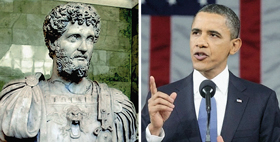
I thought you might be interested in an article that was published this week in the Corriere della Sera, Italy’s equivalent of the New York Times. The article is entitled  'Septimius Severus, the "Obama Prototype." The American dream looks back two thousand years. Two multiracial and multicultural domains. The same request for global impunity.' It was written by author Ennio Caretto. The photos, except for the one of President Obama and Severus are from the Roma Caput Mundi Exhibition.

Milan, Italy - Since America first claimed independence in 1776, it has been considered the "Second Rome." In the year "The Decline and Fall of the Roman Empire", was published, two of America’s founding fathers Thomas Paine and William Drayton, began to think of the USA as the new "caput mundi ". In the country’s first president, reserved and educated General George Washington,they saw another Lucius Quinctius Cincinnatus, supreme commander of the Roman army and statesman of the Roman Empire.
 Septimius Severus and Barack Obama
Since the election of Barack Obama, America’s first black president, America has another reason to identify with ancient Rome. The Roman Empire, like America today, was multiracial and multicultural, and took Septimius Severus as the first black emperor of the Roman Empire.

Severus was a Libyan general in the Roman army. He was married to a Syrian woman and together they had two children. He was a protégé of Marcus Aurelius and during his reign, he inaugurated a new dynasty. But unlike Democratic Obama, Septimius Severus, he established a military dictatorship. But Caracalla, his firstborn and his successor, extended citizenship to all  freemen of the empire that included one third of the known world.
Commemorative Roman Coin Issued in 71 AD to Celebrate the Subjugation of Judea

However, the differences between the two civilizations are considerable. The Roman Empire was created through the use of ‘hard power,” military power, while America’s rise to power has been mostly through the global dominance of financial markets and technologies, “soft power”.  At home, Rome was always a class driven society, first with a rigid division between the senatorial and equestrian and plebeian, and then among the "honestiores 'and' humiliores." But it was hardly racist, while America is the exact opposite. The rulers of Rome spoke two languages, Latin and Greek, languages of the intelligentsia, but America speaks only English and none the languages of its millions of immigrants.

American culture is dominant today as it was two thousand years ago in Rome. America is animated by a sense of "exceptionalism" or uniqueness that was typical of Rome. The '"American dream," the American dream of success, reflects the "Roman dream." Often in America outsiders', the children of the third world are considered inferio, as in ancient Rome considered the barbarians inferior. And around the world, Americans ask the same impunity -civis Romano. If you visit Washington, you see the throne of the Roman statue of Lincoln, and  you realize that Washington’s "Union Station" is a copy of the monumental baths of Diocletian. America has 16 cities called Rome, and in Rome, Georgia there is a statue of the Capitoline Wolf with Romulus and Remus, which was a gift from Benito Mussolini in 1929.
 Roman Emperor Trajan
Cullen Murphy, an historian who for twenty years has directed the magazine Atlantic Monthly, is the author of "Are we Rome?". It is only one of the hundreds of books on the similarities between the Roman Empire and America published in the USA. That of the crucible, says Murphy, "is not a myth, America is a model of assimilation of ethnic groups and alien cultures and it is the bearer of civilization, albeit not always welcomed, just as Rome was. And like Rome, America is a model of economic growth." It is not a myth that the sole superpower, "The Pax Americana” is the contemporary face of the “pax romana.”

No wonder the poor want to immigrate to America. “In the beginning of the first millennium," says Mr. Murphy, "everyone wanted to see Rome and today everyone wants to see New York or Washington." In his book, released in 2007, Cullen Murphy was asked if America is not in the same situation as Rome in the third century, on the eve of decadence. "Since the end of the Cold War," he says, "America does not know what role to assume. An almost imperial role that may be incompatible with its democratic institutions or a smaller role that can make it less relevant?” America, he says, is grappling with the same problems the Romans had: "The presumption of being the nation destined by God for greatness.
 Detail from Trajan's Column
There is the same excessive militarization, corruption and reckless pursuit of the privatization of public services of the past, and refusal to protect the environment. " But Mr. Murphy does not believe that American power is declining. In his view, unlike Rome, America cannot decline: "We have the extraordinary ability to reinvent and innovate. We need, however, a greater engagement with civil society and more respect for other nations." 

We need Obama.