Showing posts with label Roman Empire. Show all posts

14 October 2012

LIFE: America, Caput Mundi

SARONNO, Italy –There is a new exhibit in Rome this month, Roma Caput Mundi – a City between Domination and Integration. This celebration of the power and the glory of the Roman Empire is being held at the Coliseum and runs from 10 October 2012 to 10 March 2013. It has generated interest in comparing the current situation in the United States with the situation the Roman Empire faced thousands of years ago.
 Mitra Tauroctono, the Deity was the Guarantor of the Bond between the King and his Companions (III AD)

I thought you might be interested in an article that was published this week in the Corriere della Sera, Italy’s equivalent of the New York Times. The article is entitled  'Septimius Severus, the "Obama Prototype." The American dream looks back two thousand years. Two multiracial and multicultural domains. The same request for global impunity.' It was written by author Ennio Caretto. The photos, except for the one of President Obama and Severus are from the Roma Caput Mundi Exhibition.

Milan, Italy - Since America first claimed independence in 1776, it has been considered the "Second Rome." In the year "The Decline and Fall of the Roman Empire", was published, two of America’s founding fathers Thomas Paine and William Drayton, began to think of the USA as the new "caput mundi ". In the country’s first president, reserved and educated General George Washington,they saw another Lucius Quinctius Cincinnatus, supreme commander of the Roman army and statesman of the Roman Empire.
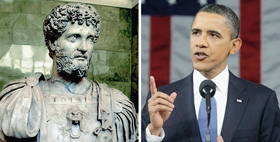
 Septimius Severus and Barack Obama
Since the election of Barack Obama, America’s first black president, America has another reason to identify with ancient Rome. The Roman Empire, like America today, was multiracial and multicultural, and took Septimius Severus as the first black emperor of the Roman Empire.

Severus was a Libyan general in the Roman army. He was married to a Syrian woman and together they had two children. He was a protégé of Marcus Aurelius and during his reign, he inaugurated a new dynasty. But unlike Democratic Obama, Septimius Severus, he established a military dictatorship. But Caracalla, his firstborn and his successor, extended citizenship to all  freemen of the empire that included one third of the known world.
Commemorative Roman Coin Issued in 71 AD to Celebrate the Subjugation of Judea

However, the differences between the two civilizations are considerable. The Roman Empire was created through the use of ‘hard power,” military power, while America’s rise to power has been mostly through the global dominance of financial markets and technologies, “soft power”.  At home, Rome was always a class driven society, first with a rigid division between the senatorial and equestrian and plebeian, and then among the "honestiores 'and' humiliores." But it was hardly racist, while America is the exact opposite. The rulers of Rome spoke two languages, Latin and Greek, languages of the intelligentsia, but America speaks only English and none the languages of its millions of immigrants.

American culture is dominant today as it was two thousand years ago in Rome. America is animated by a sense of "exceptionalism" or uniqueness that was typical of Rome. The '"American dream," the American dream of success, reflects the "Roman dream." Often in America outsiders', the children of the third world are considered inferio, as in ancient Rome considered the barbarians inferior. And around the world, Americans ask the same impunity -civis Romano. If you visit Washington, you see the throne of the Roman statue of Lincoln, and  you realize that Washington’s "Union Station" is a copy of the monumental baths of Diocletian. America has 16 cities called Rome, and in Rome, Georgia there is a statue of the Capitoline Wolf with Romulus and Remus, which was a gift from Benito Mussolini in 1929.
 Roman Emperor Trajan
Cullen Murphy, an historian who for twenty years has directed the magazine Atlantic Monthly, is the author of "Are we Rome?". It is only one of the hundreds of books on the similarities between the Roman Empire and America published in the USA. That of the crucible, says Murphy, "is not a myth, America is a model of assimilation of ethnic groups and alien cultures and it is the bearer of civilization, albeit not always welcomed, just as Rome was. And like Rome, America is a model of economic growth." It is not a myth that the sole superpower, "The Pax Americana” is the contemporary face of the “pax romana.”

No wonder the poor want to immigrate to America. “In the beginning of the first millennium," says Mr. Murphy, "everyone wanted to see Rome and today everyone wants to see New York or Washington." In his book, released in 2007, Cullen Murphy was asked if America is not in the same situation as Rome in the third century, on the eve of decadence. "Since the end of the Cold War," he says, "America does not know what role to assume. An almost imperial role that may be incompatible with its democratic institutions or a smaller role that can make it less relevant?” America, he says, is grappling with the same problems the Romans had: "The presumption of being the nation destined by God for greatness.
 Detail from Trajan's Column
There is the same excessive militarization, corruption and reckless pursuit of the privatization of public services of the past, and refusal to protect the environment. " But Mr. Murphy does not believe that American power is declining. In his view, unlike Rome, America cannot decline: "We have the extraordinary ability to reinvent and innovate. We need, however, a greater engagement with civil society and more respect for other nations." 

We need Obama.

01 January 2012

LIFE: It's a New Day, It's a New Year

SARONNO, Italy – Happy New Year – I think it’s the 1st of January and the beginning of a new year, but then again this is Italy and not everything is what it seems to be. Think I'm kidding? Well just ask those who still follow the Julian calendar and they’ll tell you today isn’t January 1st at all, but December 21st.

Not to get too embroiled in this topic, suffice to say that for centuries the then known world – i.e. the Roman Empire – operated on a calendar, called the Julian calendar after the Holy Roman Emperor Julius Caesar. It was made up of 355 days divided into 12 months, with extra time added every four years. During the leap year, an intercalary month was sometimes inserted between February and March, which meant that 22 or 23 days were added to the year, creating an intercalary year of 377 or 378 days. 

But, not quite.  For eight years out of 24, there were only three years with 377 days. This made the year longer by 365 ¼ days over the 24 year period. In addition, this adding and subtracting of days was not done on a fixed schedule, instead it was decided by the Pope. The Pope could put a few days in every second or third year if he wanted to, but there was no law that said he had to.

Julian Calendar
The problem was that the Popes were also politicians and could, and often would, change the calendar to suit their needs, sometimes at the last minute. This meant that the average Roman citizen was never really sure what the date was, especially if he was away from home and not getting the latest news bulletins from Rome on what day it was. You can see why the last years of the Julian calendar were known as the years of confusion. 

This really became a big problem in 63-46 BC, when there were only five intercalary months when there should have been eight, and none at all during the five Roman years before 46 BC. To appreciate the problem, let me just say that according to the official calendar Caesar crossed the Rubicon on January 10, 49 BC,  but the official calendar was so messed up he actually crossed the Rubicon months before that, in mid-autumn.
 Pope Gregory XIII


Enter Pope Gregory. The Pope’s chief astronomer Christopher Clavius reasoned that the problem was that the Julian calendar was too long. It gave each year 365 days of 6 hours in length. According to his calculations the actual average year was closer to 365 days, 5 hours and 49 minutes long. 

So the Pope, being a man of action, decreed that the day after Thursday, 4 October 1582 would not be Friday, 5 October, 1582, but Friday 15 October, 1582. He then declared the Julian calendar dead, long live the Gregorian calendar. 
Gregorian Calendar
If I were to tell you that everyone welcomed the new calendar with open arms, I would be fibbing. People were bitterly opposed to losing an entire week, but after a little arm twisting the Catholic countries, Spain, Portugal, Poland and Italy went along with it. Some of the others, France, a few of the states of the Dutch Republic and some of the Catholic states in Germany and Switzerland continued to resist, but within a year, they also complied.

The Protestant countries were a little more difficult to convince. It took some of them more than a century to come around and some of them didn’t adopt the new calendar until the 1700’s. By this time they were 11 days behind the Catholics. Great Britain and the American Colonies finally gave in in 1752, where Wednesday, 2 September 1752 was immediately followed by Thursday, 14 September, 1752. The last holdout, Sweden, finally got on board on 1 March, 1753.
Old Father Time Tarot Card
Over the next couple of hundred years the reluctance to conform continued, especially in parts of the world dominated by the Christian Orthodox church. It took the Russian Bolsheviks to finally institute the calendar in Russia in 1917, and the Romanians only accepted it when their King Ferdinand decreed it law in 1919. They were most unhappy that 1 November 1919 was suddenly transformed into 14 November 1919 but they were not about to argue with their King. The last Orthodox countries to accept the Gregorian calendar were Turkey and Greece, both in 1923.

And there are still holdouts. Some Orthodox churches still used the Julian calendar for fixed feast days, while using the Gregorian calendar for the rest of the time, and the Berber people of North Africa and on Mount Athos have never given in and continue to use the Julian calendar to this day. Must be fun when they are trying to book airline reservations. 


So now that you know all the trials and tribulations your new 2012 calendar has been through, you might want to hang it in an exalted position that it deserves, say over the fireplace, instead of tacking it up out behind the garage door. I’m just kidding, of course.  Happy New Year!

17 July 2011

LIFE: Italia Nostra


SARONNO, Italy - Italia Nostra  is a non-profit  organization based in Rome. It was founded in 1955 with the specific purpose of protesting the projected demolition of part of the city’s historic center.
Rome's Colosium
From the beginning, the organization focused on promoting a more sensitive approach to urban planning, which included the preservation of historic architecture. Today there are more than 200 Italia Nostra affiliates across Italy dedicated to the protection and promotion of the country’s historical, artistic and environmental patrimony.
 
As the government systematically cuts away at the already tiny budget set aside for conservation, Italy’s cultural patrimony is in danger of crumbling, and Italia Nostra is waving the red flag.
 Roman Aqueducts - Engineering Marvel
In this country, sprinkled with Roman aqueducts and amphitheatres, medieval piazzas and renaissance palazzos, only a tiny portion of the national budget is allotted to conservation, far less than other countries with a fraction of the patrimony.  
 
According to the latest figures available from the Organization for Economic Cooperation and Development (OECD), Italy earmarked only 0.8% of its public spending to culture and leisure in 2006. This put it at number 22 on a list of 27 countries for which heritage conservation statistics were available. 

  Patheon, Temple of the Gods, Built in 27 BC
All you have to do is look across the border to France to see the difference. France,  has 20 national museums, while in Italy there are 400. There are 25,000 protected buildings in France, while in Italy there are between 350,000 and 400,000, and yet France spends twice as much to protect its heritage. 

To make matters worse, in Italy the bulk of the tiny budget is generally allotted for restoration and conservation of the most popular sites, like the Coliseum in Rome and Pompeii. The rest are all at risk.  
 Monument dedicated to King Vittorio Emanuale II
Few  tourists who come into Rome by taxi realize as they speed through the Porta San Giovanni that the walls on both sides of the Porta were built in the 3rd century. The so-called Aurelian walls, of which some 8 miles remain, are among the glories of the Eternal City. They were built between 270 and 273 BC by the Roman Emperor Aurelian. Yet the Romans, as well as tourists, take them for granted, and the result is that they are gradually crumbling. A 15-metre stretch collapsed in 2007.
 Section of Aurelian Wall
The Aurelian walls are perhaps the biggest structure on Italia Nostra's "red list". So far, it takes in only seven of Italy's 20 regions, but it already comprises the names of 60 severely endangered buildings and sites.
 
They include barely known castles, far off the beaten tourist track, such as the one at Olcenengo in Piedmont, and archaeological sites of acknowledged importance such as the 7th century Greek settlement at Selinunte in the valley of the Temples in Agrigento, Sicily.

7th Century  Greek Ruins in Sicily
No one can visit Italy without looking at the crumbling buildings and monuments that you find everywhere and wonder why the government doesn’t do more to conserve them. The fact that there are so many is precisely the problem.   

There are entire nations whose total cultural heritage isn’t a fraction of what you will find just in the city of Rome or in Florence, or many other Italian cities, particularly in southern Italy. This is not a new phenomenon. The Italian government has traditionally been indifferent to conservation. The feeling seems to be that it will all be there forever.  


To find out more about Italia Nostra, visit their web site (in Italian) at www.italianostra.org, or contact them at:  Viale Liegi, 33, 00198 Rome Italy, Tel. 068537271/Fax. 0685350596.

For the latest in fashion news, views and now photos from the fashion capital of the world - follow me on twitpic.com/Italianlife