Showing posts with label Santa Margherita Ligure. Show all posts

20 September 2015

LIFE: Riviera Life - Santa Margherita Ligure

CHIAVARI, Italy – For a town that’s been around since 262 B.C., Santa Margherita Ligure is in pretty good shape.  In fact you might say that Santa, which is what locals call it, looks better today than it ever did. 
 Santa Margherita Ligure
I’ve been waiting to take photos of Santa Margherita, but not the usual kind of photos full of sunshine and happy faces, I wanted photographs of Santa taken in a different light. But since this has been a summer of sunshine, it took until the middle of last week to get the right kind of day. No sun in the sky? It’s all cloudy and grey? Yippee! I was off to the train station for the ten-minute ride to Santa. 
 
Pretty, Even on a Cloudy Day
When I got there it was cloudier and a lot darker than it had been in Chiavari, but I wasn’t too worried. Weather here in Liguria has a multiple personality disorder. One minute it’s sunny, next minute it’s not, and strangely enough the weather is different from town to town even though the towns are only 10-15 minutes apart. And forget about the weather reports, they can’t keep up with what’s going on around here either. 

At any rate I decided to wait and see if it would clear up a little, and it did. The really dark clouds passed and the sky was a beautiful shade of grey.
Castle of Santa Margherita (Photo: Wikipedia) 
The first photo I wanted to take was of the town castle, the one that protected Santa from the fierce pirate raids that plagued the entire Mediterranean coast during the 1500’s. But from street level the best shot I could get was of the entrance to the town’s public toilet, which is built into the same stone wall that supports the castle. That would never do, so I downloaded the castle photo from Wikipedia.

The castle/fort was constructed in 1550 at the foot of the hill where the beautiful Villa Durazzo is located. The villa was built the same year by the Doge of Genoa, and backed by a resolution of the Senate of the Republic of Genoa, which in plain talk means it was paid for with public money.
 
Local Farmers Selling Freshly Picked Produce 
Of course they really did need a castle/fort to defend against frequent pirate raids, but it might have been better if they built it closer to the residential part of town, but who am I to question the Senate of the Republic of Genoa.

Like it’s neighbors along the Ligurian coast, Santa was often attacked  by the fierce Turkish pirate Dragut Rais. There are no records of how many Sammargheritesi Dragut and his men carried away and sold in the North African slave markets, but by all accounts it was a considerable number. In a way being shipped off to North Africa was probably the best outcome for a bad situation because the people who were not chosen to be sold as slaves by the pirates usually ended up having their heads chopped off.   
My Favorite Bar in Santa  
But that was then, and this is now, and today Santa is a popular tourist destination. The day I was here there were a few tour groups in town.  One of the stories I’m sure they were told is how Santa Margherita got its name.

It sort of started back in the 1700’s when Santa Margherita was not a town, but two small and separate fishing villages called Pescino and Corte. They were under the protection and jurisdiction of the Capitanato of Rapallo, which was a larger, more established town with an organized government. After about 100 years had passed, the two little villages gained their independence from Rapallo and lived happily on their own. But not for long because in1805 Napoleon Bonaparte was crowned King of Italy in Milan.
Watching the Locals Watch the Tourists 
One of the first things Napoleon did was to appoint one of Josephine’s relatives as Viceroy of Italy, and one of the first things the Viceroy did was change the name of the villages of Pescino and Corte to Porto Napoleone. 

A Gypsy Working the Crowd in Front of the Basilica
A few years later, when the French annexed the Region of Liguria to the Kingdom of Sardinia, which was ruled by the French House of Savoy, Duke Vittorio Emanuele III, whose full name was Vittorio Emanuele Ferdinando Maria Gennaro of Savoy, decided to name the town after his mother, Margherita. And that is how Pescino and Corte became Porto Napoleone, which then became Santa Margherita.  
Villa Durazzo - Built for a King, errr - I Mean a Doge.
Even back then Santa Margherita was a very pretty and popular place favored by Italian royalty and wealthy Genovese.  It was so popular that when they were building the first train line from Ventimiglia to Rome, the Tyrrhenian Railway, they built two train stations for Santa Margherita. The next major development was the advent of paved roads, and soon after that came the construction of fabulous villas and grand hotels. In a very short time Santa Margherita became the playground of the rich and richer, and in some ways it still is.
Corner of the Garden @ the Villa Durazzo  
In the center of town there is a beautiful cream colored Basilica, the Basilica of Santa Margherita D’Antiochia, better known as the Santuario di Nostra Signora della Rosa, the Sanctuary of Our Lady of the Rose. Like most of the old churches in Italy, it was built over a pagan temple and renovated over the centuries.

During restoration work in 1672, workers discovered a jar filled with rose scented water under the main altar. To this day, on the Sunday before the Holy Day of May 5th, the Ascension of Jesus, locals bring roses to the church to be blessed. 
Even on a Cloudy Day, the View From Villa Durazzo is Beautiful 
In front of the Basilica you’ll see one of the best examples of decorative stonework, called risseu in Genovese dialect. It is one of the specialties crafts of Liguria. But the decoration doesn't stop there. Looking around you'll see high and narrow row houses painted in sweet pastel colors and often decorated in the most ingenious trompe l’oeil. There are garlands and colored ribbons, balustrades, medallions and more, all painted on flat concrete building to dazzle and fool the eye into thinking they are real, when they are not. 


But Santa Margherita is real enough, as all the towns along this stretch of Liguria are, each touched by the genius of the Genovese, each beautiful in its own unique way.


05 May 2013

LIFE: In Black and White


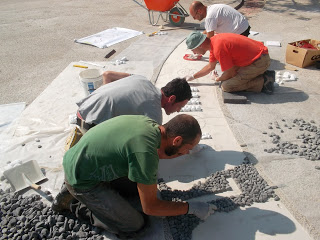
CHIAVARI, Italy – It was always the stones that fascinated me, those smooth, oval black and white stones used to create the beautiful pavement designs found in piazzas and gardens and in front of churches and other buildings here in Italy. Someone somewhere had culled those stones from the riverbeds and along the shores of the Mediterranean Sea. Someone somewhere had waded into the water and picked them up one by one, judged them perfect and carried them off.

Walking on Art
Up until World War II, stone culling was an industry In Vigevano, a small town south of Milan. Stone pickers would stand and scan the bottom of the nearby Ticino river for stones of a certain size and color. The best ones would be tossed into a small boat that they pulled along behind them.

Long before cars were invented and roads were paved the Ticino river stones were carried through the mountains and valleys of Lombardy in hand woven straw baskets tied to the backs of mules. They were used to decorate piazzas in towns as close as those on the Italian Riviera, and as far away as Venice. In the 14th century, a Venetian master craftsman discovered that by adding ground up white stones from the Ticino river to a soda ash solution, he was able to filter out the impurities in Venetian glass. The glassmakers of Murano rejoiced for that breakthrough launched the Venetian glassmaking industry, which is still going strong today.
 It Starts Like This
Here in Liguria they bought some stones from the Lombards, but they also collected them themselves. They used them to create amazingly beautiful stone carpets that added to the beauty of glorious baroque churches like the Basilica of Santa Margherita in Santa Margherita Ligure, and the Villa Durazzo, also in Santa Margherita Ligure.

The technique of creating these masterpieces in stone is called ‘risseu’ in Genovese, and it is a dying art. You have to admit we can all think of many other ways to spend our days than on our hands and knees pressing stones into wet cement to create complicated designs. You have to have had the fortune, or perhaps misfortune, of inheriting the ‘passion for art’ gene which was so prevalent in Italians in the past when those who had it made Italy one of the most beautiful countries in the world. Popular opinion that – not just my personal prejudice.

You Need Patience, Dedication and a Strong Back
But today things are different. Somehow the ‘passion for art’ gene mutated to become   the ‘passion for technology’ gene. Fortunately Luca Riggio e Luciano Bonzini are two Genovese who inherited the original gene and are now doing their best to keep the art of ‘risseu’ alive. Both men are artists and artisans who specialize in restoring old mosaics and stonework. A few years back Riggio merged his bottega with that of Bonzini’s. Their business is called Laboratorio Musivarius, and it is located in the historic center of Genova.  

It was their interest in old mosaics that led to them to trying their hand at the art of ‘risseu’, as the techniques are quite similar. They started with small pieces, little decorative ‘doormats’ of stone, but after they were hired to restore a ‘risseu’  at the 17th century Sanctuary of Madonnetta in Genova, they were hooked.

 The 'Risseu' at the Sanctuary of Madonnetta in Genova
In a recent interview with Il Secolo, Genova’s newspaper, Luciano Bonzini explained what happened. “It was so moving to work with that ‘risseu’”, he said, “to continue an art form that has been around for two thousand years, it was almost like meditation. It takes incredible patience to place one stone at a time in a particular order, often thousands of stones, and not lose your concentration. Just knowing that we were, in our small way, helping to keep a Ligurian tradition alive was very satisfying and we knew we wanted to work in this medium.”

About 15 years ago the Italian government passed a law against collecting stones from beaches. This somewhat insignificant law creates immense problems for Bonzini and Riggio. They could use river stones, like those from the Ticino river, but those stones are not part of Ligurian tradition, and both men are confirmed traditionalist. So when there are broken or missing stones in a work they are restoring, they have to ask for special permission to collect stones from the beaches of Liguria.

One Stone at a Time
But the real problem is the lack of protection not only for the works of stone art Bonzini and Riggio restore, but those found throughout Italy. While Italian law protects the pebbles on its beaches, it only protects ‘risseu’ that are near churches. Other ‘risseu’ are often abandoned or become parking lots, their historical value slowly destroyed by the daily to and fro of traffic.

One of their more interesting projects was a recent collaboration with German artist Ilona Lenk, winner of a design competition for the urban redevelopment of part of the campus of Tuebingen in Germany. Together they created a work that brought together applied art, poetry, architecture and the genius of traditional artistic Italian workmanship. It was a successful marriage of yesterday and today, and one that will stand the test of time.

Working on the Ilona Lenk Project in Germany
Most of the ‘risseu’ found in Liguria are done in black and white, a color combination that is carried out throughout the region in buildings, porticoes and churches. There are a few exceptions though, some ‘risseu’ are pink or reddish in color, but the black and white theme is much more prevalent. 

It’s pretty much impossible to rank which of the ‘risseu’ are the most beautiful. One particular example that would be on such a list, if such a list existed, is the 18th century church of Santa Croce in Moneglia, on the Ligurian coast. The church of Sant’Erasmo and the Villa Durazzo in Santa Margherita Ligure that I mentioned before would also be on that list. But truth be told, no matter where you are in Liguria, if you look around and poke around you are sure to discover a ‘risseu’ or two. They are everywhere.
 
 The Ilona Lenk Project


07 October 2012

LIFE: Somewhere Pretty


SARONNO, Italy – There are a lot of things I like about traveling by train. Most of all I like the idea of easing into a place rather than landing on it from out of the blue. Another thing I like are the people I meet, especially those from the United States who update me on what’s going on there. Somehow personal perspectives are different than newspaper and television reports, and very often a better indicator of the state of the country.
Chiavari - My Soon to Be New Hometown
For the past several months I have been looking for an apartment in Liguria, and on Friday  I had an appointment to see what I hoped would turn out to be my new house by the sea. To get there I had to take two trains.  The first train is one that comes to Saronno from Malpensa Airport and goes directly to Milan’s Central Train Station, so there are always travelers and tourists on that first train. Yesterday there were a large number of Argentinians, which is a little unusual. I think this is the first time I’ve seen travelers from Argentina in Milan, although rumor has it there is a fairly substantial Argentinian community here. 

On the second train, the one that goes from Milan to Chiavari, I ended up in a compartment with two ladies who at first said they were from New York, but as it turned out, they too were from Argentina, but live in New York now. They were interesting, they were friends, they both work and they decided they wanted to go somewhere ‘pretty’. So they were on their way to a posh hotel in Portofino. Portofino is, if nothing else, pretty. It’s right on the Mediterranean Sea, lush and tropical and just thinking about it makes me want to be there.
 Portofino, Italy
On the train home, my first conversation was with an adorable young guy from Aberdeen, Scotland.  He had come to Santa Margherita to see his mother, who had twisted her ankle and was now hopping along on crutches. The good news was that there were no broken bones and so he was returning home, and she was going to continue with her vacation. 

The first year I lived in Italy I took an Italian course offered by the University of Genoa at the Villa Durazzo in Santa Margherita. I was living in Genoa Nervi at the time, a 20 minute train ride away. I've spent a lot of time in Santa, as the locals call it, as it was the place we all seemed to go to on the weekends, either for dinner or shopping. There are several good restaurants and nice boutiques, and it's just a pretty place to be. 
 Villa Durazzo, Santa Margherita Ligure, Italy
On the second train I started talking to Barbara and Jesus, a couple from Orange, County California. They had been traveling in Italy for the past couple of weeks and had mapped themselves quite a vacation. In addition to Florence and Rome, they had spent some time on Lake Como. Given my complete dismay at the Como City Council, or whoever authorized the construction of the fence that totally blocks the view of the lake from the town of Como, I was anxious to hear what they thought of it. 

“Oh, it was lovely,” said Barbara.

“It was?” I said. “You did say Lake Como, right? And the fence? What did you think about that?”

“There was no fence where we were,” said her husband.

“There wasn’t? Where were you?”

“Varenna.”

“Ahh, Varenna. Now I understand why you didn’t see the fence. So, how is it you ended up in Varenna?” 

“We just wanted to go somewhere pretty.”
 Varenna (Lake Como), Italy
You know, sometimes I get so caught up in the day to day of living that I forget where I am and it takes people like the ones I met on Friday, who have traveled thousands of miles just to be here for a week or two, to remind me of that. Oh, and yes, I did take the apartment. Riviera Part Two is about to begin.