Showing posts with label Vigevano. Show all posts

14 July 2013

LIFE: Vigevano Redux


VIGEVANO, Italy - Call me a romantic fool but you gotta love a guy who builds (or rebuilds) himself a castle for his 40th birthday. It just goes to show what money and power can do. In this case, the money and the power was in the hands of the 15th century Duke of Milan, Ludovico Maria Sforza, known as il Moro, the Moor.

 Sforza Castel, Vigevano
The birthday castle is in Vigevano, a half hour train ride south of Milan. Vigevano is one of Italy’s quiet little cities of art, but today the piazza is buzzing with activity having been taken over by an Italian film crew. Waist high barricades have been set up around one end of the piazza to keep curious locals (and outsiders like me) from tripping over the heavy cables running from the equipment trucks to tall three-legged light poles.

“They’re filming a television commercial for a new Italian travel magazine,” says the woman standing next to me. “It’s about Vigevano.” She points at an old man dressed in a Renaissance costume who looks like he’s waiting to do something.
 
Renaissance Festa, Vigevano 
Ten minutes later the old man in the Renaissance costume is still waiting and so am I and since no one seems to be doing much of anything I walk across the black and white stone piazza and go up the stairs to the castle. At the top of the stairs I pass under a tall clock tower designed by Donato Bramante, architect to the court of il Moro.    

After passing under the clock tower, the first thing I see is a wide expanse of grass and across the way is the Duke’s castle, solid and massive and more fort like than fanciful. The castle is a massive structure, twice the size of Buckingham Palace, three times the size of St. Peter’s Basilica at the Vatican and six times the size of the Duomo of Milan.  From the beginning it was designed as both a military fortification and as a prestigious residence that would represent the power of the Visconti/Sfoza family. 
 Ludovico Maria Sforza, Duke of Milan

When the Duke summoned Bramante to his court he wanted the architect, who had just finished St. Peter's Basilica at the Vatican, to bring the 12th century Vigevano castle up to 15th century standards. What we see today is the result of Bramante's genius.

Part of Bramante’s renovation included a separate residence wing behind the main section of the castle for the Duke’s bride-to-be, Beatrice d’Este of Ferrara. Separate living quarters for royals were common in Renaissance Italy as there was no concept of romantic love between husband and wife. Beatrice, like most of the wealthy young women of her time, was considered a marriageable pawn and was used to create an alliance between the powerful Duke of Milan and Beatrice’s father, Ercole d'Este, the Duke of Ferrara.

Beatrice was only five years old when the Duke made the deal to marry her, and her dowry of four hundred thousand gold ducats, (valued at close to $1 million in pre-World War I dollars when the ducat was still a viable currency) no doubt sweetened the pot. Beatrice and the Duke were married in January of 1491. The bride was sixteen, the groom, thirty-nine.

Walking around the main part of the castle I pass through a tall arched door and find myself on a wide covered road that is 164 meters (538 feet) long and 7 meters (22 feet) wide. Above my head, mammoth wooden beams criss-cross the vaulted dome, and the road’s only light comes from the narrow windows placed close to the ceiling.  
Covered Road, Vigevano 
The road leads to what was once the outskirts of Vigevano and originally served as an escape route when the castle was under attack by outside forces, or when the citizens of Vigevano were in revolt. During World War II the Germans commandeered the castle for their headquarters and they used the road to drive their trucks and tanks from the outskirts of the town right into the castle compound. Pretty amazing when you consider the road was built by hand in 1345. It is still used daily by locals as a shortcut to get from one part of town to another. 

Across the grassy courtyard from the castle sits a long, low building that once housed the horses for the Duke’s army of 1000 mercenaries. It’s called the scudaria and it was designed by Leonardo da Vinci. Inside there are two long rows of evenly spaced marble columns that mark the edge of the stalls and flank a center foot path. 

 Leonardo da Vinci's Scudaria

To this day no one has been able to figure out how Leonardo managed to raise those massive columns all in one piece, something no one had ever been able to do. The only clue we have is the three round indentations, each about the size of a quarter, near the base of the columns. Some experts think they were made by a machine Leonardo invented specifically to raise the columns, but it’s only speculation.

With the Duke in residence Vigevano became a thriving commercial center. Twice a week a general market was held in the main piazza. Local farmers sold fruits and vegetables, poultry and pigs and merchants sold the wool and silk produced in and around Vigevano. Public executions were held there as well.

If you were condemned for sodomy, the most serious crime of the day, you were burned at the stake. The wood for the fire was carried in from the nearby woods by harlots who were then themselves publicly charged with the lesser crime of prostitution, and hanged. And while they waited for the executions to begin the locals shopped, visited with neighbors and caught up on the latest gossip. Locals still shop at the weekly market in the piazza, the hangings however, have been discontinued.

The Duke considered Vigevano an example of Leonardo’s “ideal” city and there are many similarities between the sketches found in Leonardo’s Atlantic Codex and the Vigevano castle and piazza. Apart from the visual perfection of the piazza, there are two things that stand out. The first is the shape of the chimneys you can see on the top of the buildings. Each chimney represents a city conquered by the Visconti/Sforza families. The shapes of the chimneys represent the towers found in those cities, and many of those towers are still standing today. The other thing that stands out are the black and white stones under your feet. They are a local industry.
 Sforza Conquests
The stones come from the nearby Ticino River where stone collectors, wearing thigh high rubber boots, still wade into the water and scan the bottom for stones of a certain size and color. They put the best ones into a small boat they pull along behind them as they work.

At one time the stones were carried in hand woven straw baskets tied to the backs of mules through the mountains and valleys of northern Italy. They were used to decorate piazzas in towns as close Genoa and as far away as Venice.
Aperitivo Time in Vigevano 
In the 14th century a Venetian craftsman discovered that by adding ground up white pebbles from the Ticino River to a soda ash solution he was able to filter out the impurities in Venetian glass. The glassmakers of Murano rejoiced for that breakthrough launched the Venetian glassmaking industry which is still thriving today, more than 500 years later.

If you are lucky enough to find yourself in Vigevano some warm afternoon this summer, sit back and relax with a leisurely aperitif at one of the cafes that ring the piazza. You won’t feel lonely for you’ll be in the company of generations of Vigevanesi, and along with them you’ll be having a different kind of Italian experience, one not found in any guide book – but the experience of the Italy Italians enjoy.

This article was first published on this blog on 17 January 2010.

05 May 2013

LIFE: In Black and White


CHIAVARI, Italy – It was always the stones that fascinated me, those smooth, oval black and white stones used to create the beautiful pavement designs found in piazzas and gardens and in front of churches and other buildings here in Italy. Someone somewhere had culled those stones from the riverbeds and along the shores of the Mediterranean Sea. Someone somewhere had waded into the water and picked them up one by one, judged them perfect and carried them off.

Walking on Art
Up until World War II, stone culling was an industry In Vigevano, a small town south of Milan. Stone pickers would stand and scan the bottom of the nearby Ticino river for stones of a certain size and color. The best ones would be tossed into a small boat that they pulled along behind them.

Long before cars were invented and roads were paved the Ticino river stones were carried through the mountains and valleys of Lombardy in hand woven straw baskets tied to the backs of mules. They were used to decorate piazzas in towns as close as those on the Italian Riviera, and as far away as Venice. In the 14th century, a Venetian master craftsman discovered that by adding ground up white stones from the Ticino river to a soda ash solution, he was able to filter out the impurities in Venetian glass. The glassmakers of Murano rejoiced for that breakthrough launched the Venetian glassmaking industry, which is still going strong today.
 It Starts Like This
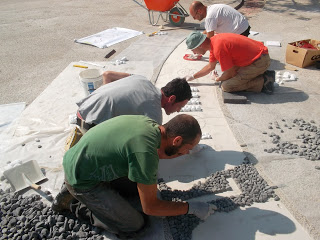
Here in Liguria they bought some stones from the Lombards, but they also collected them themselves. They used them to create amazingly beautiful stone carpets that added to the beauty of glorious baroque churches like the Basilica of Santa Margherita in Santa Margherita Ligure, and the Villa Durazzo, also in Santa Margherita Ligure.

The technique of creating these masterpieces in stone is called ‘risseu’ in Genovese, and it is a dying art. You have to admit we can all think of many other ways to spend our days than on our hands and knees pressing stones into wet cement to create complicated designs. You have to have had the fortune, or perhaps misfortune, of inheriting the ‘passion for art’ gene which was so prevalent in Italians in the past when those who had it made Italy one of the most beautiful countries in the world. Popular opinion that – not just my personal prejudice.

You Need Patience, Dedication and a Strong Back
But today things are different. Somehow the ‘passion for art’ gene mutated to become   the ‘passion for technology’ gene. Fortunately Luca Riggio e Luciano Bonzini are two Genovese who inherited the original gene and are now doing their best to keep the art of ‘risseu’ alive. Both men are artists and artisans who specialize in restoring old mosaics and stonework. A few years back Riggio merged his bottega with that of Bonzini’s. Their business is called Laboratorio Musivarius, and it is located in the historic center of Genova.  

It was their interest in old mosaics that led to them to trying their hand at the art of ‘risseu’, as the techniques are quite similar. They started with small pieces, little decorative ‘doormats’ of stone, but after they were hired to restore a ‘risseu’  at the 17th century Sanctuary of Madonnetta in Genova, they were hooked.

 The 'Risseu' at the Sanctuary of Madonnetta in Genova
In a recent interview with Il Secolo, Genova’s newspaper, Luciano Bonzini explained what happened. “It was so moving to work with that ‘risseu’”, he said, “to continue an art form that has been around for two thousand years, it was almost like meditation. It takes incredible patience to place one stone at a time in a particular order, often thousands of stones, and not lose your concentration. Just knowing that we were, in our small way, helping to keep a Ligurian tradition alive was very satisfying and we knew we wanted to work in this medium.”

About 15 years ago the Italian government passed a law against collecting stones from beaches. This somewhat insignificant law creates immense problems for Bonzini and Riggio. They could use river stones, like those from the Ticino river, but those stones are not part of Ligurian tradition, and both men are confirmed traditionalist. So when there are broken or missing stones in a work they are restoring, they have to ask for special permission to collect stones from the beaches of Liguria.

One Stone at a Time
But the real problem is the lack of protection not only for the works of stone art Bonzini and Riggio restore, but those found throughout Italy. While Italian law protects the pebbles on its beaches, it only protects ‘risseu’ that are near churches. Other ‘risseu’ are often abandoned or become parking lots, their historical value slowly destroyed by the daily to and fro of traffic.

One of their more interesting projects was a recent collaboration with German artist Ilona Lenk, winner of a design competition for the urban redevelopment of part of the campus of Tuebingen in Germany. Together they created a work that brought together applied art, poetry, architecture and the genius of traditional artistic Italian workmanship. It was a successful marriage of yesterday and today, and one that will stand the test of time.

Working on the Ilona Lenk Project in Germany
Most of the ‘risseu’ found in Liguria are done in black and white, a color combination that is carried out throughout the region in buildings, porticoes and churches. There are a few exceptions though, some ‘risseu’ are pink or reddish in color, but the black and white theme is much more prevalent. 

It’s pretty much impossible to rank which of the ‘risseu’ are the most beautiful. One particular example that would be on such a list, if such a list existed, is the 18th century church of Santa Croce in Moneglia, on the Ligurian coast. The church of Sant’Erasmo and the Villa Durazzo in Santa Margherita Ligure that I mentioned before would also be on that list. But truth be told, no matter where you are in Liguria, if you look around and poke around you are sure to discover a ‘risseu’ or two. They are everywhere.
 
 The Ilona Lenk Project


28 January 2010

Auntie Pasta - Rice is Nice


SARONNO, Italy –There is an advertisement for an exhibit of Leonardo da Vinci’s inventions playing on the message board down at the Saronno train station. The exhibit is being held at the Castle in Vigevano and will be there until 5 April 2010. What are on display are the things he invented in the late 1400’s when he was working for Ludovico il Moro, the Duke of Milan.

Some of the things he invented were truly fantastic: flying machines, tanks, submarines, cranes, tanks and even robots. So what does this have to do with food? Actually a lot. One of the things that Leonardo designed was a hinged watertight gate, a flood gate that became part of the canal system he designed to irrigate the flat fields of northern Italy which belonged to the Duke of Milan. And then they planted rice.

Today, more than 500 years later, they still grow rice in Lombardy. There are more than a dozen varieties of rice produced here, and frankly it can be a bit overwhelming for an ex-Uncle Ben-er like me. But I ask, and the Italian Mamma’s are always ready to help out. They seem to know a lot about rice.

In a publicity photos for the 1949 Italian movie Bitter Rice, the story of a young woman who works in the rice paddies of Lombardy, a buxom Silvana Mangano is shown standing in a flooded rice field wearing tight shorts and torn black stockings, her hair falling over smoldering dark eyes. She looks sexy and you might get the impression that picking rice was a romantic thing to do.

In reality, the women who worked in the rice fields didn’t have much time to think about looking sexy as they were constantly being assaulted - both above and below the water line. From above, the hot summer sun beat down on their heads while swarms of mosquitoes buzzed around them in a feeding frenzy. From below, snakes of all sizes, lizards and slippery green frogs slithered through their legs.

In the film and in real life, the women were migrant workers traveling by bus from one rice cooperative to another. They slept in specially built dormitories, spending months planting, weeding and harvesting rice. They worked in rows, moving backwards, controlled by an overseer who sat high on a chair like a tennis umpire. When the women got close to the end of a field, the overseer would call out and some of them would move in order to leave a space for the little critters (which had been driven back as the women progressed down the field) to escape. They said the water churned like it was boiling as the frogs and snakes desperately scrambled to find a way out.

On days like today, when it’s foggy and gray and I’m in my cozy kitchen stirring up a fragrant saffron gold risotto Milanese for lunch, I think about Leonardo. I hope he knows the systems he created and the canals he laid out to irrigate those rice paddies are still in use. And I think about those women who traveled from rice paddy to rice paddy and made Italy what it is today, the largest rice producer in Europe.

It wasn’t until after World War II that they mechanized the rice fields and the women went home, got married and became respectable Signoras. Actually it wouldn’t surprise me if they were the same women I run into in the grocery store, the very same ones who seem to know an awful lot about rice.

Photo: Risotto alla Milanese; Silvano Mangano
And thanks to the reader who sent this link to the exhibit: www.leoanardoevigevano.it

17 January 2010

On The Road - Vigevano

This post is the beginning of a series of monthly travel articles inspired by a recent New York Times article on 31 places to see in 2010. Most of the towns are small, all are rich in history and art and for the most part they are off the beaten track which, for me, makes them all the more interesting.


VIGEVANO, Italy - Call me a romantic fool but you gotta love a guy who builds (or rebuilds) himself a castle for his 40th birthday. It just goes to show what money and power can do. In this case the money and the power was in the hands of the 15th century Duke of Milan, Ludovico Maria Sforza, known as il Moro, the Moor.

The birthday castle is in Vigevano, a half hour train ride from Milan. The town is usually quiet but today the main piazza is buzzing with activity having been taken over by an Italian film crew.

“They’re filming a television commercial for a new Italian travel magazine,” says the woman standing next to me. “It’s about Vigevano,” she says pointing to an old man dressed in a Renaissance costume.

Ten minutes later nothing much is happening so I walk across the black and white stone piazza and go up the stairs that are under a tall clock tower designed by Donato Bramante. At the top there is a wide expanse of grass and across the way is the brick castle, solid and massive and more fort like than fanciful. The Duke hired Bramante, who had just finished St. Peter's Basilica at the Vatican, to bring the 12th century Vigevano castle up to 15th century standards. What you see today is the result of Bramante's genius.

Part of the renovation included a separate residence wing behind the main section of the castle for the Duke’s bride-to-be, Beatrice d’Este of Ferrara. Separate quarters were normal as there was no concept of romantic love between husband and wife during the Renaissance. Beatrice, like most wealthy young women of her time, was no more than a marriageable pawn used to create alliances between powerful families.

She was only five years old when the Duke made the deal to marry her, and her dowry of four hundred thousand gold ducats, (valued at close to $1 million in pre-World War I dollars when the ducat was still a viable currency) no doubt sweetened the pot. Beatrice and the Duke were married in January of 1491. The bride was sixteen, the groom, thirty-nine.

Walking around the main part of the castle I go through a tall arched door and find myself on a wide covered road. Above my head, mammoth wooden beams criss-cross the vaulted dome, and the only light comes from the narrow windows placed close to the ceiling.

During World War II when the Germans commandeered the castle to use as their headquarters, they used this road to drive their trucks and tanks right into the castle compound. Pretty amazing when you consider the road was built by hand in 1345. It is still used daily by locals as a shortcut through town.

Across the grassy courtyard from the castle sits a long, low building that once housed the horses for the Duke’s army of 1000 mercenaries. It was designed by Leonardo da Vinci. Inside, there are two long rows of evenly spaced marble columns that mark the edge of the stalls and flank a center foot path.


To this day no one has been able to figure out how Leonardo managed to raise those massive columns all in one piece. It had never been done before. The only clue is the three round indentations, each about the size of a quarter, near the base of the columns. Some experts think they were made by a machine Leonardo invented specifically for the task. But it’s only speculation.

With the Duke in residence Vigevano became a thriving commercial center. Twice a week a general market was held in the main piazza. Local farmers sold fruits and vegetables, poultry and pigs and merchants sold the wool and silk produced in and around Vigevano. Public executions were held there as well.

If you were condemned for sodomy, the most serious crime of the day, you were burned at the stake. The wood for the fire was carried in from the nearby woods by harlots who were then publicly charged with the lesser crime of prostitution, and hanged. And while they waited for the executions to begin the locals shopped, visited with neighbors and caught up on the latest gossip. Locals still shop at the weekly market, the hangings however, have been discontinued.

The Duke considered Vigevano an example of Leonard’s “ideal” city and there are many similarities between the sketches found in Leonardo’s Atlantic Codex and the Vigevano castle and piazza. Apart from the visual perfection of the piazza, two things that stand out are the oddly shaped chimneys, which are merely decorative, and the black and white stones under your feet, which are a local industry.

The stones come from the nearby Ticino River where stone collectors, wearing thigh high rubber boots, wade into the water and scan the bottom for stones of a certain size and color. They put the best ones into a small boat they pull along behind them as they work.

The stones were once carried in hand woven straw baskets tied to the backs of mules through the mountains and valleys of northern Italy to decorate piazzas in towns as close Genoa and as far away as Venice. In the 14th century, a Venetian craftsman discovered that by adding ground up white pebbles from the Ticino River to a soda ash solution he was able to filter out the impurities in Venetian glass. The glassmakers of Murano rejoiced for that breakthrough launched the Venetian glassmaking industry.

An afternoon visit to the castle, a leisurely aperitif under the porticos that ring the piazza, will put you in the company of generations of Vigevanesi. It’s a different kind of Italian experience not found in any guide book. It’s the quiet discovery of the Italy Italians enjoy.


Photos: (1) A corner of Vigevano's Main Piazza; (2) Bramante’s Tower; (3)Leonardo da Vinci's Stable; (4) Collecting Stones One by One

p.s. At the Vigevano Castle: Leonardo da Vinci's output during his time in Lombardy; 'virtual codex' on flying, botany, mathematics, weaponry, astronomy, engineering and architecture; until April 5.