CHIAVARI, Italy – Went to an artisan slash food
fair on Saturday up in Val Fontanabuona, a rather long valley in the Apennine
Mountains behind Chiavari. The artisan pavilion had some really nice things
including handmade furniture, jewelry and textiles including a beautiful white
100% cotton bedspread that I could kick myself for not buying. But, as usual,
my focus was on food.
 |
| Hello, My Pretty |
Like Chiavari’s monthly Mercato di Sapori,
the food exhibitors were primarily food producers from Liguria and regions
nearby, but I’ve never seen food like this. The first thing I spotted was a
full size stuffed boar standing on a mound of smoked wild boar meat (cinghiale),
donkey (asino) sausage and smoked deer meat (cervo). Cinghiale wandered through Italy’s
dark woods and rough, piney mountains long before the Etruscans were here. They
are the oldest of the old and much respected as Pietro Tacca’s famous 17th
century bronze sculpture of a boar, Il Porcellino, in Florence’s Mercato Nuovo
shows. They are also very tasty.
Just around the corner there were a couple of
cute guys in gray tee shirts standing behind a counter piled high with salami
and specialty meats from Tuscany, Prato to be exact. The gray tee shirts had been
carefully chosen to match their primary product which was prosciutto cured in
ashes. The technique of curing ham in ashes slows down the curing process producing
a sweeter, more tender product.
 |
| What We Have Here is Something Really Special |
Now there are two types of prosciutto in Italy.
One is prosciutto cotto, which is known as boiled ham in the States, but
since it is cured and not boiled here in Italy, it is just called cooked ham.
 |
| Well Look Who's Here |
The second type is prosciutto crudo,
which is known as prosciutto in the States, and that prosciutto is the type of
cured ham most often paired with cantaloupe. Prosciutto crudo has been
made in Italy for a very long time, about two thousand years, and its
production is tightly controlled. Don’t let the word crudo fool you
though. This ham is meant to be eaten as is, for it isn’t really raw, which is
what crudo means in Italian, but cured, like lox.
 |
| The Boss was in Charge of the Prosciutto Cured in Ashes |
They were also selling porchetta – roast
pork that was so delicious I’m still dreaming about it, as well as mortadella
di Prato, an ancient product which was first produced in the 16th
century. It sort of got lost over time but now, thanks to the Slow Food’s
efforts to revive Italy’s food treasures, it is back on the market.
 |
| Mushrooms? We've Got a Few |
Across the way from the cute guys, the mushroom
lady was standing behind the largest display of dried porcini mushrooms I have
ever seen. But they were not what caught my eye. Next to the barrels of olives,
which she was also selling, I spotted a barrel of garlic that had been peeled
and flavored with spices.
 |
| Spicy Garlic |
Next to the garlic there was a barrel of lampascioni,
which look like small onions but are actually wild hyacinth bulbs. They are part
of the traditional cuisine of Calabria, Basilicata and Puglia where they stew
them in a little oil with thyme, oregano, hot red pepper and salt, or fry them
and then lightly crush them with the back of a fork and mix with beaten eggs
for a lampascioni frittata.
 |
| Lampascioni |
One stand offered homemade orrechetti and
taralli from Puglia, another had sheep’s milk ricotta and goat
salame, and at another stand a father and his two teenage daughters were
selling really delicious tomato marmalade and other jams and jelly that his
wife makes.
Being surrounded by all that food was making
everyone hungry and the restaurants and stands were doing a bang up business.
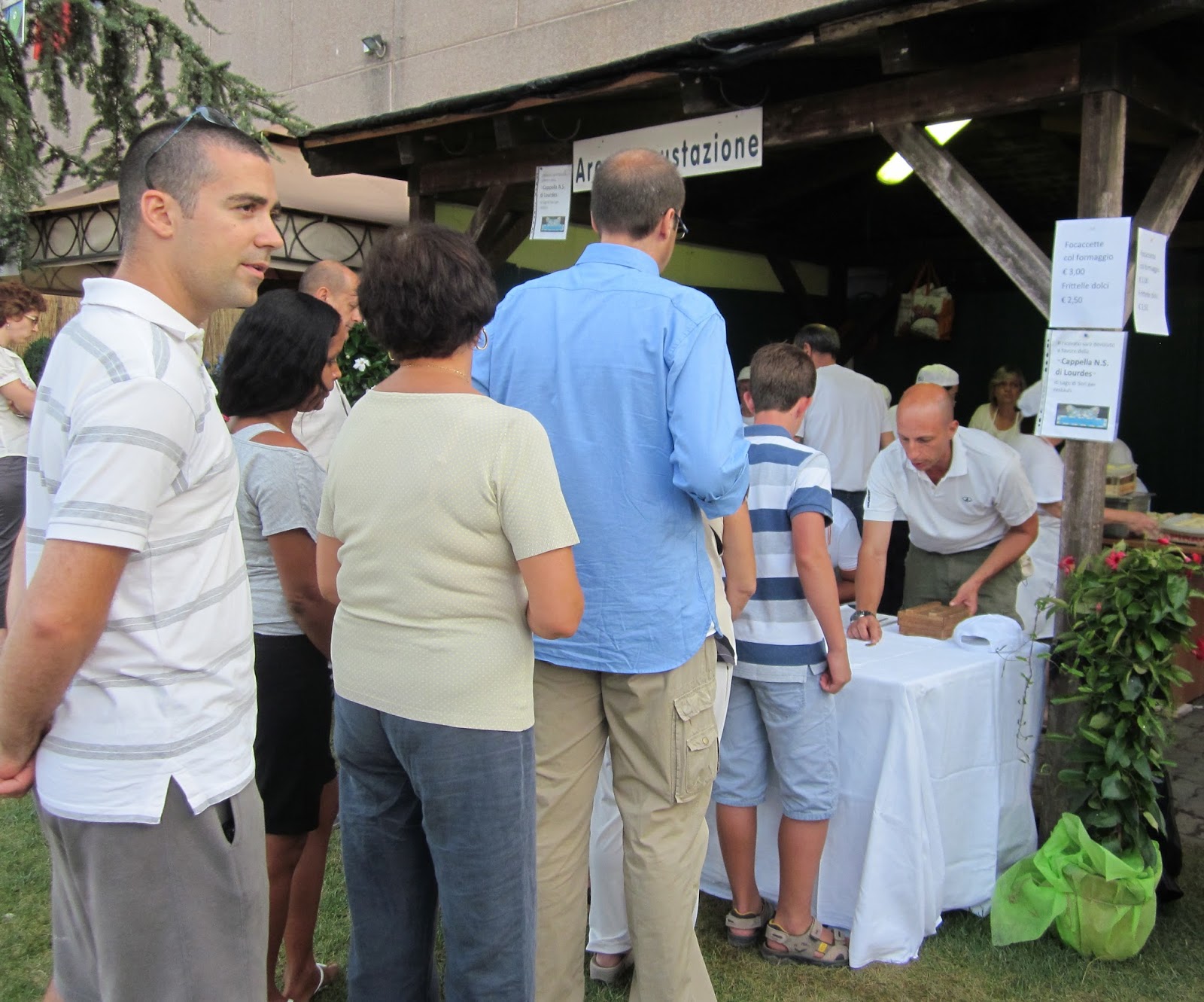
The last time I looked, the stand selling focacette with cheese and frittelle
dolci was under attack and the ladies rolling and filling the focacette
– which are little focaccia – were rolling and filling and baking them
as fast as they could.
 |
| Busy Hands are Happy Hands |
Focaccia, which is usually
associated with Genovese cuisine, is actually made throughout Italy, and has been
since the days of the Etruscans. You may not always recognize it as focaccia
because the shape is often different and it is called by different names. The
name focaccia originated with the bread the marble workers in Carrara
ate back in the days when Michelangelo would go to Carrara to choose marble for
his statues. It was called focaccia di cavatore back then, the cavatore
being the quarry workers.
 |
| Worth Waiting For |
In Naples focaccia is shaped like a ring
and called tortana, and in Venice it’s sweet and it is called fugassa,
which is similar to fougasse, which is what you would call it if you
were French. Here in Chiavari it is just plain old delicious melt in your mouth
focaccia, which is just fine with me.
 |
| Would Someone Take That Sign Down - Please? |
Ahh this Italian food, it is a wonder unto
itself and it keeps me, and the rest of the world, under its spell. And for you
food wonks out there, you might be interested to know that the country Italy
exports the largest amount of its food products to is France.


