Showing posts with label porcini mushrooms. Show all posts

05 September 2013

AUNTIE PASTA: Val' Fontanabuona


CHIAVARI, Italy – Went to an artisan slash food fair on Saturday up in Val Fontanabuona, a rather long valley in the Apennine Mountains behind Chiavari. The artisan pavilion had some really nice things including handmade furniture, jewelry and textiles including a beautiful white 100% cotton bedspread that I could kick myself for not buying. But, as usual, my focus was on food.
 Hello, My Pretty
Like Chiavari’s monthly Mercato di Sapori, the food exhibitors were primarily food producers from Liguria and regions nearby, but I’ve never seen food like this. The first thing I spotted was a full size stuffed boar standing on a mound of smoked wild boar meat (cinghiale), donkey (asino) sausage and smoked deer meat (cervo). Cinghiale wandered through Italy’s dark woods and rough, piney mountains long before the Etruscans were here. They are the oldest of the old and much respected as Pietro Tacca’s famous 17th century bronze sculpture of a boar, Il Porcellino, in Florence’s Mercato Nuovo shows. They are also very tasty.

Just around the corner there were a couple of cute guys in gray tee shirts standing behind a counter piled high with salami and specialty meats from Tuscany, Prato to be exact. The gray tee shirts had been carefully chosen to match their primary product which was prosciutto cured in ashes. The technique of curing ham in ashes slows down the curing process producing a sweeter, more tender product.
 What We Have Here is Something Really Special
Now there are two types of prosciutto in Italy. One is prosciutto cotto, which is known as boiled ham in the States, but since it is cured and not boiled here in Italy, it is just called cooked ham.
 
 Well Look Who's Here
The second type is prosciutto crudo, which is known as prosciutto in the States, and that prosciutto is the type of cured ham most often paired with cantaloupe. Prosciutto crudo has been made in Italy for a very long time, about two thousand years, and its production is tightly controlled. Don’t let the word crudo fool you though. This ham is meant to be eaten as is, for it isn’t really raw, which is what crudo means in Italian, but cured, like lox.
 
 The Boss was in Charge of the Prosciutto Cured in Ashes
They were also selling porchetta – roast pork that was so delicious I’m still dreaming about it, as well as mortadella di Prato, an ancient product which was first produced in the 16th century. It sort of got lost over time but now, thanks to the Slow Food’s efforts to revive Italy’s food treasures, it is back on the market.
 
Mushrooms? We've Got a Few

Across the way from the cute guys, the mushroom lady was standing behind the largest display of dried porcini mushrooms I have ever seen. But they were not what caught my eye. Next to the barrels of olives, which she was also selling, I spotted a barrel of garlic that had been peeled and flavored with spices.
 
 Spicy Garlic
Next to the garlic there was a barrel of lampascioni, which look like small onions but are actually wild hyacinth bulbs. They are part of the traditional cuisine of Calabria, Basilicata and Puglia where they stew them in a little oil with thyme, oregano, hot red pepper and salt, or fry them and then lightly crush them with the back of a fork and mix with beaten eggs for a lampascioni frittata.
 Lampascioni
One stand offered homemade orrechetti and taralli from Puglia, another had sheep’s milk ricotta and goat salame, and at another stand a father and his two teenage daughters were selling really delicious tomato marmalade and other jams and jelly that his wife makes.

Being surrounded by all that food was making everyone hungry and the restaurants and stands were doing a bang up business. The last time I looked, the stand selling focacette with cheese and frittelle dolci was under attack and the ladies rolling and filling the focacette – which are little focaccia – were rolling and filling and baking them as fast as they could. 

 Busy Hands are Happy Hands
Focaccia, which is usually associated with Genovese cuisine, is actually made throughout Italy, and has been since the days of the Etruscans. You may not always recognize it as focaccia because the shape is often different and it is called by different names. The name focaccia originated with the bread the marble workers in Carrara ate back in the days when Michelangelo would go to Carrara to choose marble for his statues. It was called focaccia di cavatore back then, the cavatore being the quarry workers. 
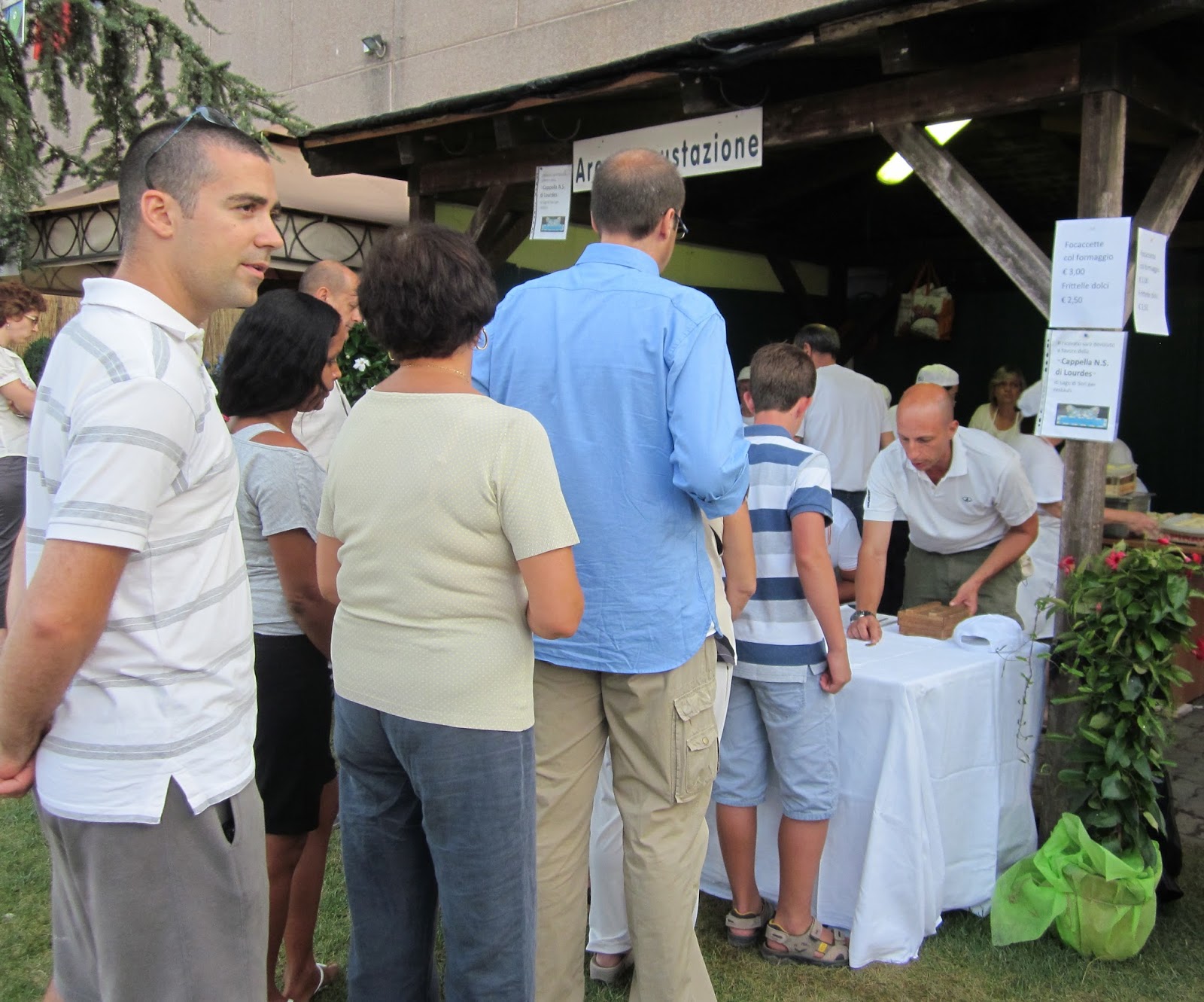
 
 Worth Waiting For
In Naples focaccia is shaped like a ring and called tortana, and in Venice it’s sweet and it is called fugassa, which is similar to fougasse, which is what you would call it if you were French. Here in Chiavari it is just plain old delicious melt in your mouth focaccia, which is just fine with me.
 Would Someone Take That Sign Down - Please?
 Ahh this Italian food, it is a wonder unto itself and it keeps me, and the rest of the world, under its spell. And for you food wonks out there, you might be interested to know that the country Italy exports the largest amount of its food products to is France.

13 September 2012

AUNTIE PASTA: Where the Wild Things Grow


SARONNO, Italy – There’s a real crisis in Italy these days, at least in northern Italy, and it doesn’t have anything to do with the economy. It’s a culinary crisis. There are no local mushrooms. At one daily outdoor vegetable market in Liguria, there was only one stand selling mushrooms at a time when there should be mushrooms at every stand.
 Typical Italian Vegetable Market
The culprit responsible for the crisis is the weather, or to be more specific, the lack of rain.  At this point in the mushroom season, the danger of little rain and a lot of wind, which is typical at the end of the summer, would destroy any hope of a decent crop of Italians mushrooms this year, especially porcini mushrooms.  In Chiavari, a seaside town along the Italian Riviera, the few mushrooms that are for sale are coming from Romania and Croatia, and, according to local housewives, they are very expensive, selling at 25 to 35 euros a kilo ($35 US to $45US a kilo).
 Delicious Porcini Mushrooms
The long, scorching hot and fiery summer, which was described in the local newspapers as ‘a flick of the Lucifer’s tail’, will make itself felt right through the fall and winter. It’s not just local mushrooms, including porcini mushrooms, that are in danger, but also chestnuts and truffles. Mushrooms need moist soil, occasional rain and temperatures in the high 60’s in the forests, something Liguria and the rest of northern Italy has not seen this year.  According to Coldiretti, the national association of farmers, more than 10 million hectares (25,000 acres) of forest covering a third of Italy can produce about 30 tons of mushrooms of various types, including porcini and chanterelles.
 Boxes of Mushrooms 
So we wait to see if the cooler weather will bring the showers we usually see in April. For those of you who live in an area where mushrooms are plentiful this season, here’s an easy recipe that I found on a food blog that is sponsored by Tiscali, an Italian telephone company based in Sardinia. You can check it out at ilcucchiaiodoro.blog.tiscali.it/  Unfortunately, when I tried to find the beef roll recipe page again, I wasn’t successful, but the recipe is easy enough to follow as almost all Italian recipes that involve wrapping a cutlet of meat around a filling are cooked the same way.

Beef Rolls with Porcini Mushrooms

Ingredients (for 2 servings)

2 slices of beef cutlet steaks (not roast beef)
2 long slices of prosciutto crudo
4 slices of scamorza cheese
100 grams of mushrooms
½ glass of white wine (more or less equal to ½ cup)
½ glass of vegetable broth (same amount as the wine)
2 tablespoons of flour 
Extra-virgin olive oil for frying

Preparation
 Cover each beef cutlet with 1 slice of prosciutto crudo and 2 slices of scamorza cheese


Roll up each cutlet and tie with kitchen string.


Roll each cutlet in  flour


Carefully clean and slice the mushrooms. Warm the olive oil in a saute’ pan and add the mushrooms, and the beef rolls. Let cook for a few minutes, turn and let the other side cook for a minute or two, then add the white wine and as soon as it evaporates, add a ladle of broth and let the meat simmer on a low heat for about ten minutes, adding more broth if needed. 


Nothing left to do but eat and enjoy. 

They didn't say this in the recipe but a sprinkle of fresh, finely chopped parsley and a drizzle of good quality extra-virgin olive oil, Italian of course, would really give this dish a nice finish. 

12 October 2011

AUNTIE PASTA: Fungo Festa

SARONNO, Italy - October is mushroom month in Italy. A variety of wild mushrooms, most of them gathered locally, have started showing up in the weekly outdoor food markets. If you have never cooked fresh, wild mushrooms, you are in for a real treat, for the difference in taste between cultivated mushrooms and freshly picked wild ones is enormous.
Funghi Porcini
Going hunting for funghi di bosco (woodland mushrooms) or funghi selvatici (wild mushrooms) is one of the joys of the season. There is something very satisfying about picking your own food from the wild. I still remember how much fun it was to go blueberry picking in the woods with my Aunt Florence and my Aunt Adele when I was a kid. No matter that we got home exhausted, scratched and bleeding, the buckets of blueberries we collected made it all worthwhile. I imagine going mushroom hunting must be a lot like that, but without the bramble bushes.   

The downside of picking wild mushrooms is that you really have to know what mushrooms to pick and which to leave behind. Even a small taste of some types  can make you deathly ill, or in some cases deathly dead. Almost all small towns in the mushroom picking areas of Italy, like Giaveno, up near Torino in the Province of Piedmonte, have experts who can help you separate the good from the bad. Even here in Saronno there is a mushroom “club”, I think it’s called Amici di Funghi, that you can turn to to check your pickings.
Fungo Festa in Gaiveno (Piedmont)
These days you need a permit to gather mushrooms and there are strict limits on the amount you are allowed to pick. In addition, it is essential to use a straw basket to hold the mushrooms you are gathering. The porous construction of wicker baskets allows the mushroom spores from the collected mushrooms to fall to the ground and insures their continued reproduction for the following season. The easiest way to prepare wild mushrooms, or any mushrooms for that matter, is to saute’ or braise them in olive oil, garlic, white wine and chopped parsley. Mushrooms prepared this way are called funghi trifolati and can be served with any kind of mean, including game, or served with polenta, pasta or risotto.

Clean, cut porcini, heat garlic, butter and olive oil
Cut and slice the rest of the mushrooms
  Cook over high heat, add wine, then parsley

During mushroom season many restaurants offer grilled porcini mushrooms. It’s easy to grill porcini, especially the large ones which can be as big as a small steak. Large or small, it’s also a good idea to cook them, all types of mushrooms actually, as soon as possible as fresh mushrooms don’t hold up well. As mushrooms are extremely porous they shouldn’t be washed. Just cut the dirt off the bottom of the stem and wipe the cap with a dry paper towel. Because they are so porous, they should be cooked over a medium high flame and not on a low flame in order to reduce the amount of liquid they shed. 

 Hmmm good
When you buy dried porcini or other dried mushrooms, look for a natural and healthy color—avoid those that look too dark or have an artificial-looking color. If possible, choose bags full of sliced tops (caps), which are the tastiest part of the mushroom. Don’t buy them if they look old, are broken apart or, even worse, almost pulverized. Spend a little more and get the best quality—it’s definitely worth it.

22 April 2010

AUNTIE PASTA: Porta Palazzo Market

TURIN, Italy – With the sky still an early morning pink, crates of dark purple eggplant, yellow pears and fragrant fennel are stacked willy nilly, cluttering the streets as fruit and vegetable vendors at Turin’s great food market, Porta Palazzo set up their market stalls for the day. Brawny butchers in white coats and blood stained aprons pull large beef hindquarters and pork carcasses from rumbling refrigerated trucks and carry them to their market stalls in the immense glass and wrought iron building nearby.

But even before the butchers start to sharpen their knives and price cards are stuck into the produce boxes, local chefs are on the prowl, menu ideas running through their minds. How many crates of Swiss chard do you have? Never mind, how about the beets, will you have more tomorrow? The day’s menu depends on what they choose. The only thing certain is that the food they’ll prepare is unlike any you have ever eaten in Italy.

Chef Roberto Donna of Washington, D.C. knows first-hand how creative the chefs in his hometown can be. He’ll tell you that with such incredibly voluptuous and seductive ingredients as white truffles, porcini mushrooms, Piedmont beef, fresh brook trout, and an abundance of game, and locals are ever really surprised when first time visitors can barely keep from swooning at the dinner table.

Turinese cuisine is unlike the food in any other part of Italy. Local dishes incorporate a much larger variety of savory sauces which are more traditional in French cuisine than in Italian. And chefs tend to reach for butter and lard rather than olive oil, which is also more French than Italian. Olive oil has only been used in local cooking since the 1950’s when it was brought north by southern Italians who immigrated to Turin to work in the automobile industry.

Another difference is that appetizers play a much larger role here than in other parts of Italy, both in the size of the portions and in their sheer creativity. In Chef Donna’s definitive cookbook, ‘Cooking in Piedmont’, he offers twenty-six recipes for appetizers including such non-appetizer sounding dishes as rabbit salad, stuffed roasted peppers, veal tongue in a spicy red sauce, a duck liver flan and spicy polenta served with fried quail eggs.

Probably the best known Piedmontese appetizers are bagna caoda –literally a hot bath -of oil, garlic, anchovies and butter served as a dipping sauce for winter vegetables, and fonduta (from the French fondre, to melt) a fondue of creamy Fontina cheese flavored with white truffles. Truffles are used extensively in Turinese cooking, and when they are in season – between November and February – they are generously showered over just about everything.

Two of Turin’s most popular pasta dishes are tajarin, golden egg noodles served with melted butter and a shaving of white truffles, and Chef Donna’s favorite, ravioli del plin, (del plin means to pinch in Turinese dialect) which are often served with a reduced veal stock and a delicate veil of grated parmesan cheese. It is interesting that the Turinese prefer fresh egg pastas, rather than pastasciutta, dried pasta, that is so popular throughout the rest of Italy.

The best rice in Italy, some say the world, grows in the wide flat lands between Milan and Turin so in addition to pasta you may find a rich and creamy risotto, rice served with meat sauce, and/or a rice and chick pea dish on the menu. Other non-pasta choices are chestnut flour gnocchi served with a cheese sauce called fonduta di Castelmagno (Castelmagno is a town southwest of Turin famous for its cheese), and baccalĂ  (salted cod), served with saffron flavored polenta. And then, as the Italians say, Coraggio! – Courage! It’s time to move on to the main course.

The city’s signature dish is bollito misto, a mix of boiled meats served with three sauces: bagnet verd, or green sauce made from parsely, anchovies, garlic and olive oil; bagnet ross, a red sauce of crushed tomatoes, garlic and hot peppers, and saussa d’avije, a yellow mustard sauce sweetened with honey and crushed nuts.

In the past, traditionalists insisted that bollito misto contain seven vegetables, seven types of meat, and seven types of ornamenti, i.e. tongues, tails and dangly bits, but today the more exotic dangly bits are slowly being eased out. You'll find bollito misto on the menu at least once a week in most Turin restaurants. The boiled meats are served from a rolling stainless steel cart and each type of meat is kept warm in its own broth filled compartment. If you are squeamish about eating dangly bits you can ask for only the meats that you want.

Other classic Piedmontese dishes include brasato al Barolo, Piedmont beef slowly braised in Barolo wine, and finanziera, a stew of cock’s crests, chicken livers, veal, peas and porcini mushrooms. In the fall and winter you’ll find venison, roe deer (a small European deer), quail and even tagliata di renna, slices of reindeer meat, on some menus along with beef and veal, free range poultry and freshly caught fish instead of fish farm fish.

In a country where no culinary rock has been left unturned, isn't it nice to know that there is still a small corner where you can find new taste experiences? The food of Turin may just change the way you look at Italian food forever.

Photos: (1) food truck at Porta Palazzo; (2) Chef Roberto Donna; (3-6) exterior and interior views of the Porta Palzazzo market

For more information about Chef Donna visit his web site: http://www.robertodonna.com/robertodonna/bio.php