13 December 2012

AUNTIE PASTA: Christmas Tree Muffins


SARONNO, Italy – Here’s a recipe that was tailor made for my daughter Stephanie. It’s a savory muffin with a small stalk of broccoli in the center of it. I’m not sure when she developed her passion for broccoli, it may have been during the years she was hanging out with her grandfather learning to play poker and cook things with eggs on them, but for as long as I can remember her favorite food has always been broccoli. So what could be better than a broccoli muffin? 
 Broccoli Muffins
Leave it to the Italians, who don’t have a tradition of Christmas trees or muffins, to take to the idea of a broccoli stalk in the middle of a muffin and call it a Christmas Tree Muffin. 

I understand why the design happy Italians like it. The broccoli does sort of look like a tree, not necessarily a Christmas tree, but with a little imagination I guess you could get there.  But as far as the texture of the broccoli and the texture of the muffin working together, I think it might be better to chop the broccoli up into little pieces, but given my record I would never say that.  

Like all the other things I’ve been wrong about during these plus 20 years, I’m sure there must be a very logical reason for the choice. Or maybe not. There are a lot of things I can't make any sense out of, and yet others seem to think they work just fine. Even the part about putting turmeric in the muffin mix to match the yellow and green tops of the broccoli flower seems a little dubious to me, but like I said it's not like I've never been wrong about anything.  

Well with a little more checking, it turns out I’m wrong about everything. Instead of the broccoli in the middle of the muffin idea originating here in the center of the Broccoli Kingdom, which is what I originally thought, broccoli muffins turn out to be rather standard fare in other parts of the world, along with dozens of variations. Who knew?  At any rate here’s the recipe. Give it a try and let me know what you think. I still have my doubts but the proof will be in the eating.
 More Broccoli Muffins
  Ingredients for Broccoli ‘Christmas Tree’ Muffins (about 12 muffins)
 
• 12 broccoli stalks (see photo) 
• 200 grams butter
4 large eggs
• 300 grams flour
• 1 packet of yeast (yeast come in mono-dose packages here which more or less equal 1 teaspoon.
• 1 tablespoon of sugar
• 100 grams of grated Parmesan cheese
• 1 teaspoon of turmeric
Salt
• Pepper

1. Boil (or steam) the broccoli stalks in salted water for a minute or two, then drain them well.

2. Mix together the butter and sugar, and then add the eggs, one at a time.  In another bowl mix the flour, baking powder, tumeric, salt and pepper and add to the butter, sugar and egg mix.  Add in  the Parmesan cheese and thoroughly  mix with a wooden spoon or spatula, until smooth.  

3. Line a muffin tin with paper cups and put a spoon of mixture into each muffin cup (or fill every space of a silicone mold ). Put a broccoli stalk  in each baking cup and bake in a preheated oven at 180 ° C (355° F)  for at least 30 minutes.

4. At the end of the cooking time, when the muffins are golden brown, take them out of the oven and let them cool before serving. 

In the Italian recipe they recommend that you cut the muffins in half just before serving them so everyone can see the ‘Christmas tree. I like that part, especially if you serve them for brunch on the Sunday before Christmas. Happy Holidays.

09 December 2012

LIFE: Travels With Ginny


SARONNO, Italy – My cousin Ginny called the other day. I haven’t talked with her in a while and just hearing her voice made me realize how much I have missed her. We’ve had some good times together, traveling around, getting into trouble, getting out of trouble and laughing all the way. What I’ve posted today is a true tale of just one adventure in my travels with Ginny.  I hope you enjoy it.
 Place Rossetti, Nice, France
 Travels with Ginny - The Foot
THE date 16 August,1999 is burned on my brain. It is the day my cousin Ginny and I were crossing rue Hotel du Poste in Nice, France when I fell and twisted my ankle. As even in tragedies there are bits of fortune, mine was that we were not far from the Lady of the Rocks Hospital, which is where I ended up.   
            I had never been in an emergency room anywhere, and my experience with such things is limited to watching ER on television. Needless to say reality is quite different from the fictionalized version. No George Clooney for one. Yes there are doctors walking around, pouty French film types, but in my opinion the entire department needs to have its blood pressure checked. If things moved any slower we would be at STOP. I want sirens to go off, or at the very least a few bells and whistles, some signal that emergencies are coming in and need to be treated, but the aura of calm is overwhelming.
Most of the emergencies appear to be motor scooter accidents. One young man they roll in is covered with twigs and branches, his face is scratched and bleeding and his jacket is a mess. He looks as if he has been launched head first into a very large bush. Then there are the old people who have apparently wandered away from where they were, forgot where they were going, and now can't remember where they came from. The woman on the gurney next to me is clutching three purses: a gold lamè evening bag, a large cloth bag with a zippered closing, and a beige plether bag with a long strap. She also has a jacket with her even though it is in the mid 90’s and the humidity is high. She is obviously a woman who prepares for every occasion.
 Then they wheel me into a hallway and leave me there.  After a while, two hours to be exact, a doctor stops by, wiggles my foot and sends me to x-ray. The bad news is that I have indeed broken a very, very small bone in my foot. A teeny tiny bone.A bone so insignificant that there isn't even a name for it.
             Off to the cast department.
"Ooo la la, vat 'ave vee 'ere?" asks the round and jolly cast person. Put your foot up like dees, ho kay? First we put this beige sock with no toes, then this bright green bandage, ho kay?  Hold eet,” she says as she goes round and round with the bright green bandage, right up to my knee. 
“It’s too tight”, I wail.
“No, no, it's not too tight, it is just right."
As the green bandage hardens into stone, my toes begin to puff up like blue Christmas tree ornaments.
"Now, we wrap eet all up with this beige and blue stripe bandage, and voila! a little tape to finish the package and eet is done!"
            I hate it immediately. It is hot. It is heavy. I feel as if a God in some far off place in the universe wants to know more about the migratory patterns of ex-pats in Italy, and had me grabbed and tagged.  Get this thing off my leg.
            “We have to go home,” I say to Ginny.   
            The next day, suitcases, green cast on my leg and shiny new crutches tucked under my arm, we take a taxi to the Nice train station.
            "Go to the tourist information office and ask them were we can get a wheel chair,” I say to her. “There's no way I can hop up and down the stairs to the tracks on crutches."
            So she does. The Tourist Information people send her to the Accuiel (Welcome) desk. The Accuiel desk sends her to another Accuiel desk. The second Accuiel desk sends her to yet another Accuiel desk, and when she finds herself in front of the Accuiel desk she had started from, she throws up her hands in true Italian fashion and says Basta. Enough.
In the meantime I was holding court with a family from Montana who had never been to Europe before and were wondering how come there are no bugs or flies here. Ginny finally comes back with a strapping young Frenchman and a wheelchair. Ahhhh. Success. Off we go, he pushing me, and poor cousin Ginny toting all the baggage like a weary train station bell cap in an old Hollywood movie.
"You go down the stairs," the Frenchman says to Ginny "and I'll meet you on the other side of the track and help you put the luggage on the train."
Ginny takes one look at the stairs, one look at the luggage, and opts to go with us, after all there must surely be an elevator somewhere. But no, instead we head for the very end of the train platform where the Frenchman proceeds to push me across the tracks, clutching my crutches in my arms like a shield. Just the thing to fend off a high speed TVG train that I'm convinced is going to come racing around the corner at any minute.
"Stop" I yell, "Help", as images flash through my mind of my much loved and carefully cared for body parts splattering from one end of the station to the other. I look over and see poor Ginny, loaded down like an Mongolian packer crossing the Himalayas following the best she can, bent over under the load, bags and suitcases swaying to and fro. 
Finally settled on the train I ask the Italian conductor to arrange for a wheel chair when we get to Milan. "No problem," he says, "I'm getting off in Genoa so when the next conductor comes on, just remind him.". 
When we arrive in Genoa and the new conductor comes on, I do.
"Signora, Signora, Signora," he clucks. "It is all taken care of." 
Fifteen minutes later he’s  back. "My colleagues in Milan want to know your name."
"My name? Are they afraid they won't recognize the person with the bright green cast on her leg carrying crutches as the one who needs a wheel chair?"
"Don't ask," he says.
I give him my Italian Identity Card and he reads my name into his cell phone. “Thank goodness you have an Italian name,” he says, “if you were German or Swedish they would have hung up on me.”
Once home, I'm stir crazy before the door closes behind me. Ginny was leaving soon to go back to the States so she spends the next couple of days running back and forth to the grocery store stocking my cupboard with stuff like tuna fish, pasta, frozen veggies and water. 
"That's what Nonna did during the War,” I tell her. "Stock up on stuff”.
Banal conversation. What I really want to know is if the lust of my life, the dairy department stocker at the GS grocery store is cheating on me and staring at her like he stares at me.  I finally get up the nerve to ask.
"I don't think so," she says. "Nobody stared at me."
Good thing, I thought, because she's a lot cuter than I am.
On my own after Ginny leaves, I rent a wheel chair. The elevator in the apartment building is a tiny little thing, so I have to shoehorn the wheel chair into it, and then squeeze my self in as well. But that turns out to be the least of my problems. Once on the street I can't get the chair to go straight. It wants to veer to the right. And while my street has wheel chair access, motorists use them as access driveways to park on the sidewalk so they are crumbled and broken up, which means that once I get the chair down into the street, I  can't get back up to the sidewalk. It is a nightmare. 
 The cast is making me crazy. I hate it with all my heart. I am afraid to go to sleep at night for fear it is cutting off my circulation and a blood clot is forming and speeding straight for my brain and I am convinced I am going to wake up dead. I decide to call Francesco, an orthopedic surgeon I know, and ask if he would please come over and take a look at the x-rays and take the cast off, for surely it is not an absolute necessity.
He comes over that same night. The cast has to stay.
How long, I want to know.
Six weeks.
Six weeks! No relief from this hot itchy thing until October? It’s inhumane. It’s excessive cruelty. It’s against every international law on the books, it’s even against the Geneva Convention I whine.
"Phyllis, Phyllis, Phyllis, you are the worst patient I have ever met," he says shaking his head as he walks out the door. 
In the end, an exhausted Ginny was happy to get home and I managed to survive. Since then Ginny and I have gone on to many other adventures, like the time we almost got washed overboard on a boat trip to the Cinque Terre. But never mind, that's another story for another day. Besides, from the conversation we had yesterday, I have a feeling there are more adventures in our future, and I for one can't wait.
 

06 December 2012

AUNTIE PASTA: Kitchen Cousins of the Riviera

SARONNO, Italy -  Posted today is an article I wrote on the food of the Riviera. I hope you enjoy it.


NICE, France - The plump, dark-haired woman turns and pulls a large flat pan out of one of the hot ovens behind her and slips it on to the worn counter in front of her. With a practiced flick of her wrist, she scoops pieces of the just baked chickpea flour pancake called socca, onto small paper plates.  Finalmente”, the  woman standing in front of me murmurs, shuffling her feet in anticipation. We have been standing in line in front of Chez Theresa, a food kiosk in Nice’s historic center, waiting for this very moment.
 Cours Saleya, Nice, France
Up until the day I arrived in Nice, I thought socca, or farinata as it is called in Italian, was an Italian specialty. I had only seen it in Genoa and in some of the towns along the Italian Riviera. but the sign in front of Theresa’s kiosk declares that she is the Queen of Socca, and that she, or more likely her family, have been selling socca at this stall since 1925. 

Seeing socca was only the beginning of the surprises in store for me that week. Everywhere I went I saw Italian food. But I was still in France, wasn’t I? I found myself wondering at times if I hadn’t simply slipped back over the border into Italy by mistake and but didn’t know it yet.  
  
The streets of Vieux Nice (Old Nice) are crowded with restaurants, bistros and food kiosks. Pasta, gnocchi and ravioli are standard fare. Blackboard menus advertise pasta with pistou (pesto), les gnocchis (gnocchi) and raioles (ravioli). And there are more kioks selling pizza and pissaladière, a savory onion tart similar to foccacia with onions,  than there are olives on a tree. 
 Even Local Chefs Shop Cours Saleya
In the late afternoon when local chefs start prepping for the dinner hour, the heady fragrance of garlic and oregano floats out over the streets. Like a gastronomic Song of the Sea, the seductive aroma starts the juices flowing and crowds of people, who didn’t even know they were hungry, rush to the nearest food kiosk. But not just for socca.  In a town where the official dinner hour is nine ‘o’clock, foot weary tourists often need something more substantial to tide them over. Squares of torte de blèa, a tasty tart of Swiss Chard and pine nuts, (torta salata in Italian) may do, or a few farcis a la Niçoise, stuffed vegetables, usually zucchini, large bell peppers and sometimes onions. 

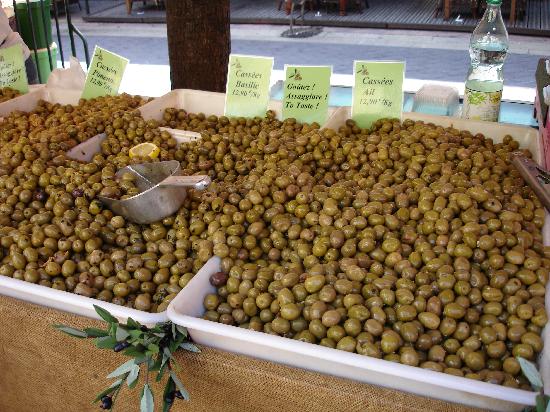
Many of the stuffed vegetables sold in the food kiosks come from the daily produce market held along the main street in the old city, Cours Saleya. There are more than a hundred permanent market stalls where vendors sell the produce they truck in every morning from the nearby countryside. Other stalls sell spicy green and black olives, olive oil, homemade cheeses, cookies and cakes, honey and herbs and flowers. And as I walked along wishing I was in an apartment with a kitchen instead of a hotel, I would occasionally catch glimpses of the sea and feel the soft breeze coming off the water in my hair. If this isn’t a food lover’s heaven, I don’t know what is.
 Local Olives
Early the next morning back on the Cours Saleya, I was photographing wedding bouquet perfect zucchini flowers at one of the market stalls when I heard what sounded like Genovese dialect. With Italy only 20 miles to the east, it wouldn’t be unusual to find a few Genovese here, but it wasn’t tourists I heard. It was the vendors. And what I heard turned out not to be Genovese dialect either.   It was le Nicois, the Nissard dialect, which I later learn is a hybrid of Italian which harkens from the days when Italian, not French, was the official language of Nice.

France and Italy have been kissing cousins for centuries. In bits and pieces of time, as far back as the early 1400’s and as recently as 1814, Nice was part of the Italian Kingdom of Sardinia, ruled by Italy’s royal family, the House of Savoy, who happened to be French.  In addition to Nice, their Kingdom included the northern Italian province of Piedmont (think Barolo wine and truffles) as well as the Republic of Genoa. As control of Nice passed back and forth between the French and the Italians, the lines between French and Italian customs, culture and cooking, soon ran together like the colors in a tie dyed tee shirt.   
  
 Street Food Heaven
The blurring is evident in the simple, Italianate approach to food here. As Escoffeir’s La Guide Culinaire Moderne collects dust on restaurant kitchen shelves, chefs reach for olive oil instead of butter and cream, and there is hardly a sauce in sight. In fact traditional Niçoise food is so uniquely Mediterranean that visitors from other parts of France hardly recognize it as their own. Meanwhile, the Italians, who have long considered the French Riviera part of their back yard, feel right at home.

On rainy winter days, housewives on both sides of the border head down to their local fishmonger for codfish. A Mediterranean favorite since the Middle Ages, the cod sold here is caught in the cold waters off of Newfoundland, preserved in salt and packed in small pine boxes right on the fishing boats. Cod is also preserved by putting it out in the sun to dry. Sun drying, as a means of preservation, works well and was the best way to keep the fish from spoiling back in the days when salt was a luxury item used to pay soldiers in ancient Rome for their service. The only drawback with preserving cod in salt is that it renders the fish as solid as a roof rafter.  In fact the Italian word for air-dried cod is stoccofisso, which means fish dried as stiff as a stick. 

Today fish vendors on both sides of the border sell already softened codfish, ready to be put in a pot with tomatoes and onions and simmered over a low flame. The stoccofisso recipes garnered from my Genovese friends call for potatoes and pine nuts, while Nice’s l’estocaficada is a little spicier with the addition of hot pepper and garlic. But in both versions locally grown olives are added just before serving. The tiny greenish black olives are used extensively in Mediterranean cooking, and along with the large variety of herbs that grow in the region, add another layer of flavor to the simple dishes that make up the rustic cuisine of the Riviera.
If you are in Nice when the weather is cool, you’ll find soupe au pistou, a hearty vegetable soup spiced up with a final spoonful of pistou, the Niçoise version of minestrone al pesto on the menu. Poitrine de veau farcie aux petits legumes, a stuffed veal breast called cima in Genovese dialect should be there too, as well as les petits choux farcis, little bundles of cabbage stuffed with sausage meat and rice. In the Genovese version, lattughe ripiene, lettuce leaves are used instead of cabbage, and the bundles are served in the broth the lettuce was cooked in. No one could ever accuse the Genovese of being wasteful.

The traditional food of the French Riviera is fresh, uncomplicated and satisfying, and while it may look like Italian food and taste like Italian food, it is solidly French. Fresh fish, locally grown fruits and vegetables, herbs, olives and olive oil, dishes are prepared avec cour, with heart. The flavours are genuine and reflect the area they grow in. Just like Italy.

02 December 2012

LIFE: Bits and Bobs


SARONNO, Italy - 

The First Bit ..... 

I made three interesting discoveries this week, the first is the Google Art Project. The Google Art Project is an online platform which allows  access to the artworks of some of the world’s most famous museums. In 2011 the Uffizi Gallery in Florence was added to the site and now the Museo Poldi Pezzoli in Milan, the Musei Senesi in Siena, the Museo di Palazzo Vecchio in Florence and the Musei di Strada Nuova in Genova are also participants.  You can even take virtual tours of the museums, which intrigued me all the more.
Museo di Palazzo Vecchio, Florence, Italy
To be able to tour - well virtually tour - some of the world’s greatest museums, most of which I will never see in my lifetime, seemed to me as thrilling as being able to see what’s going on on the moon. Maybe even a little more.

 Museo Poldi Pezzoli, Milan
However, when I went to the web site (www.googleartproject.com/it) I couldn’t quite figure out it works. I mean I can read, obviously, so I did click away and bring up paintings from the Auckland Art Gallery Toi o Tamaki, and amazing artifacts from the Museum of Islamic Art in Qatar, but I couldn’t figure out how to do what I wanted to do, which was have a look around the place. I take that back. I did hit on one virtual tour quite by accident, but I don’t know how I did it and when I tried to do it again – I couldn’t. 

But this is a Google project, right? So who better than Google to turn to for help. In a flash I found a three minute video entitled Art Project - How to Use the Site. I watched a finger slip and slide across the screen pressing icons and making stuff bigger and smaller, all amazing, but not even the finger managed to do the one thing I wanted to do. 
Then I noticed that someone had left a message saying what a wonderful site it was, but they couldn’t figure out how it works either. While that made me feel better, at least for a minute or two, it didn’t really solve my problem. So here’s the video and the address for the web site. If anyone can shed any light on this I would greatly appreciate hearing from you.   

The Second Bit  - Voting with Your Chestnuts

For those of you who don’t know, in Italy sometimes chestnuts are also called marroni, a less than polite name for a man’s dangling bits, which is why I found this bit of etymological research interesting. In 1282 the historic Torre della Castagna (Tower of the Chestnuts) in the center of the city of Florence, became the meeting place of the Florentine Priori delle Arti. The Priori, also known as the Signoria, was the governing body of the Florentine Republic.

 Piazza della Signoria, Florence
The members of the Priori delle Arti were elected for two-month terms, during which time they were not allowed to leave the tower unless in the company of another member, ensuring that all contact with outsiders was monitored to reduce the risk of threats or bribery. Now there’s an idea worthy of revival given the sorry state of politics today.

Torre delle Castagna, Florence
 The Priori were very influential in the decisions made for the Republic and they used a voting system similar to the modern day ballot. But instead of using pieces of paper stuffed in a box, they use chestnuts.  The number of chestnuts placed in small fabric bags indicated the voting preference of each member. In Florentine dialect boiled chestnuts are known as ballotte - you see where I’m going with this -  and so there are some scholars who think this is why ballots are now called ballots.  Could very well be.

And the Last Bit .....

If you are a dedicated marathon runner, you might want to consider participating in next year’s Run the Renaissance in Florence.  The 42+ kilometers (26 miles) kicks off at the Duomo in the center of the city, and goes from there. Here’s the official web site, (in English) www.firenzemarathon.it , which still has the details from this year’s marathon posted, but I’m sure that it will be updated after the first of the year.  

At any rate the next marathon date is November 24, 2013, so there’s plenty of time to register and make your travel arrangements, not to mention get in shape.