02 September 2010

AUNTIE PASTA: Turin's Culinary Gold

TURIN, Italy – With the sky still an early morning pink, crates of dark green artichokes, yellow pears and fragrant fennel are stacked wily nily, cluttering the streets as fruit and vegetable vendors at Turin’s great food market, Porta Palazzo set up their market stalls for the day. Nearby, brawny butchers in white coats and blood stained aprons, pull large beef hindquarters and pork carcasses from the back of rumbling refrigerated trucks and hang them on large hooks behind their counters in the immense glass and wrought iron market building.

Porto Palazzo Market

But even before the butchers start to sharpen their knives and price cards are stuck into the produce boxes, local chefs are on the prowl, menu ideas running through their minds. How many crates of Swiss chard do you have? Never mind, how about these beets, will you have more tomorrow? The day’s menu depends on what they choose. The only thing certain is that the food they’ll prepare is unlike any you have ever eaten in Italy.

Just ask Turin native Chef Roberto Donna of Washington, D.C.’s four-star Galileo restaurant (more about Chef Donna in the March 11, 2010 Auntie Pasta: Bruciolo) He knows first-hand how creative the chefs in his hometown can be. He’ll also tell you that with such incredibly voluptuous and seductive ingredients as white truffles, porcini mushrooms, Piedmont beef, fresh brook trout, and an abundance of game, no one is ever really surprised when first time visitors can barely keep from swooning at the dinner table.


The Vast Selection Boggles the Mind
In part it’s the luck of the location. Turin is in the extreme northwest corner of Italy, in the province of Piedmont. But while Piedmont, home of the Slow Food movement, has become a Mecca for food lovers, Turin seems to hover below the radar line. As gourmands track elusive white truffles in Alba and frolic through the vineyards of Montferrato, the tables of Turin are largely ignored.

Turinese cuisine is not like the food in any other part of Italy. For one, chefs tend to reach for butter and lard rather than olive oil. Olive oil has only been used in local cooking since the 1950’s, brought north by southerners who immigrated to Turin to work in the automobile industry. And more than in any other part of Italy, local dishes incorporate a variety of savory sauces.


Truffles Big and Small, Black and White
Another difference is that appetizers play a much larger role here than in other parts of Italy, both in the size of the portions and in their sheer creativity. In Chef Donna’s cookbook, ‘Cooking in Piedmont’, he presents twenty-six recipes for appetizers including such non-appetizer sounding dishes as rabbit salad, stuffed roasted peppers, veal tongue in a spicy red sauce, a duck liver flan and spicy polenta served with fried quail eggs.
Probably the best known Piedmontese appetizers are bagna cauda –literally a hot bath -of oil, garlic, anchovies and butter served as a dipping sauce for winter vegetables, and fonduta (from the French fondre, to melt) a fondue of creamy Fontina cheese flavored with white truffles. Truffles are used extensively in Turinese cooking, and when they are in season – between November and February – they are liberally showered over just about everything.

Ravioli del Plin

In a traditional Italian meal, appetizers are followed by a primo, usually pasta. Two of Turin’s most popular dishes are tajarin, golden egg noodles served with melted butter and a shaving of white truffles, and Chef Donna’s favorite, ravioli del plin, (del plin means to pinch in Turinese dialect) often served with a reduced veal stock and a veil of grated parmesan cheese. It is interesting that the Turinese prefer fresh egg pastas, rather than pastasciutta, dried pasta, that is so popular throughout the rest of Italy

The best rice in Italy, some say the world, grows in the wide flat lands between Milan and Turin so in addition to pasta you’ll find rich and creamy risotto, riso all piemontese, rice served with meat sauce, and riso e ceci, a rice and chick pea dish on menus. Other non-pasta choices are chestnut flour gnocchi served with a fonduta di Castelmagno (Castelmagno is a town southwest of Turin that is famous for its cheese), or baccalĂ  (salted cod), served with saffron flavored polenta. And then, as the Italians say, Coraggio! – courage! It’s time to move on to the main course.

Bollito Misto


The city’s signature dish is bollito misto, a mix of boiled meats served with three sauces: bagnet verd, a parsley sauce spiced up with anchovy, garlic and olive oil; bagnet ross, crushed tomatoes, garlic and hot peppers, and saussa d’avije, a mustard sauce sweetened with honey and crushed nuts. In the past, traditionalists insisted that bollito misto contain seven vegetables, seven types of meat, and seven types of ornamenti, i.e. tongue, tail and dangly bits, but today the more exotic dangly bits are slowly being eased out. On the menu at least once a week in most Turin restaurants, the boiled meat dish is served from a rolling stainless steel cart, each meat kept warm in its own broth filled compartment, and you can ask for the meats that you want.


Other classics include brasato al Barolo, Piedmont beef slowly braised in Barolo wine, and finanziera, a stew of cock’s crests, chicken livers, veal, peas and porcini mushrooms. In the fall and winter, you’ll find venison, roe deer (a small European deer), quail and even tagliata di renna, slices of reindeer meat, on some menu, along with beef and veal, free range poultry and freshly caught fish instead of fish farm fish.

Elegant Dining in Turin

In a country where no culinary rock has been left unturned, it’s nice to know that there is still a small corner where you can find new taste experiences. The food in Turin may just change the way you look at Italian food forever.

In next week’s Auntie Pasta post you’ll find a preview of what’s on the menu at some of Turin’s restaurants, and some insider tips by Chef Donna as to the best Turinese dishes to try.


For the latest in fashion news and views from the fashion capital of the world follow me on twitter.com/Italianlife

29 August 2010

LIFE: Out of the Kindness

SARONNO, Italy - The first real work I had when I first moved to Italy was in Genoa teaching English at a small private language school. I was being paid under the table (in nero) which meant that sometimes when I would come into the school one of the owners would put her finger on her lips, a warning for me not to say anything. It meant the Guardia di Finance, or fiscal police, were in inspecting the books. They knew schools hired illegals, especially English mother-tongue illegals, all the time and they paid off the books.

I knew I was not being paid what Italian teachers, or foreigners who were here legally, were paid but I didn’t complain. I was happy to have a job after not working for nearly six months.

So with the little bit of money I was earning I started putting together my Italian life. I was living in a furnished apartment about half an hour out of Genoa in a borgo called Santa Maria Quezzi, (see January 31, 2010 blog).

Another Beautiful Ginori Design

With no car, my only means of transport to and from the city was the No. 15 bus. I would get off on Via XX Settembre, Genoa’s main street, and walk the few blocks to the language school passing a rather posh china and gift shop along the way. They had the most beautiful things in that store and I remember standing and staring in the window and wondering if I would ever be able to afford anything in there.

January and July are the State designated sales periods here in Italy and so shortly after Christmas my favorite shop filled their window with all the bits and bobs they were willing to part with at a discounted price. That’s when I saw them – the gold rimmed Richard Ginori plates with the small roses. I loved them.

Every day on my way to work I would stop and stand with my nose pressed against the glass and look at them, dreaming about how they would look on my dinner table. I had no idea how much they really cost for I had yet to figure out the value of lire to dollars and vice versa. If a newspaper cost 1,000 lire, and a cup of coffee cost 1,500, how many thousands, or even millions of lire would the dishes cost? And how much was that in real money? Dealing with such high numbers was not only confusing, it was downright overwhelming.

My Beautiful Dishes

Then one day, fearful the plates would be snapped up and gone forever, I gathered my courage and went in. In my halting Italian I told the young clerk I wanted six of the Richard Ginori plates in the window. She knew immediately which ones I was talking about.

“There are only ten plates left,” she said. “Why don’t you take them all?”
“I wish I could,” I said, “but I am a poor English teacher and I don’t have enough money to buy them all.”

I knew that Richard Ginori was one of the oldest porcelain manufacturers in Italy, founded in 1735 by the Florentine Marquis Carlo Ginori. The early pieces he made were primarily destined for the court of the Medici family, the godfathers of the Florentine Renaissance, so whatever they cost, it was surely more than I could afford. As it was I was convinced I would have to eat bread and onions for a month just to pay for the six plates I asked for.

The cups that go with my dishes

The clerk nodded. She went to the window, took the plates out and then disappeared into the back room. A few minutes later she reappeared with a package all done up in brown paper and tied with heavy string. She put it on the counter and rang up the sale. I don’t remember what I paid for those plates, now that we’ve converted to Euros it’s hard to remember what things costs back in the day of the lira, but it seemed like an awful lot of money.

I carried the package to school that night and it wasn’t until the next morning that I opened it. She had given me all ten plates.

What a sweet beginning to my Italian life. I’ve been very lucky these past twenty years, I’ve met a lot of nice people who have gone out of their way to help a stranger. Every time I use those beautiful dishes I think about that young girl in Genoa and I hope that in some small way I am able to pass that kindness on.

For the latest in fashion news and views from the fashion capital of the world follow me on twitter.com/Italianlife

25 August 2010

AUNTIE PASTA: Italians Do It Whey Better

SARONNO, Italy - Any cook worth his or her salt will tell you that in the culinary world you don’t throw anything away. Take ricotta for example. Ricotta is made from what is left over after making other cheeses. In truth, ricotta isn’t a cheese at all but a latticino, a dairy by-product. Cow and buffalo milk mozzarellas are also considered latticini.

Creamy Ricotta

Ricotta is made from whey, the same stuff Little Miss Muffet was eating as she sat on her tuffet. Simply speaking whey is the watery liquid that is left after cow, sheep or goat cheese is made. Italians love ricotta and while you may look at it and say, 'what's the big deal?' there's a lot of story behind ricotta. It's   been part of the Italian cucina for centuries.

During the days of the Roman empire ricotta production was regulated by Cato the Elder (234 to 149 BC). He introduced laws regarding sheep farming and agriculture. In those days, sheep’s milk was used for many things: as part of sacrificial rites, as a beverage, for the production of pecorino cheese – and ricotta. Even back then they used the whey instead of throwing it out.


Variations on a Ricotta Theme

It is fairly easy to make ricotta. The name ricotta means “recooked” in Italian and recooking is the basic idea behind this product. What happens is whey is allowed to ferment for one or two days in tepid temperatures until it becomes more acidic. After the fermentation is complete the whey is cooked to almost boiling; then the left over proteins solidify into curds which are then filtered through a cloth. The result is a product that is a lot like cottage cheese but with a sweeter taste.

There are many forms of ricotta but the most common types are: ricotta di mucca (cow milk ricotta), ricotta di pecora (sheep milk ricotta) and ricotta di bufala, (buffalo milk ricotta). The best ricotta is that which comes straight from the farm, but even here in Italy, at least in the towns around Milan, it can be hard to find.

I’ve heard that in some areas of Italy you can also find ricotta di mucca e pecora, a mix of cow and sheep milk and ricotta di capra, goat milk ricotta. And more recently they have started selling buffalo milk ricotta in the southern regions of Campania and Puglia where buffalo mozzarella is produced.

For ravioli, tortelloni, agnolotti, stuffed crepes and cakes and pastries, the most common ricotta to use is cow milk ricotta. But in areas where sheep herding is more widespread, like Tuscany, Lazio, Abruzzi, Campania, Puglia and Sardinia, sheep milk ricotta is the most popular, particularly for regional specialties. Each region produces a slightly different tasting milk and cheese, but generally speaking sheep milk ricotta is a little richer than cow milk ricotta.

Zucchini and Ricotta Quiche

Ricotta di pecora is most often used in sauces and pasta recipes, particularly those that include eggplant, peppers, zucchini and spinach. It is also very good for pasta al forno, baked pasta, especially the type prepared in the central southern regions of Italy, and deserts like Sicilian cannoli and cassata.

Ricotta Romana DOP is one of the better known ricottas in Italy. The DOP designation says that it is produced in the region of Lazio and classic production methods have been followed. One of the most renowned ricotta in Italy is the sheep milk Ricotta Romana (D.O.P.), which has a protected designation of origin. This certifies that it is produced only in the region of Lazio and that strict requirements regarding its method of production are followed.

Sicilian Cannoli

Ricotta producers in Campania recently applied for a DOP designation for their ricotta di buffalo and there is every indication that they will get it. There are a few other special types of ricotta too, like ricotta salata, a hard, seasoned cheese that is often used in place of pecorino and grated over pasta. Ricotta al forno or infornato, is a baked ricotta that can be eaten as in or added to pasta dishes. Ricotta affumicata, or smoked ricotta has a delicious taste of charred oak and chestnut. But the most unique ricotta is ricotta scanta which you will only find in Puglia. It is a pungent, aromatic, beige-colored and creamy ricotta that the Pugliese spread on bread or on vegetables. 

And for a change of pace, and a lighter calorie count, you might want to try using ricotta the next time you make a vegetable (maybe zucchini) quiche.
For the latest in fashion news and views from the fashion capital of the world follow me on twitter.com/Italianlife

21 August 2010

LIFE: The Big Vay Kay

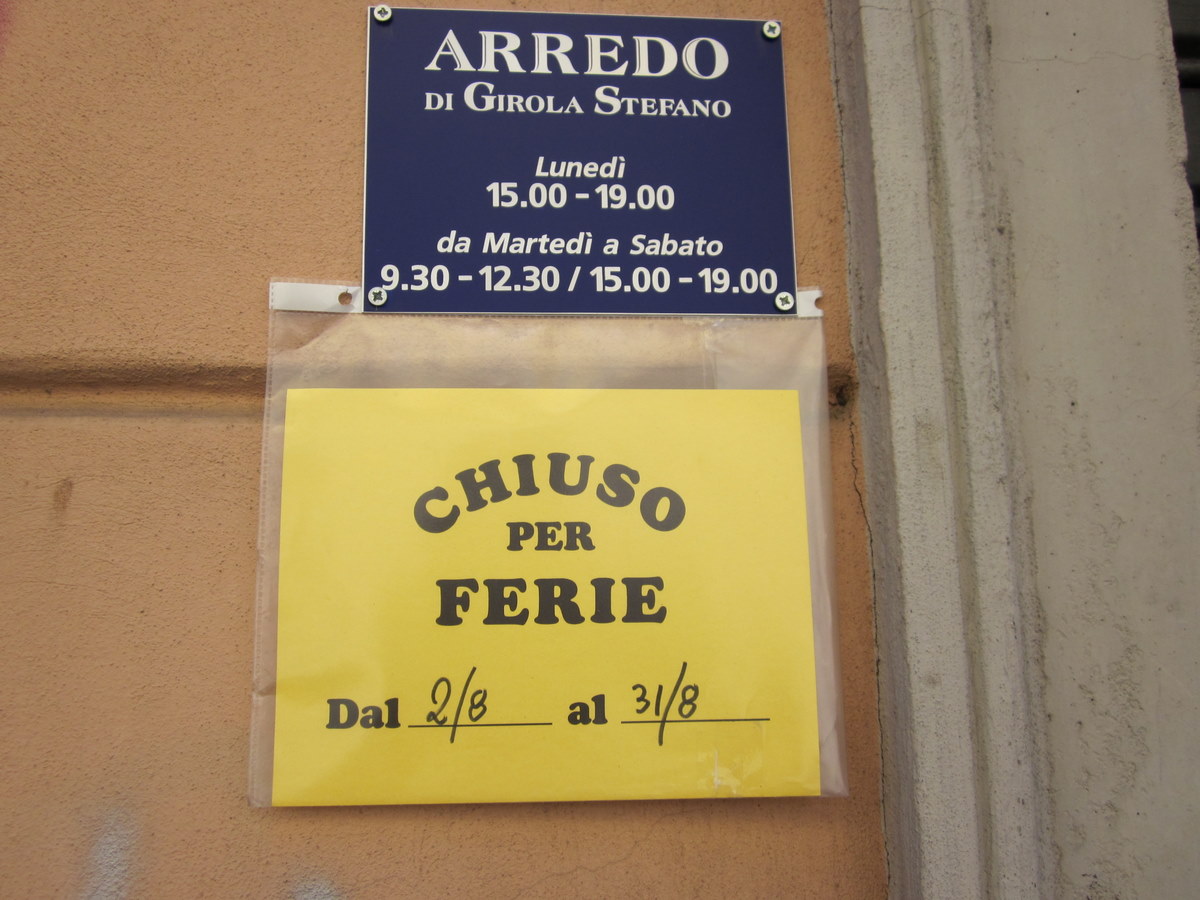
SARONNO, Italy - It’s almost over. In another week or so Saronno will start to come back to life and the eerie silence that has hung over the town for the past month will start to fade. It was lonely walking around town today. The streets are empty, the curtains on the windows of my favorite bar are closed, the tapperelle all pulled down and a computer printed sign on the door that says: Chiuso per ferie – Ci vediamo 30 Augusto. They have been on vacation for the entire month. They are not alone. So have the butchers, the bakers and the Saronno park rakers.

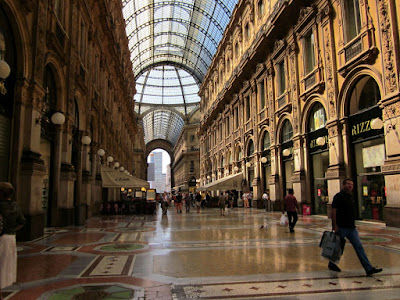
Milan’s Galleria in August

In Milan the only sign of life are tourists following their designated flower on a stick through the empty corridors of the Galleria, giggling and taking photos of each other twirling around three times on the bulls privates. After a quick look at the statue of Leonardo da Vinci, and the La Scala opera house across the street, they too will be whisked away to the next stop on their tour and the sound of the city will be reduced to the dry rattle of the empty trolleys rolling up Via Manzoni. There should be large signs posted at all of the major Italian airports like the one posted on my local bar - Italia chiuso per ferie– ci vediamo in settembre – Italy is closed for vacation – See you in September.

A Trolley Just for Me

Not knowing this truest of all Italian truths was just one of the many mistakes I made when I planned my move from Philadelphia to Italy many years ago. I moved in May foolishly thinking I would be able to pick up some work teaching English over the summer months and then look for a real job in the fall. But everything, and I mean everything, was closed. The local paper would publish a list of shops where you could buy bread and milk, and that list changed daily as one shop after another shut its doors for vacation. How could anyone who grew up in a land that operates 24/7, 12 months a year ever imagine that an entire country could, and would, close down for almost the entire month of August.

It’s a Little Lonely Trolley

As fast as Italy closes down once the weather turns warm, it is slow to get back up to speed when the vacation period is over. Unfortunately the up to speed part doesn’t last very long for as the weather cools people start browsing the travel agency windows thinking about the upcoming Christmas holidays, which at this point are only a little more than a couple of months away.

Cinzia, a very nice lady I met this summer, told me she gets 32 paid vacation days a year. She can pretty much pick the days she wants off because there are only a few people in her office so they decided among themselves what days they will take. Thirty-two days may sound like a lot but it is normal in Italy, even for new hires. Of course if you work for a company for a long time you get even more vacation days added on to the thirty-two.


Closed for Vacation - Will Reopen Sept. 1, 2010

A week off at Christmas is normal with a few additional days tacked on for New Year’s, which is followed almost immediately by the Settimana Bianca, or White Week, the traditional after the holidays ski holiday that no one would dream of missing. By then it is almost March and time to start planning for Easter. There’s an old Italian saying that goes something like – Christmas with your family, Easter wherever you want  - so Easter week is the perfect time for a quick jaunt up to the mountains for one last ski weekend if there is still snow. On the other hand you may want to take a quick trip to the seaside, a sort of preliminary run to get in the mood for what’s coming – summer vacation - where anything short of two consecutive weeks is considered cruel and inhuman.

Seventy Will Reopen August 24

So here we are closing in on the end of August and my computer, which decided on August 1 to start acting up, is still acting up. While it’s not a super serious problem, it does need to be taken care of. I thought about calling my computer guy when it first happened but I know better. Even if he was in town, which I doubt, he wasn’t going to be in the mood to do any work. So I decided to just sit back, pour myself a tall glass of lemonade and take another book off the pile of “want to reads” that piled up during the year and enjoy the peace and quiet of summer in Italy. It won’t last much longer.
 
For fashion news and views from the fashion capital of the world, follow me on Twitter.

18 August 2010

AUNTIE PASTA: Peachy Keen

SARONNO, Italy - Wednesday is market day in Saronno. With more than 80 market stalls, it is the biggest market in this area and people come in from all the smaller towns around Saronno just to shop here. It can get very crowded, and with good reason: the prices are good and the food is fresh.

Saturine Peaches

They sell everything at this market, stuff to eat like fruit, vegetables, meat, poultry, fish, cheese, cookies, breads and spices, plus clothes, tablecloths and other household linens, pots, pans, plants and flowers, underwear, clothes, shoes, handbags, yarn and thread, just about anything you can think of.

Yummy Peaches

It’s always interesting to see what the local housewives are buying, and every once in a while I discover something new. My new discovery last week it was Saturnine peaches. “You know where they’re from?” the fruttivendolo asked me as I was taking a picture of the peaches on display at his stall.

“Yep,” I said. “Sicily.”

He smiled. “Not just Sicily,” he said, “but from the area around Bronte in the province of Catania, near the slopes of Mount Etna. They love that volcanic soil. Here, go ahead, try one.”

While they may have a strange shape, like a mini-donut, the flavor is so sweet and delicious they literally melt in your mouth. Mr. Fruttivendolo says they are the original peach, how peaches used to be back in the day of Adamo and Eva and cautions me not to fall for the Saturnine knock-offs called “tipo Saturnine”. They are not the real thing.

Summer Bounty

Well, we were both wrong about where they come from. Saturine peaches don’t grow in Sicily but in le Marche, the province that borders Emilia-Romagna and the Republic of San Marino. And they don’t date back from the days of Adam and Eve, well, maybe they do but they have only been grown in Italy since the early 1980’s. The squashed peaches that grow in Sicily are called umbilico di Venere or pesche tabacchiere, and while they look the same they are technically different. If you are very imaginative you might be able to see how they resemble Venus’ bellybutton, but pesche tabacchiere totally escapes me.

A Cornucopia of Fruit

On http://www.pesca-rosalia.com/ a site dedicated to these special peaches, they claim the peaches are called tabacchiera because of their snuff box like shape, but I don’t get it. I’m not an expert on snuff boxes, far from it, but the snuff boxes I looked up on the internet do not look particularly squashed.

The name pesche comes from the Latin persica as the Romans thought this fruit came from Persia. The Romans then went on to develop several other varieties of peaches as the fruit was incorporated into the Italian diet. In Sicily they still call all types of peaches persiche.

Pretty as a Peach

The pesca-rosalia site also has some interesting peach recipes, and you can substitute regular peaches for the Saturine, although the results probably won’t be as sweet. If you are further intrigued by these beauties and find yourself in Sicily in the summer months you can visit the orchards and who knows, they may even hire you as a peach picker. That’s a step up from what Peter Piper did, and I bet it’s a whole lot more fun too.

For fashion news and views from the fashion capital of the world, follow me on Twitter.

13 August 2010

ON THE ROAD: Savory Savona

This is another in a series of monthly travel articles inspired by a New York Times article on 31 places to see in 2010. All of the towns on my list are in Italy, most are small, rich in history and art and for the most part off the beaten track which, for me, makes them all the more interesting.

SAVONA, Italy - Savona isn’t your typical Italian Riviera hotspot. It’s an old, serious, seafaring kind of place, not glamorous, not slick and not particularly tourist friendly either.


Savona Harbor

A few years ago you wouldn’t have given this town of 78,000 inhabitants a second glance as you sped along to, or from, the south of France. But things are different now. Savona has become a major kick off point for Costa Cruises, which means thousands of people are passing through town every week. It doesn't make the town any more glamourous, but then again Vicki, my eight year old sidekick and I are not looking for anything glamorous. We are on a mission. Her plan is to take photographs of what we see today and then write about them in a journal. My plan is to keep this curious little person out of trouble and sneak in a few photos myself.


Cathedral of Savona

Daniele, Vicki’s father, gives us a ride into town and drops us off near Piazza Sixtus IV. Before we head for Vicki’s favorite Savona site, the Pancaldo tower, I want to see the nearby Baroque Cathedral of Santa Maria Assunta. It takes a little convincing to get Vicki to go in, but in the end she’s a pretty good sport about it, and she even manages to generate a little interest in the Renaissance wooden choir. But when I suggest visiting the Sistine chapel next door, she digs in her heels. The fact that two popes were born in nearby Albissola, Sixtus IV (1471-1484) and Julius II (1503-1513), and that it was Pope Sixtus IV who commissioned both Sistine Chapels, the one in Rome and the one next to the Cathedral in Savona, means nothing to her. It is not a battle I’m going to win.
We head back to Savona’s main street, Via Paleocapa, a long, 18th century porticoed street that runs from the harbor right through the heart of town. Along the way Vicki is taking pictures of everything that catches her eye, the tall look-out towers in the historic center, the soaring cactus that decorate the fronts of buildings, the miniature bronze cast of the town so the blind can see what the town looks like, the many boats docked in the harbor and the Leon Pancaldo Tower.


Via Paleocapa

Vicki is fascinated with Leon Pancaldo. Leon was about her age when he set sail with Ferdinand Magellan on his now famous expedition around the world. Leon was also one of 18 surviving sailors out of a crew of more than 200 who lived to talk it.

His stories of seeing a ‘camel without a hump,’ and a ‘black goose’ that had to be skinned instead of plucked left the locals thinking the trip had really done the poor boy in. But now we know he wasn’t daft, just one of the first Europeans to see a llama and a penguin when Magellen’s ship reached the most southern tip of South America, Tierra del Fuego, the land of fire.


Trattoria Vino and Farinata

Later that evening Vicki, her parents and I head back into the old town for dinner at Farinata and Vino. It’s a hot summer night and we are lucky we don’t have to wait very long inside the trattoria entrance where overheated cooks are pulling and pushing large round pans of farinata in and out of the blazing open oven. Our reservations are for 7 PM, uncommonly early for Italy, and they tell us have to be out by 8:30, also uncommon for Italy. But this is a happening place and they are booked to the max.
It’s the farinata that draws the crowds. Farinata is a simple dish of chickpea flour, water and olive oil baked into a thin pancake, and along with pesto, it is one of the major components of Liguria’s famed cucina povera. Vicki’s father orders another Ligurian summer specialty, room temperature minestrone with pesto while Tracy, Vicki’s mother, and I order fish. After a plateful of farinata, Vicki can barely manage to eat a shrimp or two from her mother’s plate. As we sit there I realize I can’t even count how many times over the past 18 years we have sat together like this and shared a meal.


Crowd in Vino and Farinata

The one place Vicki and I didn’t get to was the Fortezza del Priamar, an imposing stone fortress at the edge of the historic center. I think she would have liked walking through the massive fort, especially if I could have come up with a swashbuckling tale or two about the pirates who were held prisoners here.

Back in the 16th century when the Fortezza was built the Mediterranean Sea was not the playground of the rich and richer it is today, but a watery nest of marauding pirates and armed ships from rival city states looking to attack Savona. The fort stood strong for two hundred years, never challenged until the mid 1700’s when it was attacked by troops of the French Dukes of Savoy. The invading army won the battle and Savona was absorbed into the territories controlled by the Savoy, who would later become the Italy’s first, and last, royal family.

There is a grittiness to Savona that may not appeal to everyone but if you’re the type of person who likes to explore less touristy places, it may be just the town for you. What I like best about it is that there are no pretenses here. What you see is what you get.

09 August 2010

AUNTIE PASTA: Lakeside Wizardry

SARONNO, Italy - Lake Como, in Italy’s northern Lake District, is not the place most people travel to for the food. The lure of the sapphire blue water, seductive picture perfect landscapes and the heady scent of jasmine and honeysuckle in the air tend to conjure up thoughts of love and romance, not fish and risotto. But for years now my fantasy has been to throw an outdoor dinner party at one of the posh villas that ring the lake.

Villa Balbianello, Lake Como

In my mind the menu would reflect the summer cuisine of the lake. Freshly caught seafood and fish and the richly colored fruits and vegetables piled high on the outdoor market stalls in Como would be transformed into platters of Mediterranean magic by a talented culinary wizard. But who would that be?

I found my wizard in Maurizio Marfoglia, a Saronno native who, the last I heard, was the executive chef slash owner of Tutto il Giorno in Sag Harbor, New York. As Marfoglio grew up in Saronno, and Saronno is in the Lake District just 40 minutes from Lake Como, he was the perfect person to talk to.

“The cuisine of the Italian lake district is one of Italy’s best kept secrets”, Marfoglia tells me. “It is uncomplicated, countrified cooking made from fresh, local ingredients. In the winter restaurants serve a variety of hearty mountain food, roast rabbit, wild boar and venison stews and unique polenta dishes only found in this region. But in the summer the food is as light and delicate as the cool breezes blowing off of the lake. The trick is to take advantage of what is in season, to move the material prima from market stall to table as quickly possible and do as little damage as possible along the way.”

Chef Maurizio Marfolgio

For my fantasy dinner party, which he teasingly calls my ‘magnificence’ after the staged spectacular fetes Catherine de Medici used to hold in 16th century France, he suggests greeting my guests with ice cold flutes of Prosecco, Italian sparkling wine, and a selection of cold antipasti that are easy to eat.

“It’s an outdoor party so you want your guests to relax and the courses to unfold at a friendly, leisurely pace,” he says. “Then, when everyone is at the table, grilled fresh-water shrimp served with bite size pieces of cool watermelon and paper thin slices of cucumber will keep the conversation going.” The combination is startling, but who can argue with the sheer joy of cool sweet melon, refreshing crisp cucumber and sweet grilled shrimp, especially on a warm summer night.

Moving from the innovative and unusual to the classic, Marfoglia suggests a typical Comasco dish for the main course: fried lake perch and buttered white rice. The fish and rice combination is the quintessential dish of Lake Como, and has been on the menu since the days of the ancient Romans. But instead of the traditional treatment, which is to fry the fish in butter and sage and serve it on a bed of rice, he recommends another approach that is inexplicably satisfying beyond the measure of the ingredients.

Branzino alla Marfolgio

“Cook the filets in a small amount of olive oil and serve them on a bed of watercress that you have lightly sautĂ©ed with a garlic clove and a finely chopped scallion,” he says, “and then drizzle a little piquant lemon caper sauce over the fish.”

Following the traditions of the Italian table, salad is served after the main course. Here Marfoglia’s non-stop creativity spins a new version of an Italian classic, coming up with a combination that would win him a thumbs up in any century. In his hands, the ordinary spinach salad takes on a fashionable ‘Made in Italy’ quality when the spinach leaves are tiny and tender and paired with slices of wild strawberries and a tangy poppy seed dressing. It is enough to make a purists head spin.

I ask him if he stays up nights thinking about food. “Actually, I do,” he says, “my wife complains about it all the time.” With his blonde hair and blue eyes, Marfoglia looks more like a mid-western stock broker than a top Italian chef, but he’s been cooking since the summer of 1986 when he was hired as the chef’s helper by the La Dolce Vita restaurant in Venice.

“What I didn’t know,” he says, “is that chef’s helper is just another way of saying galley slave.”

It was his first restaurant job and he says he has never worked so hard in his life. The La Dolce Vita kitchen was as noisy and chaotic as Times Square on New Year’s eve; the heat, the pressure, the chef always shouting at the top of his lungs, and yet through it all the raw and unpeeled were transformed into wonderful, even beautiful dishes.

“I loved it,” he says. “It was a mind numbing job, but there was something about the high level of chaos and creativity that was fascinating. They hired me again the next summer and the next three summers after that. It didn’t take me long to realize that I wanted to cook full time so at the end of the fourth summer I went home and got a job at a restaurant in Milan. I’ve been at it ever since.”

Villa for Rent on Lake Como

Marfoglia moved to New York about 15 years ago and has made a name for himself, cooking at notable New York restaurants like the Tribeca Grill, Mad 61, Le Madri, 7 MoMa, Tuscan Square and Coco Pazza, not to mention his stint as private chef to the Italian Ambassador to the United Nations.

“The key to successful entertaining, especially in the summer, is to keep things simple,” he says with the confidence of someone who is secure in his talent. Perhaps it is his culinary culture and respect for classic cuisine that gives him the courage to bend the rules and treat tradition with a bit of irreverence. Growing up in Italy certainly helped form his vision of how food should taste, but I still can’t help thinking there must be a bit of wizardry in there someplace.