Showing posts with label Italian culture. Show all posts

26 September 2010

LIFE: Passion for Fashion

SARONNO, Italy - You would think that after working for Women’s Wear Daily and all the other Conde’ Nast fashion publications for years and years, I would post more fashion oriented articles on this blog. There’s no real reason why I’ve stayed away from writing about it, especially since my tweets are  fashion oriented, it just happened.


Corso Vittorio Emmanuele, Milan
But September is fashion month in Milan, and like the elephant in the room – it is impossible to ignore. On Sept. 9th Vogue Magazine sponsored Milan’s Fashion Night Out, which simply means an evening of fashion extravaganza when the designer shops of Milan’s Fashion Quad stay open until the wee hours of the morning, bands play, people dance in the streets, it's a festa. 

The Quad, which is sometimes called the golden Quad, is the area between Via della Spiga, Via Sant'Andrea, Via Montenapoleone and Via Manzoni in downtown Milan. It  is where you will find glitzy boutiques like Giorgio Armani, Dolce & Gabbana, Gucci, Versace, Prada, Krizia, Fendi, Louis Vuitton, La Perla, Bruno Magli and all the others.

From Sept. 21 to Sept. 26 Milan will be gasping in the grip of Moda Donna Spring/Summer 2011. It is one the biggest fashion events of the season and all the major fashion houses will be strutting their stuff on the runways. Milan is buzzing with fashion editors, buyers, photographers and gorgeous, long legged models, both male and female, crowding and pushing their way into the subways and onto the trolley cars.

Tickets to the private parties and backstage events sponsored by fashion houses are in great demand as everyone wants to feel they are part of the “in” crowd, the insiders who dictate what the rest of us will be just dying to wear come spring.

Daily Flower Delivery on Via Montenapoleone

Even before the madness started the Italian fashion magazines could talk of nothing else. One article I found interesting (more commercial than fashion oriented however) was in the weekly woman's magazine Corriere della Sera publishes.   

I thought you might find it interesting what Italian women are wearing this fall, and  the prices. I checked the internet (http://www.x-rates.com/calculator.html) for the most current euro to dollar exchange rate.

Here’s what I found:


1. Sunglasses by Borsalino: $295
2. Zip-up leather jacket by Caractere: $697
3. Silk blouse by Conbipel: $67
4. Leather gloves by Emporio Armani: $241
5. Stretch tube skirt by Max Mara: $226
6. Platform shoes in black and red by Love Moschino:$315
7. Leather handbag by Serapian: $603

The clothes in Io Donna are pretty much a cross section of what is in the shops now  here in Milan and Saronno, except for the Max Mara store. Every outfit, including coats, boots and gloves in their Milan store windows was black. That’s absolutely fine with me but sometimes even I like to get a little wild and step out in something bright and colorful, like beige. 

Here are a few of the other outfits featured in Io Donna.
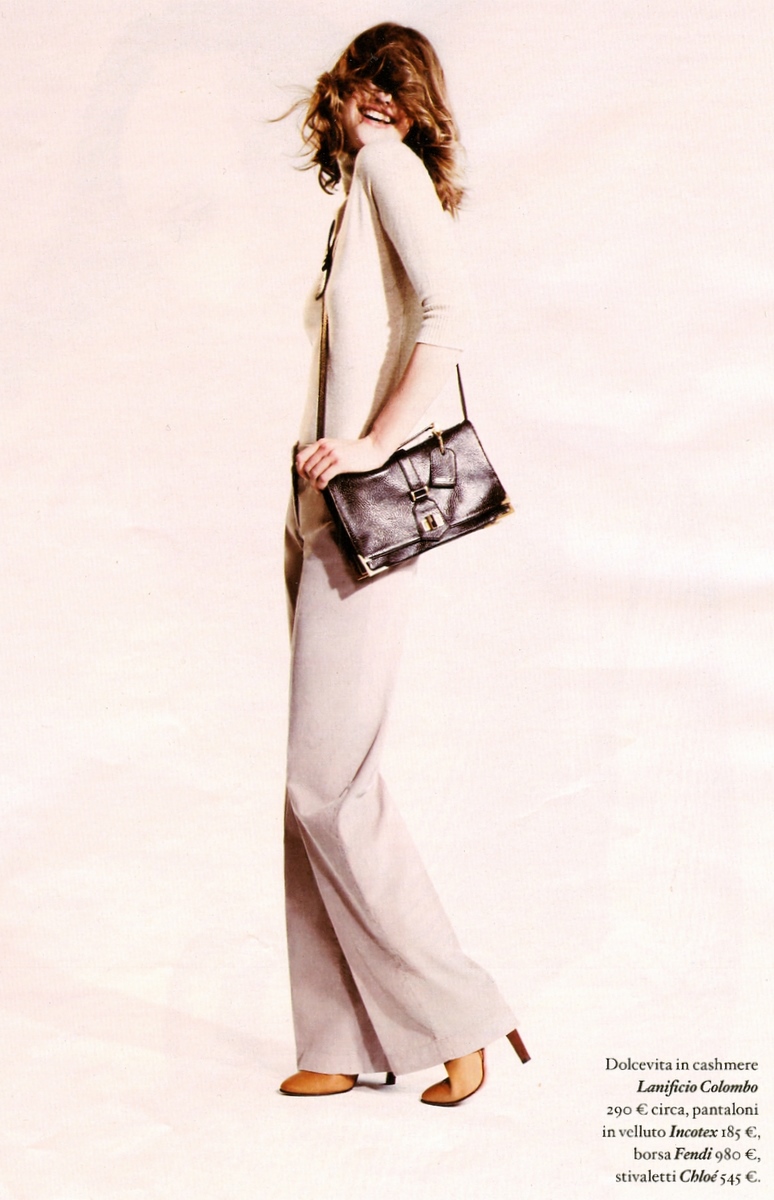

Cashmere turtleneck, Lanificio Colombo, €290$369; corduroy pants, Incotex, €185/$235; handbag, Fendi, €908/$1,248, boots, Chloe’ €545/$694.

Denim shirt, MCS Marlboro Classics, €115/$146; jeans, Chloe’, €390/$497; leather moccasin Tods, €280/$356.

Alpaca and wool cardigan, Daniela Drei, €790/1,006; corduroy pants MCS €115/$146; snakeskin moccasins, Armani, €311/$396
Wool and tricot cardigan, Midali Toujours, €198/$252; silk plisse’ blouse, Sportmax, €249/$317, wool flannel wide leg pants, Stephan Janson, €500/$637.

You have to admit the clothes are beautiful, albeit expensive. I could do with a few new outfits myself this fall and if I could only find that sack of gold I hid somewhere in this apartment, I would go shopping. 

For the latest in fashion news and views from the fashion capital of the world follow me on twitter.com/Italianlife

04 July 2010

LIFE: This Italian Life

SARONNO, Italy - As I sat on my balcony this week with my feet up, sipping lemonade, I started thinking about the things I love about living in Italy. I realized it wasn’t one big thing that captured my heart, but many little things. If you think about it, it’s never the big things that draw people to something. I mean did you ever hear anyone say they pulled up stakes and moved here because of the Coliseum in Rome, or that they simply couldn’t bear to live another day without the Uffizi Gallery in Florence. Me neither.

Trevi Fountain, Rome

Maybe it started when I lived in Rome. Every Saturday I would leave my apartment on the Via della Vite, cross Via del Tritone and go up Via della Stamperia to a small street market near the Trevi Fountain. At a certain point I would be greeted by a John Hamm look alike who would smile and bow ever so slightly and say: “Buon Giorno Contessa.” With no real language skills I would stammer something back and continue on my way, but I ask you, who would not want to start their day like that?

I love the way Italians live with their art.

“Oh this, yes, well yes it is a 16th century bla bla bla.” And then the conversation about where to go for pizza continues for there are many incredible masterpieces stuck here, there and everywhere that are a normal part of everyday life.

A Green Grocer in Puglia
I love my green grocer when she tells someone looking for zucchini in January to come back in April. Of course you can find zucchini in January but zucchini grown who knows where and tasting like who knows what.

I love the fact that Italian orthopedic surgeons go to Africa every year and perform hundreds of operations on little African kids, free of charge and they don’t tell anybody about it. I love that there are still church missions in this world staffed by Italians giving their all in the name of humanity.

I love the way hospital patients drift down to the hospital bar in their pj’s for a coffee or a grappa and a smoke. I love the fact that hospitals want your friends and relatives to be with you and help you when you are sick. After all, what are friends and relatives for?

Friends Forever
And speaking of friends, the day my friends Tracy and Daniele got married in Savona there was a wicked storm and the road to the restaurant where the reception was to be held was closed. That meant no reception and that would never do. We talked the barman into opening the bar in the Savona City Hall, selling us some champagne, giving us glasses and throwing in some nibbles. Instant party. Try that in NYC.

I love the shiny brass name plates on the buildings. You rarely see names scribbled on scraps of paper stuck between two pieces of plastic to indicate this month’s occupant is….

I love the absolute differences between the sexes. I love the way Italian men look at women – even if it is a little unnerving at times. I love the way Italian women start talking faster and pull, ever so slightly on their husband’s arm whenever a pretty girl walks by. He can look, but why make it easy for him.

One Way to Keep His Attention
I love the bars, the big bars, the little mom and pop bars, especially the old historic bars in the center of most cities. To sit and have a coffee in the Café’ San Carlo in Torino, or Covo in Milan is to be part of the drama being played out in those places at that time.

I love the sense of history that seeps through your shoes as walk down the streets. Quarto dei Mille? Oh, it’s called that because that is where Garibaldi set off for Sicily with his band of one thousand Red Shirts in his drive to unify Italy.

I love the names of the streets. Via Gabriele D’Annunzio, Vicolo Simon Boccanegra, Piazza Camillo di Cavour. It’s like walking around in a history book. Piazza Savonarola? Oh yeah, he’s the 15th Dominican friar and prophet of doom that they burned after they hung him back in 1498.”

I love the fact that Italians make up the rules as they go along. I remember forgetting my passport on a trip up to Switzerland and reporting it to the Italian police when they came on board the train in the border town of Chiasso. “Signora,” they said, “you are leaving Italy, that is a problem for the Swiss border guards.”

Don't Worry, Be Happy
“Yes,” I said, “but on Sunday, when I have to come back? I have to go to work on Monday.”

“Ah, Signora, you worry too much. Just sit down, be calm and pretend we never had this conversation.”

So I did. I continued up to Switzerland, had a great time with my friends, came back into Italy, no passport, no hassle, no problem.

Yes there have been problems over the years, mostly having to do with trying to get a work visa, but there was never any doubt in my mind that I had made the right choice. I knew from the beginning I was in the right place, and while this isn’t a new list, it is still all true.

A version of this article was published in The Informer Magazine, No. 103.

10 June 2010

AUNTIE PASTA: Back of the Box

SARONNO, Italy - Even before the idea for this blog was fully developed, I knew I wanted the Auntie Pasta page to be about food, but not about recipes. But since then I have included some recipes on this blog, and in going through my collection of recipes the day, I found there were others that I would like to share with you as well.

What got me thinking about recipes was the review of the new summer cookbooks in the Sunday New York Times last week, including one that claims to teach you what your grandmother never taught you. Grandmothers seem to play an important part in the cooking lives of a lot of people, me for one.

My Grandmother was a very good cook but I never saw her open a cookbook, in fact I don’t think there were any cookbooks in her house. She just seemed to know what to do. She, like most women of her generation, had learned to cook by watching and doing what she was told when she was a kid growing up in Italy.


Preparing food was serious business in Italy at the turn of the 20th century, there wasn’t a lot of it and there was no messing around in the kitchen. She carried that philosophy with her to the New World, and when she told me to watch the pot of boiling snails on the stove and make sure none of them escaped, you’d better believe my five year old eyes were glued to that pot lid.

By the time I was given that responsibility I had eaten, and helped prepare all types of greens, tripe and snails, rabbit and venison, rolled meatballs, cut fresh pasta into strips of fettucine, chopped parsley and knew the difference between regular mint and the mintuccia that Aunt Mary sent from Italy. I was a cook in training and didn't know it.

Sometimes it was difficult not to start playing with the gooey mess that water and flour make before it becomes pasta dough, or pressing ground meat around my ten little fingers and playing an imaginary hamburger piano. It wouldn’t take much to keep me in line though; a look would usually do the trick. That was the culinary discipline part of my training.

As a young bride I would often call my mother and ask her for recipes. She was not a patient person and her instructions were short and to the point. Sometimes I would get recipes from my aunts, scribbled on scraps of paper with vague proportions and approximate instructions. They were my mentors, and even though I was young and had a lot to learn, they treated me as an equal, cooks talking to another cook.

In those days before Gourmet (unfortunately now defunct) and Food and Wine, before Julia Child made culinary history with her French Chef television series, and long, long before the advent of celebrity chefs, that is how we all learned to cook. A certain amount of knowledge was always assumed and the key points of a dish were often all you needed, i.e. clean and boil artichokes before you season them and put them in the oven to bake - a small, but crucial detail that results in being able to eat them rather than throw them away, as I did on my first solo flight into the wonderful world of artichokes.

I use quite a few recipes I find on the back of boxes of pasta and packages of things here in Italy but I’ve hesitated to include them in this blog because the instructions are often vague and the measurements approximate. But I’m wrong. You are cooks and if we speak cook to cook, I think it will work out. With that in mind, here is a Sicilian fish recipe that uses frozen codfish, but you can use any firm, white fish, fresh or frozen.

Fiori di Merluzzo di Capperi (Filets of Cod with Capers)

Defrost the fish. Chop a bunch of parsley and two garlic cloves. In a frying pan heat 3-4 tablespoons of olive oil and when it is barely hot, add half of the chopped parsley, garlic and the fish. Season with salt and pepper. When the fish filets have cooked on one side, turn them over. Add ½ glass of dry white wine and when it has evaporated add a can of chopped tomatoes. Let the fish and tomatoes cook for about 15 minutes and then add the remaining parsley and garlic, a pinch of dried oregano and two teaspoons of capers. Cook for an additional 5 minutes. The recipe suggests serving the fish with mashed or boiled potatoes but I prefer serving it over white rice.

Two suggestions: One, use capers that have been preserved in brine, not in salt; and I found that if you fry a sliced onion in the olive oil before you add the parsley, garlic and fish, it gives the dish another layer of flavor.

If you try this recipe I would appreciate knowing how it worked and what problems you had, if any. You can write to me at thisitalianlife@yahoo.com. Buon Appetito.

05 June 2010

LIFE: Most Livable City in Italy? Really?

SARONNO, Italy - The Italians are mad. Il Sole 24 Ore, the country’s leading financial newspaper, recently published its annual list of the 100 most livable cities in Italy and their number one pick was Trieste. What a shock. Trieste sits on the border between Italy and Slovenia and is probably the least Italian city in all of Italy. Last year it was number five on the list and irate readers wanted to know how it managed to move up five slots in just one year. Actually what they wanted to know is why it was even considered in the first place.

Piazza Unita' D'Italia, Trieste

One reader, complaining about the editor’s choice, asked how it was possible for Trieste to be the most livable city in Italy when the Triestini have the highest percentage of suicides in all of Italy. And, wrote another reader, to add insult to injury, they don’t even speak Italian. They speak a variation of the Venetian dialect in the city and just one kilometer outside of the city they speak Slovene.

I can’t argue with that, but in all fairness Trieste is very nice. I was there once, a long time ago back in my travelin’ days. We took the train from Venice to Trieste on a whim. It’s about a two hour ride, and what I remember most was that the train was practically empty. Of course there was a war going on not too far away from there at the time but still, you wouldn’t think that would drop the tourism rate to zero.

Rotonda Panzera, Trieste
The city is elegant, the café’s are beautiful, especially those around the port, but truthfully I didn’t feel like I was in an Italian city. What was missing was that Italian frisson, that special, elusive something is that makes me so happy to get back to Italy after a weekend in Lugano, Switzerland. And I’m not saying that Lugano isn’t nice, it is, and they also speak Italian, maybe not better than but almost better than the Triestini. The truth is that in spite of its Roman heritage, Trieste wasn’t part of Italy until 1954. Up until then it was part of the Austro-Hungarian Empire, which is where other readers thought it should have stayed.

Perhaps the readers of Il Sole didn’t realize the survey wasn’t the usual “best city to live in” kind of survey that measures school quality and parks, but rather a snapshot of the most eco-friendly city in Italy which only makes sense when you know that the survey was done in collaboration with the Ministry of the Environment. What was measured was the quality of the air and the number of days the cities sustained acceptable pollution levels.

Arch of Ricardo, Roman Gate 33BC, Trieste
It's a wonder Milan is on the list at all but it somehow managed to jump nine points from last year’s list and come in fifth beating out Rome which was eighteenth on the list after having dropped five points. The majority of the top ten cities were in the central-northern part of Italy, except for Bari. Here’s the list:

1. Trieste
2. Florence
3. Parma
4. Trento
5. Milan
6. Venice
7. Reggio Emilia
8. Padova
9. Bari
10. Modena

Because of the number of angry emails the editors received they decided to print a small editorial that said that the end of the year classification is really just a pastime they print for the amusement of their readers. They know that every year the small towns walk away with all the high marks while the big cities like Milan, Rome and Turin, which are in a constant state of change and flux trying to better themselves, end up on the bottom of the list. It’s normal, they said. Look at the New York Times. When the Times editors tried to put together a list of their own, New York came out as the least happy city in America.

Fountain of Neptune, Trieste

That was as much a surprise to the New York editors as Il Sole's list was to the Italians. But if nothing else at least now I know why Italians shrug their shoulders so much.