Showing posts with label Italian cooking. Show all posts

04 October 2012

AUNTIE PASTA: Milan's Great Vegetable Soup

SARONNO, Italy – Milanese style vegetable soup doesn’t have anything to do with fashion, it has to do with the way the cuisines in Italy developed. In this case it’s the addition of rice instead of pasta to a basic vegetable soup that gives it its Milanese twist.
 Piazza Duomo, Milan, Italy
I don’t know if this is true in other countries, but here in Italy each region took what it had available and created its own unique cuisine. That’s the reason why in the past you would only find basil pesto in the sunny region of Liguria and risotto in Milan. Of course that has all changed now, although each region does tend to favor its own cuisine.   

This recipe, which I found on Barilla pasta web site, reminds me a little bit of a diet soup recipe that was circulating a few back that consisted primarily of cabbage and tomatoes, but I think this version tastes a whole lot better. Along with the recipe there were some common sense tips on soup making.
Milan's Famous Peck's Food Emporium - A Foodie's Paradise
The first tip was that you need to take the cooking times of the various vegetables into consideration, going from the hardest to the softest. This is a good tip because if you put all of the vegetables in at the same time, some of them, like the potatoes, are going to be too soft.

The second tip was to add salt only at the end because as your soup cooks, it reduces in volume and when it has finished cooking it can be too salty. So hold off on the salt until your soup has cooked completely. They also suggest using semi-fine rice, Vialone Nano, Lido, or Padano. I know that in a lot of places there isn’t a wide variety of rice to choose from, or the rice that is available may not be Italian rice, so it’s doubly important to pay attention to cooking times on the rice package so your rice doesn’t over cook.
 Great Soup Veggies
And one other thing I’d like to add, simply because it came up this week in a conversation with a friend of mine who doesn’t cook. When you refrigerate this soup, or any homemade soup you are going to find a layer of congealed fat on the top of the soup when the soup is cold. It’s normal. It’s actually good because you know that the soup has been made with real meat. You can skim it off if it seems excessive, but be sure to leave some of it because that is what gives your soup a good flavor. 

Ingredients
Servings 4
3 ½ oz beans
1 ¾ oz celery, white 
4 oz Rice
1 ¾ oz tomatoes 
7 oz potatoes 
3 ½ oz savoy cabbage
2 oz white onion
1 ¾ oz carrot
1 oz leek
3 ½ tablespoons extra virgin olive oil  
⅛ oz parsley
3 basil leaves
⅛ oz garlic
⅛ oz sage
3 ½ oz Parmigiano Reggiano cheese (freshly grated)  
8 cups vegetable broth
salt and pepper to taste
1 ¾ oz pancetta (italian bacon), or lard 

Preparation Time: 35 minutes preparation + 1 hour and 45 minutes cooking 

Step 1
Chop the pancetta, brown it, and then remove the grease from it that has formed during browning. Add the onion finely chopped, and the sage.

Step 2
Then add the carrots, celery, and leeks, all diced. Leave to stew and then add the diced potatoes, and only at the end the tomato cut into regular pieces.


Step 3
Add the beans, previously blanched, and mix everything together and leave to gain flavor, seasoning with the salt and pepper.


Step 4
Pour in the hot stock and bring to the boil. Leave boiling for around 1 hour and 20 minutes.


Step 5
During the cooking, add the cabbage cut into little pieces and finish off the cooking. Ensure that the soup has not become too dry and add the rice, being careful to stir every once in a while.


Step 6
Remove from the heat and flavor with Grana cheese. Sprinkle with finely chopped parsley and torn basil leaves.


19 October 2011

AUNTIE PASTA: Sounds Fishy to Me

SARONNO, Italy – The other day I discovered a great little restaurant  right here in Saronno. It’s called LaPerla. The name has come up in casual conversation more than once and it has been on my 'To Do' list for quite a while, but somehow I’ve never gotten around to it. Then on Sunday some friends called and suggested we have lunch there.
La Perla Ristorante, Saronno, Italy
LaPerla is run by two brothers, Emilio and Massimo Conte, who are from the small southern town of San Martino d’Agri in Lucania (Basilicata).  The Conte brothers started working in restaurants in Milan about 30 years ago and are now up to their eyeballs in the restaurant business. In addition to LaPerla they manage two pizza parlors and another restaurant, Roppongi, in Saronno. But from what I hear, LaPerla is the best of the bunch.
 
The menu had several seasonal offerings that were very tempting, porcini mushrooms for example, and puntarella salad. I ordered baccala with potatoes, something I really love but never make because it's too much work. But if you have the time and the inclination you can try the recipe below, it’s not the exactly the same dish they serve at LaPerla, but close. 
 The LaPerla Family
My grandmother used to cook stoccafisso, which is the dried version of baccala, although I can’t remember what she did with it. She may have cooked it in a tomato sauce. What's fixed in my brain is the sight of those stiff, gray fish propped up in the kitchen sink softening under cold running water.  
 
When I moved to the Genova Nervi there was a small store on the main street that sold baccala and stoccafisso and they always had those same wood like fish sitting and softening in marble sinks in their front window. 
 Before the Makeover
When I moved to the Genova Nervi there was a small store on the main street that sold baccala and stoccafisso and they always had those same wood like fish sitting and softening in marble sinks in their front window.

Even though baccala and stoccafisso come from the same fish, cod, the difference is in the way they are preserved. Baccala is cut and salted while stoccafisso is salted and then hung up to dry. 
  After the Makeover
I was a little surprised when I saw baccala on the LaPerla menu as it isn’t a common ingredient in Northern Italian cooking, but that was before I learned that the Conte brothers are from the south. Actually I thought they were Genovese because of the way the baccala' was served. It seems to me that the fish was poached in milk or broth and then served with slices of boiled potatoes with a drizzle of olive oil and a little parsley. Less always seems to be more in great Italian dishes. 

You can try poaching a piece of baccala’, which is what I’m going to do, or try the recipe below for baccala’ with potatoes and olives. It calls for baccala', not stoccofisso, potatoes, an onion, a little olive oil, olives, a little flour, fish stock (or fish bouillon) and bay leaves.   

You can try poaching a piece of baccala’, which is what I’m going to do, or try the recipe below for baccala’ with potatoes and olives. It calls for baccala', not stoccofisso, potatoes, an onion, a little olive oil, olives, a little flour, fish stock (or fish bouillon) and bay leaves. 

First you have to rinse the cod well to remove the excess salt and then put the fish to soak in cold water for at least two days, changing the water every 6-8 hours. Drain well and cut into squares. Remove all bones (you may have to use tweezers).

Flour the fish (1). In a low, wide pan fry the chopped onions in a little olive oil; (2) add the floured codfish; (3) and let brown on both sides, about 20 minutes on low heat.
 
While the fish is cooking, peel and slice the potatoes. In another pan, large enough to hold the fish and the potatoes, heat 3 ladles of broth (4) the slices of potatoes; (5) cover the pan; (6) let simmer. 

 
Put the browned fish in the same pot as the cooked potatoes(7), add the bay leaves (8) the black olives (9) a little salt. Let cook for another 15-20 minutes, adding broth if necessary.  This type of cooking is called “in umido” and the fish and potatoes should be served with a little of the cooking juice. Serve immediately.
Enjoy.

02 June 2011

AUNTIE PASTA: Viva la Pappa

SARONNO, Italy - Sometimes you just can’t keep a promise. In this case the promise was to post a blog about summer food in Italy this week. I was all set to write about butterfly pasta with zucchini and saffron, veal in tuna sauce and Tuscany’s classic tomato soup, pappa col pomodoro. 

Pappa col Pomodoro
But when I was checking the internet to compare my recipe for pappa with some of the recipes on the Italian cooking sites, I found the fantastic step-by-step photos you see below. Their recipe is a little different than mine, but the end results are pretty much the same.

Interestingly the site is managed by a company that sells saffron, and there is no saffron in this simple, but delicious Tuscan favorite. You can check out the website  @http://ricette.giallozafferano.it/Pappa-col-pomodoro.html

Pappa col pomodoro originated in Tuscany, specifically in the town of Sienna, and has been a Tuscan favorite since the Middle Ages. It was originally devised to make use of left over bread and the abundance of red, ripe tomatoes you find in Tuscany in the summer.  The dish became popular throughout Italy  after singer Rita Pavone recorded her hit song, Viva la Pappa col Pomodoro. The catchy tune  was an instant hit and is still one of the most popular songs ever recorded in Italian history. I doubt there is an Italian who doesn’t know the words.  http://www.youtube.com/watch?v=aqIKVEh9BPI  

While Italian food is fairly easy to prepare, most Italian recipes tend to utilize fresh ingredients rather than take shortcuts. I, on the otherhand, do - take shortcuts that is. In my humble, albit lazy opinion there really is no need to go to the bother of peeling, chopping and pressing fresh tomatoes  through a passavedura, as the recipe calls for, when I can just open a can of good quality already peeled Italian tomatoes and get excellent results.

If you are wondering what “pappa” is, it is any kind of food that is mushed up, most generally for babies but it can also be food for the infirmed and old folks who don’t have any teeth. On that appetizing note, here are the recipes.

Pappa col Pomodoro
500 g (about 1lb) of fresh ripe tomatoes
Half a round loaf of unsalted Tuscan bread or firm, rustic bread, slightly stale.
3 heads of garlic, peeled  
Bunch of fresh basil – washed, dried and torn into small pieces
About 4 cups of vegetable broth, preferably homemade
Extra virgin Italian olive oil
Salt and pepper QB ("quanto basta" is Italian for "to taste")
1/2 teaspoon sugar

 
(1)Cut the bread into slices and lightly toast. Let cool and then rub each slice with a piece of peeled garlic. (2) Dip the tomatoes into boiling water for one minute;

 
(3) Peel them and (4) push them through a passavedura. (5) Collect the juice and mashed pulp from the tomatoes in a container. (6) Layer the bread slices in a terra cotta or non-stick pot;

 
(7) Ladle the tomatoes over the bread slices, (8) add the vegetable broth to cover, add salt, pepper and sugar, (9) cook over low flame for 40-50 minutes, mixing the bread and tomatoes occasionally to break up the bread;

 
(10) When cooked, taste and add more salt if needed, and pepper to taste, (11) add the shredded basil and (12) pour into serving dishes and top with a drizzle of good quality olive oil. Serve at room temperature.  

My version of this recipe is just a little different. Besides using canned tomatoes I cut the bread into slices and then into 1/2 inch cubes and set them aside. In a terra cotta pot I lightly brown 2 cloves of garlic (which I have smashed with the side of my knife) in olive oil, and then add the torn up pieces of basil. 

Let the garlic cook for about 2 minutes then add the bread cubes, mix and let cook for a couple more minutes. Then add the tomatoes straight from the can and mix thoroughly. At this point, add the broth and salt and pepper to taste. (Prepared broth can be very salty, so be sure to taste it before adding additional salt.) 

Keep in mind that regardless of which recipe you use, tomato pappa should be very thick, not liquid. The key to making this great summer dish is the quality of the bread and tomatoes you use. If they are good, the pappa will be good, and you won't believe how delicious this simple dish will be.

Serve in soup bowls with a little olive oil drizzled over the top. This dish tastes even better if refrigerated it overnight and served the next day. Buon Appetito.

For the latest in fashion news, views and now photos from the fashion capital of the world - follow me on Twitter

Life Sunday Preview: Here Comes the Bride

11 October 2010

AUNTI PASTA: Shhh, It’s Ossobuco Time

Ossobucco alla Milanese
SARONNO, Italy - You should never say the word ossobuco, or l’ òs büüs in Milanese dialect, out loud in Milan. Just the name of this slow braised veal shank is enough to bring the strongest of the strong Milanese to tears. Mention that you paired it with risotto Milanese, that is risotto with saffron and parmigiano cheese, and you’ll have them on their knees.

The Makings of a Good Soffrito

Few dishes affect the ever-so-busy, ever-so-chic Milanese like this one does. And yet it is a simple dish to make. The traditional recipe calls for veal shanks, patiently braised in white wine and broth, with the addition of a battuta of celery, carrots, onion and parsley and served with Risotto alla Milanese. It is one of the few “piatti unici”, or one dish meals in Italian cooking.

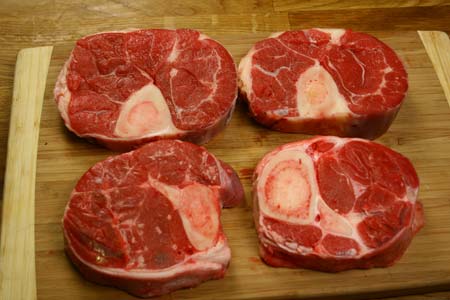
Veal Shanks

It takes a couple of hours to prepare ossobuco but the results are worth it. The veal shanks, which should be at least two inches thick, are first dipped in flour, and then browned in a rather heavy pot or deep frying pan. If the shanks are very large, one per person should be enough, otherwise two, or even three will do if they are very small.

You can find dozens of recipes for ossobuco on the internet so I won’t publish one here, but I will tell you that the wine, a couple of fresh tomatoes or a small can of peeled tomatoes, a cup or two of beef broth, a soffritto of onions, celery and carrots paired with the veal shanks creates the most delicious sauce. It even goes well even with mashed potatoes, but don’t tell anybody I said that. If you decide to take the traditional route and make risotto as a side dish, you might want to reduce the amount of parmigiano cheese you normally would use in the risotto.

Makings of Gremolada

For many Milanese the best part of the dish is the marrow. There is a special long-handled spoon called an esattore that they use to dig it out of the bone. But don’t despair if you are a marrow fan but don’t happen to have an esattore on hand. A demitasse or baby spoon works just as well. In Milan the act of scooping the marrow out of the bone is called riscuotere le tasse or tax collecting, maybe because of the determined way marrow eaters try to get every little bit of marrow out of the bone. Actually one of the secrets of making a really good risotto is to mix in a spoonful of bone marrow in with the rice before you start adding broth.

The Winning Combination: Ossobuco with Risotto Milanese

The most traditional way to serve ossobuco is with a simple condiment called gremolada. It is made with parsley, garlic, a little lemon zest and half a canned anchovy all finely chopped together. If you intend to eat the bone marrow add the gremolada to the center of the shank bones just before serving the dish. Otherwise you can add a little to the sauce. Either way it adds a certain zing to the dish, or as the Italians would say, si sposa bene con ossobuco.

25 August 2010

AUNTIE PASTA: Italians Do It Whey Better

SARONNO, Italy - Any cook worth his or her salt will tell you that in the culinary world you don’t throw anything away. Take ricotta for example. Ricotta is made from what is left over after making other cheeses. In truth, ricotta isn’t a cheese at all but a latticino, a dairy by-product. Cow and buffalo milk mozzarellas are also considered latticini.

Creamy Ricotta

Ricotta is made from whey, the same stuff Little Miss Muffet was eating as she sat on her tuffet. Simply speaking whey is the watery liquid that is left after cow, sheep or goat cheese is made. Italians love ricotta and while you may look at it and say, 'what's the big deal?' there's a lot of story behind ricotta. It's   been part of the Italian cucina for centuries.

During the days of the Roman empire ricotta production was regulated by Cato the Elder (234 to 149 BC). He introduced laws regarding sheep farming and agriculture. In those days, sheep’s milk was used for many things: as part of sacrificial rites, as a beverage, for the production of pecorino cheese – and ricotta. Even back then they used the whey instead of throwing it out.


Variations on a Ricotta Theme

It is fairly easy to make ricotta. The name ricotta means “recooked” in Italian and recooking is the basic idea behind this product. What happens is whey is allowed to ferment for one or two days in tepid temperatures until it becomes more acidic. After the fermentation is complete the whey is cooked to almost boiling; then the left over proteins solidify into curds which are then filtered through a cloth. The result is a product that is a lot like cottage cheese but with a sweeter taste.

There are many forms of ricotta but the most common types are: ricotta di mucca (cow milk ricotta), ricotta di pecora (sheep milk ricotta) and ricotta di bufala, (buffalo milk ricotta). The best ricotta is that which comes straight from the farm, but even here in Italy, at least in the towns around Milan, it can be hard to find.

I’ve heard that in some areas of Italy you can also find ricotta di mucca e pecora, a mix of cow and sheep milk and ricotta di capra, goat milk ricotta. And more recently they have started selling buffalo milk ricotta in the southern regions of Campania and Puglia where buffalo mozzarella is produced.

For ravioli, tortelloni, agnolotti, stuffed crepes and cakes and pastries, the most common ricotta to use is cow milk ricotta. But in areas where sheep herding is more widespread, like Tuscany, Lazio, Abruzzi, Campania, Puglia and Sardinia, sheep milk ricotta is the most popular, particularly for regional specialties. Each region produces a slightly different tasting milk and cheese, but generally speaking sheep milk ricotta is a little richer than cow milk ricotta.

Zucchini and Ricotta Quiche

Ricotta di pecora is most often used in sauces and pasta recipes, particularly those that include eggplant, peppers, zucchini and spinach. It is also very good for pasta al forno, baked pasta, especially the type prepared in the central southern regions of Italy, and deserts like Sicilian cannoli and cassata.

Ricotta Romana DOP is one of the better known ricottas in Italy. The DOP designation says that it is produced in the region of Lazio and classic production methods have been followed. One of the most renowned ricotta in Italy is the sheep milk Ricotta Romana (D.O.P.), which has a protected designation of origin. This certifies that it is produced only in the region of Lazio and that strict requirements regarding its method of production are followed.

Sicilian Cannoli

Ricotta producers in Campania recently applied for a DOP designation for their ricotta di buffalo and there is every indication that they will get it. There are a few other special types of ricotta too, like ricotta salata, a hard, seasoned cheese that is often used in place of pecorino and grated over pasta. Ricotta al forno or infornato, is a baked ricotta that can be eaten as in or added to pasta dishes. Ricotta affumicata, or smoked ricotta has a delicious taste of charred oak and chestnut. But the most unique ricotta is ricotta scanta which you will only find in Puglia. It is a pungent, aromatic, beige-colored and creamy ricotta that the Pugliese spread on bread or on vegetables. 

And for a change of pace, and a lighter calorie count, you might want to try using ricotta the next time you make a vegetable (maybe zucchini) quiche.
For the latest in fashion news and views from the fashion capital of the world follow me on twitter.com/Italianlife

18 August 2010

AUNTIE PASTA: Peachy Keen

SARONNO, Italy - Wednesday is market day in Saronno. With more than 80 market stalls, it is the biggest market in this area and people come in from all the smaller towns around Saronno just to shop here. It can get very crowded, and with good reason: the prices are good and the food is fresh.

Saturine Peaches

They sell everything at this market, stuff to eat like fruit, vegetables, meat, poultry, fish, cheese, cookies, breads and spices, plus clothes, tablecloths and other household linens, pots, pans, plants and flowers, underwear, clothes, shoes, handbags, yarn and thread, just about anything you can think of.

Yummy Peaches

It’s always interesting to see what the local housewives are buying, and every once in a while I discover something new. My new discovery last week it was Saturnine peaches. “You know where they’re from?” the fruttivendolo asked me as I was taking a picture of the peaches on display at his stall.

“Yep,” I said. “Sicily.”

He smiled. “Not just Sicily,” he said, “but from the area around Bronte in the province of Catania, near the slopes of Mount Etna. They love that volcanic soil. Here, go ahead, try one.”

While they may have a strange shape, like a mini-donut, the flavor is so sweet and delicious they literally melt in your mouth. Mr. Fruttivendolo says they are the original peach, how peaches used to be back in the day of Adamo and Eva and cautions me not to fall for the Saturnine knock-offs called “tipo Saturnine”. They are not the real thing.

Summer Bounty

Well, we were both wrong about where they come from. Saturine peaches don’t grow in Sicily but in le Marche, the province that borders Emilia-Romagna and the Republic of San Marino. And they don’t date back from the days of Adam and Eve, well, maybe they do but they have only been grown in Italy since the early 1980’s. The squashed peaches that grow in Sicily are called umbilico di Venere or pesche tabacchiere, and while they look the same they are technically different. If you are very imaginative you might be able to see how they resemble Venus’ bellybutton, but pesche tabacchiere totally escapes me.

A Cornucopia of Fruit

On http://www.pesca-rosalia.com/ a site dedicated to these special peaches, they claim the peaches are called tabacchiera because of their snuff box like shape, but I don’t get it. I’m not an expert on snuff boxes, far from it, but the snuff boxes I looked up on the internet do not look particularly squashed.

The name pesche comes from the Latin persica as the Romans thought this fruit came from Persia. The Romans then went on to develop several other varieties of peaches as the fruit was incorporated into the Italian diet. In Sicily they still call all types of peaches persiche.

Pretty as a Peach

The pesca-rosalia site also has some interesting peach recipes, and you can substitute regular peaches for the Saturine, although the results probably won’t be as sweet. If you are further intrigued by these beauties and find yourself in Sicily in the summer months you can visit the orchards and who knows, they may even hire you as a peach picker. That’s a step up from what Peter Piper did, and I bet it’s a whole lot more fun too.

For fashion news and views from the fashion capital of the world, follow me on Twitter.

30 June 2010

AUNTIE PASTA: If You Can Make it There

SARONNO, Italy - The date to mark on your calendar is August 31, 2010. The place: New York. The event: Eataly, New York is opening at 200 Fifth Avenue, between 23rd and 24th Street in downtown Manhattan. It’s no small deal. Oscar Farinetti and his partners have invested over 25 million dollars in the project. No one is worried about their investment, however, as Farinetti is the guy who conceived and developed the now very successful idea of Eataly.

Oscar Farinetti on 5th Ave. NYC in front of entrance to Eataly
Within the 5,000 square meters of sprawling store space you’ll be able to buy the best food Italy has to offer. You’ll find Piedmontese beef raised under the watchful eye of veterinarian Sergio Capaldo. Capaldo hovers over his herds like an Italian mamma, making sure they are always well fed, comfortable and happy, three elements Italians believe makes for better tasting meat.

Super Star Pastry Chef Luca Monersino

You’ll also find fresh fish, specialty cold meats like San Daniele ham from Parma, loads of vegetables, all types of bread, artisan pastas and rice from Italy’s rice belt, honest to goodness Parmesan from Parma and other wonderful Italian cheeses, creamy, delicious gelato, a dazzling array of chocolate from the Master chocolate makers of Torino, and a pastry shop managed by Luca Montersino, the ex Executive Director of the Etoile Institute of Culinary Arts, and the youngest superstar on the Italian pastry planet.

To go along with your pastries you can sip coffee at the Lavazza coffee bar. And if you need something more substantial you’ll find food counters scattered throughout the shop where you can rest your feet and restore your spirit.  But that’s not all. There will be no less than six restaurants, and the restaurant on the top floor is part of the famous Mario Batali chain of restaurants which includes Babba and Del Posto, both in New York City. Also on the top floor you’ll find a fully stocked wine cellar and a birreria where you will be able to buy not only beer made by Matterino (Teo) Musso, Italy’s premier artisan beer maker, but specialty beers from around the world. And did I mention the bookstore? That’s in there somewhere too.

When Only the Best Will Do - Choose Italian

I’m happy that Italian food is enjoying such success outside of Italy. For one thing it lets people taste genuine Italian food products instead of Parmesan cheese made in Wisconsin, or horrors of all horrors, Spanish and Tunisian olive oil sold as “Made in Italy”.

The Wonderful World of Eataly in Torino

And once you’ve tasted the real thing, and I'm not just talking Italian olive oil, you’ll understand why I could easily move bed into Eataly in Torino and live out the rest of my days eating my way up and down the aisles and gleefully writing the food page of this blog.

First Torino, now New York, what I want to know is what's wrong with Milan? I know this is not a major center for haute cuisine, but still and all we do cook and eat. Okay, I admit it. I’m jealous. I want a big, impressive, massive Eataly of my own and I have the ideal spot, right here in little old Saronno. Farinetti, call me.

24 June 2010

AUNTIE PASTA: Pucker Up


Picking lemons on the Amalfi Coast

SARONNO, Italy - It’s summer in Saronno. There is plenty of sunshine and the trees in park cool the soft breezes that pass through my apartment windows and balconies. Life is easy. On my kitchen table there’s a big basket stacked with lemons that I bought at the market this week. Some are smooth, bright yellow ovals, the picture perfect type from Sicily, while others are twice as big and knobby with thick mottled yellow skins typical of the lemons from the Amalfi Coast. They are called Sfusato Almafitano.


The origin of lemon cultivation on the Amalfi Coast has been lost in the annals of time, but most certainly lemons were one of the treasures of the Republic of Amalfi before the year 1,000. In its heyday the Republic traded textiles and precious stones with the countries of the Middle East, and it has been verified that one of the things they imported were small, yellow fruits called lemoncello de India. The local farmers began to cross pollinate the lemoncello de India with the bitter oranges that grew in the area. Over time, centuries actually, this cross pollination resulted in the Sfusato of Amalfi sitting in the basket on my kitchen table today.

The Italians believe whole heartily in the health benefits of lemons. In addition to being a rich source of vitamin C, they believe fresh lemons help combat stress, stimulate the immune system and are a cure for the common cold. They may be right.
The Amalfi Coast
The Sfusati grow on the steep terraced hills along the Tyrrhenaian Sea from Positano to Vietri sul Mare, a territory of no more than 700 acres. With their exceptional aroma and flavor, they are widely used in the local cuisine. The house specialties at Ristorante Donna Rosa in Positano include an antipasto of raw artichokes with lemon, caramelle of fresh pasta filled with lobster and lemon, and ravioli with lemon and ricotta.

And it’s not just the lemon juice and pulp that is used. At Albergo Ristorante Bacco in Furore, they still follow the ancient tradition of cooking food in lemon leaves. Some of the dishes they offer are grilled smoked provola wrapped in lemon leaves, rabbit roasted in lemon leaves and home-made tagliolini in lemon sauce. But other than being a principle ingredient in the kitchen, Sfusato Almafitano are the basis of that delicious, sweet liqueur, limoncello that is enjoyed after dinner during the warm summer months.

Ravello, on the Amalfi Coast

In surfing the web this morning I found this video of Miami chef John DiRicco making limoncello in his kitchen. I liked his straight forward approach and thought you might like it too. My only point of contention with Chef DiRicco is that here in Italy small glasses of limoncello are sipped and savored after dinner, not thrown back as he does on the video but, to each his own.

12-16 lemons, preferably organic and unwaxed
1 bottle Everclear alcohol (or good grade vodka)
1 bottle of water (use the Everclear bottle)
1-1 ½ cups sugar

It takes about 30 to 45 minutes to do the initial preparation (mainly peeling the lemons and shaving out the bitter white pith.) You can also do the prep work gradually, doing two lemons at a time and tossing them in the alcohol, until all of the lemons are done. The peels should ferment a minimum of three weeks.The more of the white lemon pith that you leave, the more bitter the limoncello will taste.

The type of sugar affects the color of the limoncello. For John’s “limoncello naturale,” use a darker raw cane sugar.

If you can’t get a hold of Everclear, you can use ½ Grey Goose vodka and ½ Absolut. For a poor man’s version, strain cheaper vodka though your Brita pitcher 3 or 4 times.

Store your limoncello in the freezer.

It should be completely liquid. If it’s slushy, you used too much water.

And here’s a recipe for Lemon Risotto with Sautéed Shrimp I found at: cooksrecipes.com

Lemon Risotto with Shrimp

LEMON RISOTTO WITH SAUTEED SHRIMP

1/4 cup, divided use2 tablespoons olive oil
1/4 cup finely chopped onion
1 tablespoon freshly grated lemon peel
1 1/2 cups uncooked Arborio rice or other short-grain white rice
4 cups warm water
2 tablespoons dry white wine
1 tablespoon lemon juice
3 teaspoons vegetable base or instant bouillon granules
1/4 teaspoon ground black pepper
2 tablespoons freshly grated Parmesan cheese
8 ounces medium raw shrimp, peeled and deveined
1 teaspoon finely chopped garlic
1 teaspoon finely chopped fresh flat-leaf parsley
1 teaspoon grated lemon peel


1. Melt 2 tablespoons butter in medium saucepan. Add oil, onion and lemon peel; cook for 2 to 3 minutes or until tender. Stir in rice; cook for 1 minute. Stir in water, wine, lemon juice, bouillon and pepper. Cover; cook gently over medium-low heat for 30 to 35 minutes. Stir in cheese; stirring occasionally.
2. Melt remaining butter in medium skillet. Cook shrimp over medium-high heat for 3 to 4 minutes or until pink. Serve shrimp over risotto; sprinkle with Gremolata.
3. For Gremolata: Combine 1 teaspoon finely chopped garlic,
4. 1 teaspoon finely chopped fresh parsley and 1 teaspoon grated lemon peel in small bowl.

Makes 4 servings.
Buon appetito.

16 June 2010

AUNTIE PASTA: La Pescaria

Venice, Rialto Bridge

VENICE, Italy - With dawn’s first light breaking over the Venetian lagoon, the fish merchants of the Rialto market are already at work on their displays of fresh fish and seafood culled that morning from just beyond the Venetian lagoon. The fish market, called La Pescaria, is not very big, about thirty or so fishmongers and their helpers. They stand under canvas canopies supported by age-old colonnades. What you see today may not be that old, but seafood has been sold in this spot for more than 500 years.

The Rialto market has always been much more than just a fish and food market. In the past it was the major trading point between the Byzantine Empire and the Venetian Empire. Its location, near the Rialto Bridge is particularly important as the bridge, which connects the district of San Polo with the district of San Marco across the Grand Canal, was the only way to cross the Canal on foot for hundreds of years.

And for hundreds of years, the fishmongers have stacked, iced and priced the prawns, scampi, squid, baby octopus and fish of every size and color. Today they head for the closest bar before the chefs of Osteria Da Fiore, Hotel Albergo Cipriani and other posh restaurants and hotels start making the rounds in search of their piatto del giorno. And right on their heels are the local housewives, who are just as critical about freshness and taste as the chefs.

If they are lucky they will find granseole today. Granseole are small crabs, about as big as a man’s hand, that are found in the rich vast tidal basins of the marshes around the island of Murano. While crabs are good to eat at any time, during the spring and autumn something happens to them that makes them even more delicious: the young male crabs shed their shells in order to grow larger ones. During this change, the muta, fishermen catch the crabs and put them in a special tank called vieri. They are held there for about a day, just long enough for them to be soft enough to eat, shell and all. At that point they are no longer called granseole but moleche, soft shell crabs, and they are quickly carried off to the Rialto fish market to be sold.

There are two good ways to eat them: the first is fried. My first encounter with fried soft shelled crabs was in Bookbinder’s in Philadelphia. A friend of mine, Ken Klein, convinced me to try them. I confess I was a little squeamish at the beginning, but by the end of the meal I was licking my fingers just like everyone else around the table.


The easiest way to cook them is to coat them with flour and fry them in oil. I think Bookbinders coated them with breadcrumbs, but it was a long time ago and I may be wrong. Mostly I remember how delicious they were.

Another way to cook soft shell crabs is to stuff them, or rather, let them stuff themselves. Put the live crabs in a bowl of beaten eggs, salt and grated parmesan cheese and let them sit and take in this mix for a few hours. When they have eaten their fill, take them out, coat them with flour and fry them in hot oil. They may not look particularly appetizing, but they truly are. The texture is soft and creamy, the taste a cross between crab, oyster and lobster and all good things from the sea.

10 June 2010

AUNTIE PASTA: Back of the Box

SARONNO, Italy - Even before the idea for this blog was fully developed, I knew I wanted the Auntie Pasta page to be about food, but not about recipes. But since then I have included some recipes on this blog, and in going through my collection of recipes the day, I found there were others that I would like to share with you as well.

What got me thinking about recipes was the review of the new summer cookbooks in the Sunday New York Times last week, including one that claims to teach you what your grandmother never taught you. Grandmothers seem to play an important part in the cooking lives of a lot of people, me for one.

My Grandmother was a very good cook but I never saw her open a cookbook, in fact I don’t think there were any cookbooks in her house. She just seemed to know what to do. She, like most women of her generation, had learned to cook by watching and doing what she was told when she was a kid growing up in Italy.


Preparing food was serious business in Italy at the turn of the 20th century, there wasn’t a lot of it and there was no messing around in the kitchen. She carried that philosophy with her to the New World, and when she told me to watch the pot of boiling snails on the stove and make sure none of them escaped, you’d better believe my five year old eyes were glued to that pot lid.

By the time I was given that responsibility I had eaten, and helped prepare all types of greens, tripe and snails, rabbit and venison, rolled meatballs, cut fresh pasta into strips of fettucine, chopped parsley and knew the difference between regular mint and the mintuccia that Aunt Mary sent from Italy. I was a cook in training and didn't know it.

Sometimes it was difficult not to start playing with the gooey mess that water and flour make before it becomes pasta dough, or pressing ground meat around my ten little fingers and playing an imaginary hamburger piano. It wouldn’t take much to keep me in line though; a look would usually do the trick. That was the culinary discipline part of my training.

As a young bride I would often call my mother and ask her for recipes. She was not a patient person and her instructions were short and to the point. Sometimes I would get recipes from my aunts, scribbled on scraps of paper with vague proportions and approximate instructions. They were my mentors, and even though I was young and had a lot to learn, they treated me as an equal, cooks talking to another cook.

In those days before Gourmet (unfortunately now defunct) and Food and Wine, before Julia Child made culinary history with her French Chef television series, and long, long before the advent of celebrity chefs, that is how we all learned to cook. A certain amount of knowledge was always assumed and the key points of a dish were often all you needed, i.e. clean and boil artichokes before you season them and put them in the oven to bake - a small, but crucial detail that results in being able to eat them rather than throw them away, as I did on my first solo flight into the wonderful world of artichokes.

I use quite a few recipes I find on the back of boxes of pasta and packages of things here in Italy but I’ve hesitated to include them in this blog because the instructions are often vague and the measurements approximate. But I’m wrong. You are cooks and if we speak cook to cook, I think it will work out. With that in mind, here is a Sicilian fish recipe that uses frozen codfish, but you can use any firm, white fish, fresh or frozen.

Fiori di Merluzzo di Capperi (Filets of Cod with Capers)

Defrost the fish. Chop a bunch of parsley and two garlic cloves. In a frying pan heat 3-4 tablespoons of olive oil and when it is barely hot, add half of the chopped parsley, garlic and the fish. Season with salt and pepper. When the fish filets have cooked on one side, turn them over. Add ½ glass of dry white wine and when it has evaporated add a can of chopped tomatoes. Let the fish and tomatoes cook for about 15 minutes and then add the remaining parsley and garlic, a pinch of dried oregano and two teaspoons of capers. Cook for an additional 5 minutes. The recipe suggests serving the fish with mashed or boiled potatoes but I prefer serving it over white rice.

Two suggestions: One, use capers that have been preserved in brine, not in salt; and I found that if you fry a sliced onion in the olive oil before you add the parsley, garlic and fish, it gives the dish another layer of flavor.

If you try this recipe I would appreciate knowing how it worked and what problems you had, if any. You can write to me at thisitalianlife@yahoo.com. Buon Appetito.